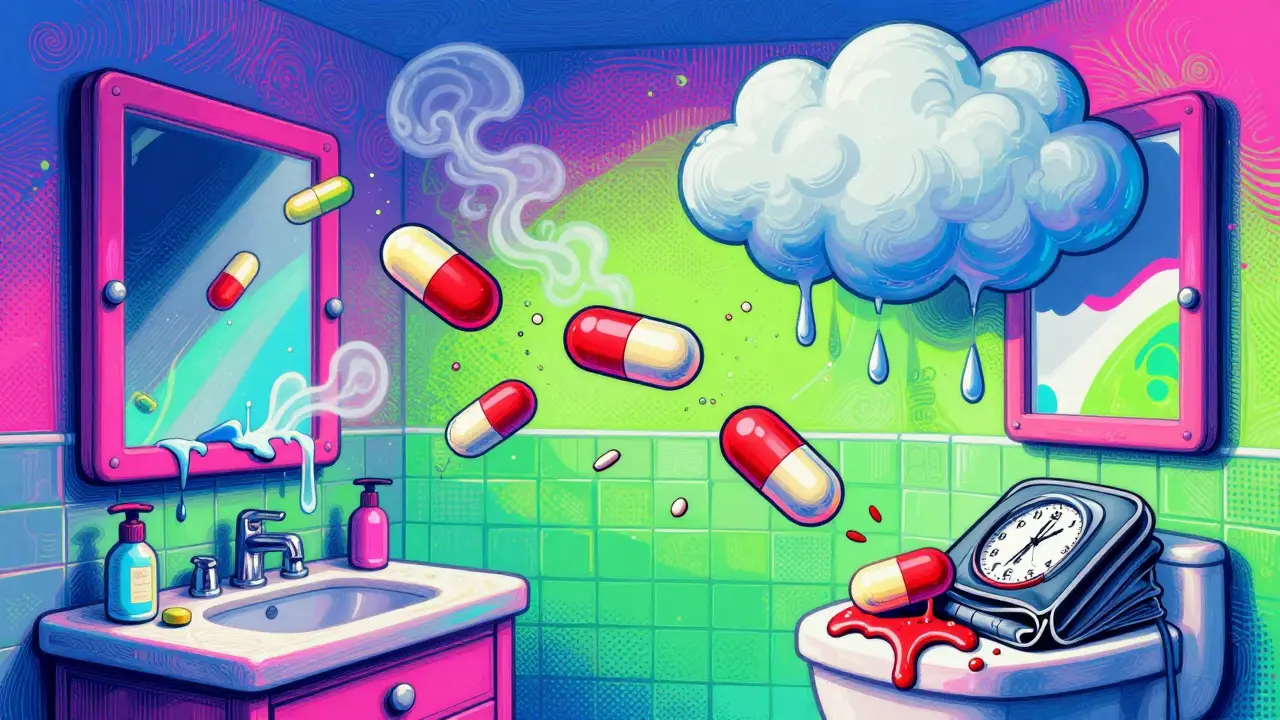
Most people keep their medications in the bathroom. It’s convenient. The medicine cabinet is right there, next to the toothbrush and shampoo. But here’s the truth: storing medications in the bathroom is one of the most common-and dangerous-mistakes people make with their prescriptions.
It’s not just about expired pills or cluttered shelves. The real danger is hidden in the air. Moisture. Heat. Steam. These aren’t just annoyances during a hot shower-they’re silent killers of medicine potency. A blood pressure pill that’s lost half its strength won’t stop a heart attack. An antibiotic that’s degraded won’t clear an infection. And a birth control pill that’s gone bad? It might not prevent pregnancy at all.
Why the Bathroom Is the Worst Place for Medicines
Bathrooms are designed for water, not medicine. Every time you shower, the temperature spikes. Humidity climbs to 80-100%. That’s not just uncomfortable-it’s destructive to pharmaceuticals. The U.S. Food and Drug Administration (FDA) and major health systems like Kaiser Permanente agree: bathrooms are unsuitable for storing most medications.
Medications are chemical compounds. They’re engineered to stay stable under specific conditions: between 59°F and 77°F (15°C-25°C), with low humidity. Bathrooms regularly hit 90°F or higher during showers, and humidity levels far exceed safe limits. This causes three major problems:
- Tablets absorb moisture and break down through hydrolysis-active ingredients dissolve or change chemically.
- Capsules become sticky, brittle, or leak, making them hard to swallow or inaccurate in dosage.
- Powders clump. Liquid medications separate. Insulin proteins denature.
Studies show this isn’t theoretical. A 2021 study in the Journal of Diabetes Science and Technology found that blood glucose test strips stored in bathrooms gave wrong readings in 68% of cases. That’s not a glitch-it’s a health risk. If your glucose monitor is wrong, your treatment plan is wrong. The same principle applies to every pill in your cabinet.
Medications That Fail Fast in Humidity
Not all medications degrade the same way-but some are especially vulnerable.
- Nitroglycerin (for chest pain): Loses potency within months if exposed to moisture. A degraded tablet could mean the difference between life and death during a heart attack.
- Insulin: Must be kept between 36°F and 46°F (2°C-8°C) if unopened. Once opened, it’s stable at room temperature-but not in a steamy bathroom. Heat breaks down the protein structure, making it ineffective.
- Birth control pills: FDA testing shows humidity can reduce hormone levels by up to 35%. That’s enough to trigger unintended pregnancy.
- Antibiotics: If they don’t work because they’ve degraded, infections linger. This contributes to antibiotic resistance-a global crisis the World Health Organization calls one of the top 10 public health threats.
- Beta-blockers (for high blood pressure or heart conditions): A study in Circulation found that 30.2% of patients with improperly stored beta-blockers had uncontrolled blood pressure. Their meds weren’t expired-they were just ruined by humidity.
These aren’t rare cases. A nurse in Sydney reported that 42% of patients she visited had visibly damaged medications-cracked pills, sticky capsules, discolored tablets-all stored in bathroom cabinets. Only 8% of those same medications showed damage when stored elsewhere.
Security Risks: More Than Just Potency
It’s not just about your meds losing power. It’s about who else can get to them.
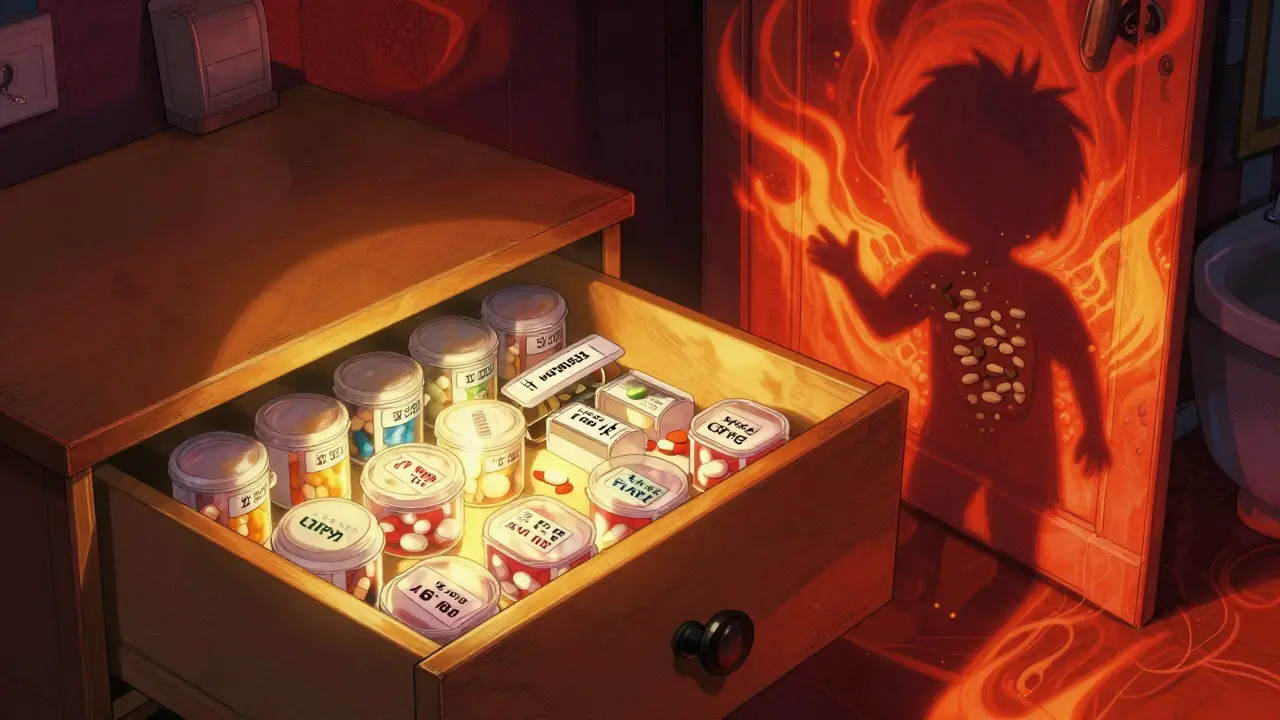
Most bathroom medicine cabinets are unlocked. That means children, teens, visitors, even pets can reach them. The CDC reports that 70% of misused prescription opioids come from home medicine cabinets. In households with kids, 63% store high-risk drugs within easy reach. The American Academy of Pediatrics says all medications should be locked away. A bathroom cabinet? It’s not a lock. It’s a sign that says, “Take me.”
And it’s not just opioids. ADHD medications, sleep aids, painkillers-any controlled substance stored in an open cabinet is a risk. One parent in Melbourne told their pharmacist their 14-year-old found their father’s pain pills in the bathroom and took them. They ended up in the emergency room.
Where to Store Medications Instead
There’s a simple fix: move them.
Find a cool, dry, dark place. Not the kitchen-too many temperature swings from the oven and fridge. Not the car-summer heat can hit 140°F. Not the window sill-sunlight breaks down drugs.
Best options:
- A locked drawer in your bedroom dresser
- A cabinet in a hallway closet, away from heat sources
- A dedicated medicine box with a latch
These spots typically stay within 65°F-72°F and have low humidity. No steam. No sun. No kids grabbing pills.
If your medication needs refrigeration (like insulin or some antibiotics), use a dedicated fridge-not the one you share with leftovers. Kitchen fridges open and close constantly, causing temperature spikes. A small, labeled fridge drawer or a pharmaceutical-grade mini-fridge is ideal.
How to Know If Your Medication Is Still Good
Expiration dates aren’t just suggestions. They’re based on stability testing under ideal conditions. But if your meds were stored in the bathroom, they may have gone bad long before the date on the bottle.
Look for these signs:
- Pills that are cracked, discolored, or smell odd
- Capsules that are sticky, swollen, or leaking
- Liquids that are cloudy or have particles
- Eye drops that changed color or smell
- Test strips that look faded or warped
If you see any of these, don’t take the risk. Dispose of them safely. Taking degraded meds can be dangerous-or useless.
How to Dispose of Old or Damaged Medications
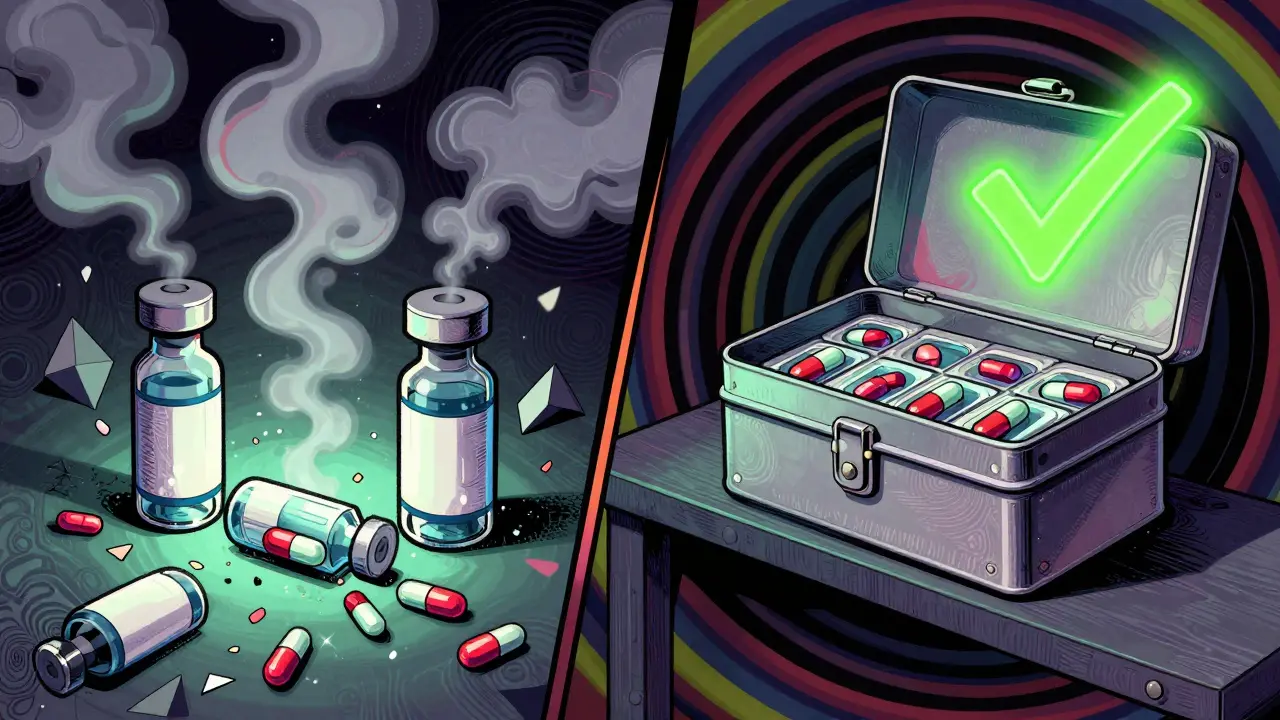
Never flush pills down the toilet or toss them in the trash. That pollutes water supplies and risks accidental ingestion by kids or animals.
Here’s what to do:
- Find a take-back program. Pharmacies, hospitals, and police stations in Australia often offer free disposal bins.
- If no take-back is available, mix pills with coffee grounds or cat litter in a sealed container, then throw them in the trash.
- Remove personal info from prescription labels before discarding bottles.
The National Association of Boards of Pharmacy estimates that over $98 million worth of unused medications sit in Australian and U.S. homes. Most of it’s expired or damaged. Proper disposal protects your family and the environment.
What’s Changing in Medication Storage
Pharmacies are catching on. More prescription bottles now include storage instructions. Some include humidity-indicating stickers that change color if exposed to too much moisture. A few companies now put temperature-sensitive labels on insulin pens and other sensitive drugs.
Apps are helping too. A 2023 study found that medication reminder apps with storage alerts improved proper storage habits by 47%. If your phone reminds you to take your pill, why not remind you to keep it in the right place?
Still, the problem persists. A 2023 survey showed 68% of Americans still store meds in the bathroom-even though 89% know it’s not safe. That gap between knowing and doing is dangerous.
It’s time to break the habit. Your medicine cabinet isn’t a bathroom fixture. It’s a medical device. And like any device, it needs the right environment to work.
Can I store pills in the fridge instead of the bathroom?
Only if the label says to. Most pills are fine at room temperature. Refrigerating them can cause condensation when you take them out, which introduces moisture. That’s just as bad as the bathroom. Stick to a cool, dry drawer unless your medication specifically requires refrigeration-like insulin or certain antibiotics.
What if I have no closet or drawer to store my meds?
Use a small, latched plastic or metal box. Place it on a high shelf in your bedroom, away from windows and heat sources. Even a locked lunchbox works. The goal is to keep them out of reach of kids and pets, and away from humidity and heat. You don’t need a fancy cabinet-just a secure, dry spot.
Do over-the-counter meds also degrade in the bathroom?
Yes. Pain relievers like ibuprofen, antihistamines like loratadine, and even cough syrups can lose effectiveness in humid conditions. A 2022 study found that antihistamines stored in bathrooms were 20% less effective at controlling allergies than those kept in dry cabinets. If your allergy meds aren’t working, check where you’re storing them.
How often should I check my medicine cabinet?
Every three months. Look for changes in color, texture, or smell. Discard anything expired or damaged. Many hospitals recommend this schedule because medications degrade faster than people realize-even before the printed expiration date. If you’ve been storing them in the bathroom, check even more often.
Is it safe to store medications in the car during winter?
No. Cars get extremely cold in winter and dangerously hot in summer. Freezing can damage liquid medications and injectables. Heat above 86°F (30°C) ruins pills and patches. If you need to carry meds in the car, keep them in an insulated bag and bring them inside as soon as possible. Never leave them overnight.
Storing your medications properly isn’t about being overly cautious. It’s about making sure your medicine does what it’s supposed to: keep you healthy. Your bathroom isn’t the enemy-it’s just the wrong place. Move your meds to a safe, dry spot. Your body will thank you.
Harbans Singh
December 24, 2025 AT 19:06I never thought about how humidity could wreck my blood pressure meds. I’ve kept them in the bathroom since college-guess it’s time to move them to my nightstand. Thanks for the wake-up call.
Also, my grandma’s insulin was stored in the bathroom for years. She never knew why her numbers were all over the place. This post could’ve saved her a lot of trouble.
Lindsay Hensel
December 26, 2025 AT 11:19As a clinical pharmacist with over two decades of experience, I must emphasize: bathroom storage is not merely suboptimal-it is clinically negligent. The degradation of pharmaceutical compounds under elevated humidity and thermal stress is not speculative; it is empirically documented, peer-reviewed, and universally condemned by regulatory bodies. The consequences are not hypothetical-they are lethal.
Michael Dillon
December 26, 2025 AT 12:27So we’re supposed to believe that every single pill in every bathroom is useless? I’ve been storing my ibuprofen there for 10 years and I’ve never had a headache I couldn’t knock out. You’re exaggerating this for clicks.
Also, my cat knocks over my meds every time I shower. Maybe the real problem is my cat, not the bathroom.
Oluwatosin Ayodele
December 27, 2025 AT 18:54You think this is new? In Lagos, we’ve known for decades that tropical humidity ruins pills. People store meds in sealed plastic bags with silica gel packets-because they don’t have climate-controlled cabinets. Your ‘FDA says’ is irrelevant when your fridge is broken and your house has no closet.
Stop lecturing. Start solving.
Jason Jasper
December 28, 2025 AT 01:39My dad’s beta-blockers were stored in the bathroom. He had three hospitalizations in a year. The doctor finally asked where he kept them. That’s when we moved them. No one told him it mattered.
Just because you didn’t get sick doesn’t mean it didn’t happen.
Mussin Machhour
December 29, 2025 AT 21:22Bro, I just moved my whole medicine stash to a locked drawer under my bed. No more steam, no more kids grabbing my Adderall, no more ‘is this expired?’ panic.
Also bought one of those little lockboxes for $12. Best $12 I’ve ever spent. Seriously, do it. Your future self will high-five you.
Winni Victor
December 30, 2025 AT 12:05Oh my GOD. I just realized I’ve been storing my Xanax in the bathroom since 2018. I’m going to scream. I’m going to cry. I’m going to throw out every pill I own and start over. My anxiety just doubled. Thanks for that.
Also, I’m now terrified my birth control is useless. I’m single. I’m 32. I have no kids. This is a disaster.
Sophie Stallkind
December 30, 2025 AT 20:38It is imperative that individuals recognize the potential for pharmaceutical degradation in environments characterized by elevated humidity and thermal fluctuation. The integrity of therapeutic agents is contingent upon adherence to manufacturer-specified storage parameters. Failure to do so constitutes a breach in pharmacological safety protocols.
Please consult your pharmacist for individualized guidance.
Katherine Blumhardt
December 31, 2025 AT 15:03i just moved my meds to my dresser drawer but i think i forgot to lock it?? oops. also my cat just sat on it. is that bad? i think my pills smell weird now. help??
Bailey Adkison
January 2, 2026 AT 13:08Stop using the word 'silent killers'. It's dramatic. Also, you say 'studies show' but never cite the actual study. And you mention the FDA but don't link to their guidelines. This is fearmongering dressed as advice.
Also, 'degraded meds' aren't poison. They're just less effective. You're making people panic over expired aspirin.
Gary Hartung
January 2, 2026 AT 21:10Let’s be real: the bathroom is the most logical place. You brush your teeth, you take your pills-same ritual. Same space. Same time. It’s symbolic. It’s poetic. It’s… human.
But fine, move them to a drawer. I’ll just keep mine where they’ve always been. And if my nitroglycerin fails? Well. At least I died with dignity. In the bathroom. With my toothbrush.
Ben Harris
January 3, 2026 AT 11:07Everyone’s acting like this is some revolutionary revelation. I’ve been telling people this for years. I even made a chart. I put it on my fridge. No one listened.
Now I just keep my meds in my sock drawer. It’s dark. It’s dry. And no one ever opens it. Not even my wife. Perfect.
Carlos Narvaez
January 4, 2026 AT 17:20Proper storage is basic. If you can’t manage that, you shouldn’t be managing your own meds. But let’s be honest-most people don’t read labels. They don’t understand chemistry. They just want the pill to work.
So maybe the real issue is pharmaceutical literacy. Not the bathroom.