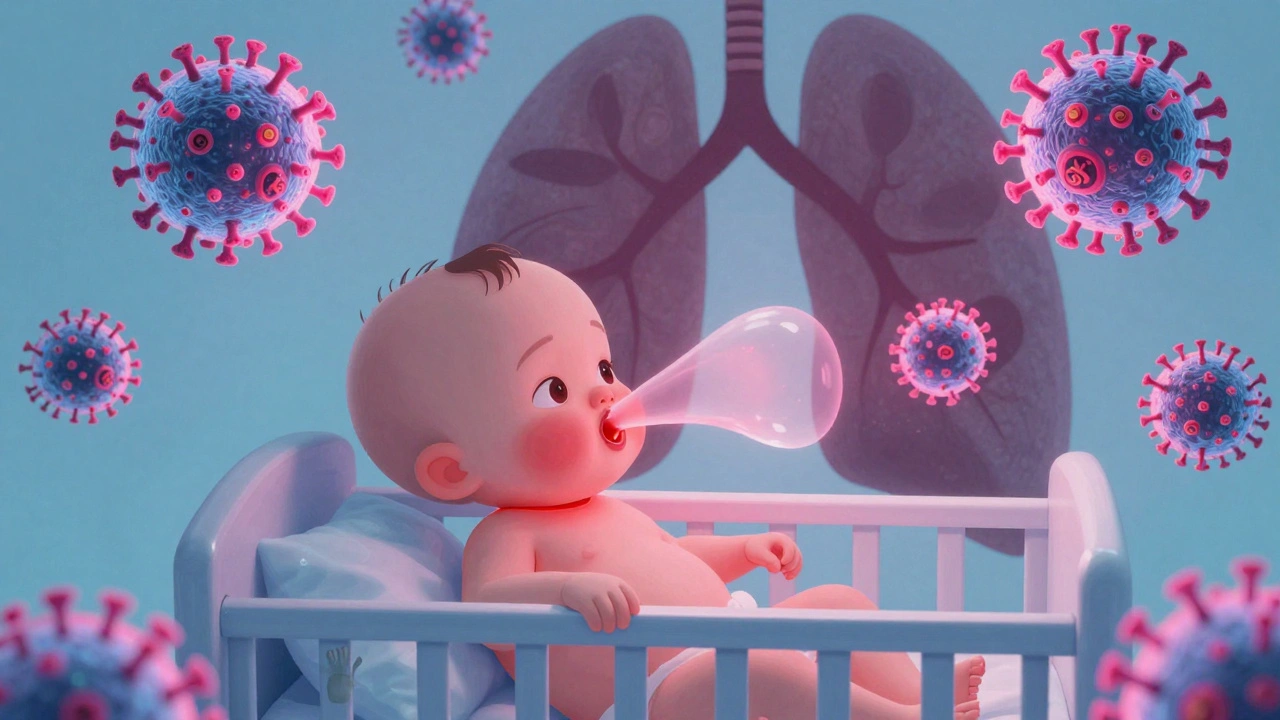
RSV isn’t just a bad cold. For babies under one year and adults over 65, it can turn life-threatening in days. Every year in the U.S. alone, RSV sends about 80,000 children under five to the hospital and causes up to 160,000 hospitalizations in older adults. It’s the number one cause of bronchiolitis and pneumonia in infants, and it’s getting worse for seniors as our population ages. The good news? We now have powerful tools to stop it - if we know how and when to use them.
What RSV Actually Does to the Body
Respiratory Syncytial Virus, or RSV, attacks the lining of your nose, throat, and lungs. It starts like a typical cold: runny nose, sore throat, cough, fever. But in vulnerable people, it doesn’t stop there. The virus spreads down into the small airways of the lungs, causing swelling and mucus buildup that blocks airflow. In babies, those airways are tiny - as thin as a drinking straw. When they get clogged, breathing becomes a desperate struggle. In older adults, RSV worsens existing heart or lung conditions, pushing already weakened systems past their limits.
Symptoms usually show up 4 to 7 days after exposure. Most people feel better in a week or two. But for high-risk groups, the real danger comes in the next few days: rapid, shallow breathing, flaring nostrils, chest pulling inward with each breath, refusal to eat, and extreme tiredness. These aren’t just signs of being sick - they’re signs of oxygen starvation.
Why Infants Are Most at Risk
Infants under six months face the highest risk of severe RSV. Their immune systems haven’t learned how to fight it yet. Premature babies - especially those born before 29 weeks - are 3 to 5 times more likely to be hospitalized. Babies with congenital heart disease face a 20 to 25 times higher risk. Those with chronic lung disease from birth are 10 to 15 times more likely to need intensive care.
Every year in the U.S., 2 to 3% of all infants under six months end up in the hospital with RSV. That’s about 58,000 to 80,000 kids. Globally, RSV kills over 100,000 children under five each year - nearly all of them in countries without access to oxygen tanks, ventilators, or neonatal intensive care. In rural Kenya, the death rate from RSV can be as high as 2.5%. In remote parts of Papua New Guinea, it’s over 15%.
Even after recovery, some children pay a long-term price. Kids hospitalized with RSV bronchiolitis before age two are more than four times as likely to develop asthma by age seven. Their lungs never fully catch up - studies show their breathing capacity remains 8 to 12% lower than peers well into their teens.
Older Adults Are Facing a Silent Crisis
For decades, RSV was seen as a child’s illness. That changed in the last five years. Now we know it’s a major killer of older adults. In the U.S., RSV causes 60,000 to 160,000 hospitalizations and 6,000 to 14,000 deaths in people 65 and older every year. That’s more than the flu kills in some seasons.
The risk spikes sharply after age 75. Seniors in that group stay in the hospital 2.3 times longer than younger adults - an average of nearly 7 days. Their death rate is nearly double. Why? Their immune systems weaken with age, and many already have COPD, heart failure, or diabetes. RSV doesn’t just cause pneumonia - it triggers heart attacks, strokes, and complete loss of mobility.
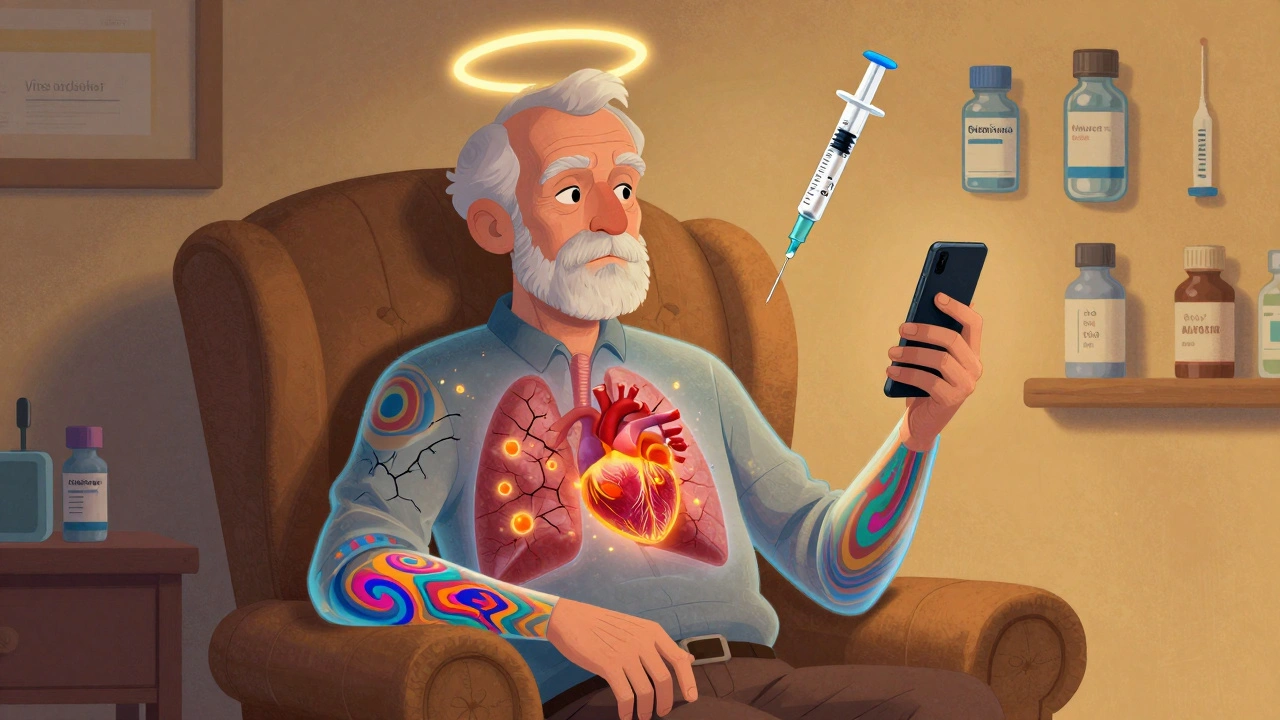
Three out of four older adults hospitalized with RSV see their existing heart or lung disease get dramatically worse. One in three needs intensive care. And after they leave the hospital, 42% can’t do basic tasks like bathing or dressing without help. Nearly one in three ends up in a nursing home - something they never needed before RSV hit.
How RSV Spreads - And How to Stop It
RSV is contagious before symptoms even appear. It spreads through droplets in the air when someone coughs or sneezes. But it also lives on surfaces - doorknobs, toys, phones - for up to 9 hours. You can get it by touching something infected, then touching your face.
Handwashing with soap for at least 20 seconds cuts transmission by 35 to 50%. Avoiding face-touching reduces risk even more. Clean high-touch surfaces daily with EPA-approved disinfectants - those labeled to kill RSV reduce surface spread by 85 to 95%.
Stay away from crowded places during RSV season (late fall to early spring). If you’re sick, wear a mask around babies and older adults. Don’t kiss infants if you have a cold. Grandparents and caregivers should wash hands before holding a baby, even if they feel fine.
The New Tools That Are Changing Everything
In 2023, two major breakthroughs arrived: a vaccine for older adults and a shot for babies.
For older adults: Two vaccines are now approved - GSK’s Arexvy and Pfizer’s Abrysvo. Arexvy is 82.6% effective at preventing severe lower respiratory disease. Abrysvo is 66.7% effective. Both are given as a single shot before RSV season. The CDC recommends them for adults 60 and older, especially those with heart or lung disease. Talk to your doctor - this isn’t just for the frail. Even healthy seniors benefit.
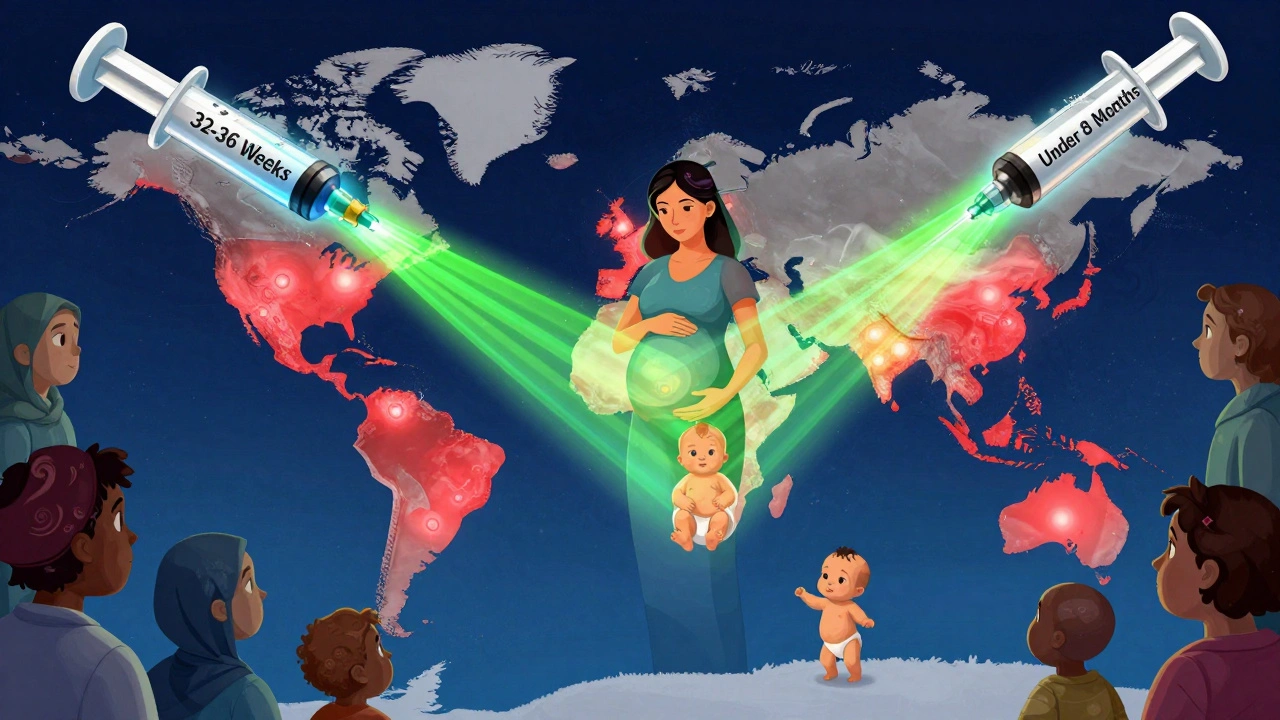
For babies: Before 2023, only high-risk infants got a monthly antibody shot called palivizumab during RSV season. Now, there’s nirsevimab (Beyfortus™), a single injection that protects for the entire season. It cuts the chance of hospitalization by 75%. The CDC now recommends it for ALL infants under 8 months entering their first RSV season. Babies 8 to 19 months with certain health conditions should also get it in their second season.
There’s another layer: pregnant women can now get Pfizer’s Abrysvo between 32 and 36 weeks. It passes protective antibodies to the baby before birth, offering up to 82% protection against severe RSV in the first 6 months of life.
What’s Still Missing - And Why It Matters
These tools are revolutionary - but only if they reach the people who need them. In the U.S., access is improving, but cost and awareness remain barriers. Arexvy costs $295 per dose. Nirsevimab is even more expensive. Many families don’t know their baby is eligible. Some doctors still don’t offer it.
Outside the U.S., the situation is dire. Low- and middle-income countries account for 97% of all RSV deaths in children. They have almost no access to vaccines, monoclonal antibodies, or oxygen therapy. Global health leaders estimate that if these tools were made affordable and widely available, we could prevent 400,000 to 600,000 hospitalizations a year by 2030 - and cut global RSV deaths by half.
What You Can Do Right Now
- If you’re pregnant: Ask your doctor about Abrysvo between weeks 32 and 36.
- If you have a baby under 8 months: Make sure they get nirsevimab before RSV season starts.
- If you’re 60+: Ask your doctor if you should get an RSV vaccine this fall.
- If you care for an infant or older adult: Wash your hands often. Clean surfaces daily. Stay home if you’re sick.
- If you’re healthy: Get vaccinated. You’re not just protecting yourself - you’re protecting the most vulnerable around you.
RSV is no longer a mystery. We know how it spreads. We know who’s most at risk. And we have the tools to stop it. The question isn’t whether we can prevent these deaths anymore. It’s whether we will.
Is RSV the same as the flu or COVID-19?
No. RSV is a different virus, though it causes similar symptoms. Unlike flu, there’s no rapid test for RSV in most doctor’s offices - diagnosis often requires a nasal swab. Unlike COVID-19, RSV doesn’t typically cause loss of taste or smell. But all three can be deadly for older adults and infants. Getting the flu shot and COVID boosters doesn’t protect you from RSV - you need specific protection for each.
Can my child get the RSV vaccine?
No - RSV vaccines are only approved for adults 60 and older. For babies, the protection comes from a monoclonal antibody shot called nirsevimab (Beyfortus™), not a vaccine. It’s a single injection that gives immediate, temporary protection. It’s not a vaccine because it doesn’t train the immune system - it gives ready-made antibodies. All infants under 8 months should get it before their first RSV season.
How do I know if my baby needs nirsevimab?
The CDC recommends nirsevimab for all infants under 8 months entering their first RSV season - no exceptions. Babies 8 to 19 months with chronic lung disease, severe immunodeficiency, or cystic fibrosis should also get it in their second season. Talk to your pediatrician. Most hospitals and clinics now stock it, and it’s covered by most insurance plans and public health programs.
Are the RSV vaccines safe for older adults?
Yes. Both Arexvy and Abrysvo were tested in tens of thousands of adults over 60. Common side effects are mild: sore arm, fatigue, headache, muscle pain. Serious reactions are rare. The benefits far outweigh the risks, especially for those with heart or lung disease. The CDC and FDA continue to monitor safety - no new red flags have emerged since approval in 2023.
Can I get the RSV vaccine at the same time as my flu shot?
Yes. You can get the RSV vaccine and flu shot on the same day, even in the same arm. Studies show no interference between them. Many pharmacies and clinics now offer all three - flu, COVID, and RSV - in one visit. This is the easiest way to protect yourself this season.
Michael Gardner
December 13, 2025 AT 07:54Let’s be real - RSV isn’t some new threat, it’s just the virus that finally got rich people to care. Kids have been dying from this for decades, but now that old folks are getting hospitalized, suddenly we’ve got vaccines and media blitzes. Where was all this energy when it was just poor kids in Kenya? 🤷♂️
Willie Onst
December 14, 2025 AT 23:09Man, I just read this and felt like someone handed me a flashlight in a dark room. I’ve got a grandkid on the way, and honestly? I had no clue RSV was this serious. I used to think it was just a ‘bad cold’ - now I’m washing my hands like I’m prepping for surgery. 🙏 Thanks for laying it out like this - you just saved my family from a nightmare.
Ronan Lansbury
December 16, 2025 AT 05:17Interesting how the CDC suddenly endorses these ‘breakthroughs’ right after Big Pharma poured millions into lobbying. Nirsevimab? A ‘monoclonal antibody’? That’s just a fancy word for passive immunization - which has existed since the 1950s. The real story isn’t science - it’s profit margins and patent extensions disguised as public health. The ‘vaccine’ for seniors? A 30% efficacy boost on a virus that mostly kills those already on their way out. Coincidence? I think not.
Shelby Ume
December 17, 2025 AT 09:03As a pediatric nurse for over 20 years, I’ve seen RSV take a breath from a baby who was smiling 12 hours before. I’ve held mothers as they begged for oxygen. I’ve watched seniors who used to garden and bake become dependent on strangers to wipe their faces. This isn’t theoretical. These numbers? They’re faces. Please - if you’re eligible, get the shot. If you’re around a child or elder, wash your hands. Don’t wait for a crisis. Prevention isn’t optional anymore.
John Fred
December 18, 2025 AT 15:05Just got my RSV shot + flu shot + COVID booster all in one go 🎯💉🩹 My 6-month-old got Beyfortus last week - we’re basically walking around with a forcefield now 😎 Don’t be that guy who says ‘I’m healthy, I don’t need it’ - you’re not just protecting yourself. You’re protecting the little ones who can’t say ‘I’m sick’ yet. Stay sharp, stay safe, stay vaccinated!
Harriet Wollaston
December 18, 2025 AT 19:52I lost my dad to RSV last winter. He was 72, active, loved his garden. One cough turned into three weeks in the hospital, then a nursing home. He never came home. I didn’t even know RSV could do that. Now I’m telling everyone I know - my coworkers, my book club, my cousins. If this can take someone like him, it can take yours too. Please, get the shot. It’s not fear. It’s love in action.
Himmat Singh
December 20, 2025 AT 15:45While the article presents a compelling narrative, it is imperative to acknowledge that the statistical models employed in estimating RSV-related hospitalizations are subject to significant methodological variance, particularly in extrapolating from limited surveillance data. Furthermore, the economic implications of mass vaccination campaigns must be weighed against the natural mortality rates of geriatric populations, wherein comorbidities often serve as the primary causal agents. The assertion of ‘preventable deaths’ presumes a level of medical intervention that may not be ethically or economically sustainable in a resource-constrained healthcare environment.
kevin moranga
December 22, 2025 AT 11:02Look, I’m not a doctor, but I’ve got three grandkids and I’ve been reading everything I can. I used to think ‘RSV’ was just what the pediatrician said when my daughter’s baby had a cough. Now I know - it’s a silent assassin. And here’s the thing: the shot for babies? It’s not just for ‘high-risk’ kids. It’s for ALL of them. My daughter didn’t even know she could get the shot while pregnant. We got it. We’re not taking chances. If you’re a grandparent, a caregiver, a parent - don’t wait until it’s too late. This isn’t hype. This is real. And the tools are here. Use them. Your family will thank you. I promise.
Alvin Montanez
December 23, 2025 AT 20:09Let me be blunt: if you’re not getting the RSV vaccine because you think it’s ‘too expensive’ or ‘not necessary,’ you’re not just being irresponsible - you’re selfish. You think your ‘freedom’ to skip a shot matters more than the life of a premature infant or a 78-year-old woman who just wants to see her great-grandchild graduate? Wake up. This isn’t about politics. It’s about basic human decency. If you can afford to buy a new phone every year, you can afford to protect someone’s child. Stop making excuses. Get the shot. Or get out of the way.
Lara Tobin
December 24, 2025 AT 04:17I’m so glad this got shared. My niece was in the NICU for 18 days last year because of RSV… I still get chills thinking about it. The nurses said if she’d gotten the shot, she might’ve never gone in. I cried for three days after she came home. I’m telling everyone now - please, if you’re pregnant, ask about Abrysvo. If you have a baby, ask about Beyfortus. Don’t wait for the emergency room to teach you how serious this is. 💔🫂
Jamie Clark
December 25, 2025 AT 11:18It’s not RSV that’s the problem - it’s the medical-industrial complex. They’ve spent decades ignoring this virus, then suddenly ‘discovered’ it when the profit potential exploded. The real tragedy isn’t the disease - it’s that we only care when it affects the wealthy and the elderly. Meanwhile, in the Global South, kids still die in rooms without oxygen because we didn’t make these tools affordable. This isn’t progress - it’s performative compassion. We need systemic change, not just shots for those who can afford to ask for them.
Keasha Trawick
December 26, 2025 AT 09:16Okay, imagine your lungs are a balloon. Now imagine RSV is a toddler with a needle. It doesn’t pop it - it just slowly, sneakily lets all the air out while you’re distracted by your phone. And for babies? Their balloons are made of tissue paper. For seniors? Their pumps are rusted. And now we’ve got this magic spray - Beyfortus - that wraps their balloon in Kevlar. It’s not magic. It’s science. And it’s here. So why are we still whispering about it? Let’s scream it from the rooftops. 🎈💥
Scott Butler
December 27, 2025 AT 13:53Why are we letting Big Pharma dictate our health policies? In my grandfather’s day, people didn’t need vaccines for every sniffle. We had grit. We had fresh air. We didn’t need a shot for every virus that came along. Now we’re vaccinating babies before they even leave the hospital? What’s next? Mandatory antibodies for sneezing? This isn’t prevention - it’s overmedicalization. And don’t get me started on the cost. This is socialism disguised as science. We’re turning healthy Americans into patients.