
Probiotic-Antibiotic Timing Calculator
How This Calculator Works
To maximize probiotic effectiveness, take them 2-3 hours after your antibiotic dose. This calculator helps you schedule your probiotic intake to avoid killing beneficial bacteria.
Important timing guidance: Probiotics should be taken 2-3 hours after antibiotics to avoid being killed by the antibiotic. Continue taking probiotics for 1-2 weeks after finishing antibiotics to help restore gut health.
When you're on antibiotics, you might expect to feel better-but instead, you get bloating, cramps, or worse, watery diarrhea. It’s not just bad luck. Antibiotics don’t just kill the bad bacteria; they wipe out the good ones too. Your gut is home to over 100 trillion bacteria that help digest food, support your immune system, and keep harmful bugs in check. When antibiotics disrupt that balance, side effects aren’t rare-they’re common. About 1 in 5 people on antibiotics get antibiotic-associated diarrhea (AAD). For some, it’s mild. For others, it’s a dangerous Clostridioides difficile infection, which can land you in the hospital.
How Probiotics Help During Antibiotic Treatment
Probiotics are live bacteria and yeasts that can help restore what antibiotics destroy. They don’t cure infections, but they can protect your gut while you’re fighting one. The most studied strains include Lactobacillus rhamnosus GG, Saccharomyces boulardii, and certain Bifidobacterium species. These aren’t magic pills-they’re targeted tools. For example, Saccharomyces boulardii, a yeast probiotic, has been shown in studies to cut the risk of antibiotic diarrhea by nearly half. In one large review, only 3.1% of people taking probiotics got C. diff diarrhea compared to 11.6% who didn’t.
How do they work? Probiotics crowd out harmful bacteria, strengthen the gut lining, and produce substances that make the environment less friendly to pathogens. They also help your body recover faster after antibiotics stop. Think of them like rebuilding the neighborhood after a storm. You don’t just wait for nature to fix things-you plant new trees, fix the roads, and bring back the shops.
Which Probiotic Strains Actually Work?
Not all probiotics are created equal. The strain matters more than the brand. If you’re looking to prevent diarrhea while on antibiotics, stick with strains backed by solid research:
- Lactobacillus rhamnosus GG (L. GG) - Reduces diarrhea risk by up to 50% in multiple trials. Found in Culturelle and other popular supplements.
- Saccharomyces boulardii - A yeast, not a bacteria. Works well even with strong antibiotics. Shown to cut C. diff risk significantly.
- Bifidobacterium lactis and Bifidobacterium bifidum - Often paired with Lactobacillus in multi-strain formulas. Helpful for general gut balance.
- Multi-strain blends - Some studies show combinations work better than single strains, especially for broader protection.
Avoid products that don’t list exact strains or CFU counts. Many store-bought yogurts and fermented foods contain probiotics, but the doses are too low and the strains too inconsistent to reliably prevent antibiotic side effects. For this purpose, supplements are more effective.
When and How to Take Probiotics With Antibiotics
Timing is everything. If you take your probiotic at the same time as your antibiotic, the antibiotic might kill the probiotic before it has a chance to work. The best practice? Space them out.
Take your probiotic 2 to 3 hours after your antibiotic dose. This gives the antibiotic time to do its job without wiping out the good bugs you’re trying to introduce. Some experts recommend taking probiotics on an empty stomach-especially if they’re acid-resistant strains like L. GG or S. boulardii-because stomach acid can kill them. Others say food helps buffer the acid. Check the label or ask your pharmacist.
Start taking probiotics on the same day you start antibiotics, and keep going for at least 1 to 2 weeks after you finish the course. Stopping too early means your gut doesn’t get enough time to rebuild. Daily dosing matters. Most effective doses range from 5 to 10 billion CFUs per day. Higher isn’t always better-stick to what’s studied.

What You Might Experience at First
When you start probiotics, especially if your gut is already upset from antibiotics, you might feel worse before you feel better. Temporary bloating, gas, or even mild constipation can happen. That’s normal. It’s your gut adjusting. These symptoms usually fade within a few days. If they don’t, or if you get severe cramping or diarrhea, stop and talk to your doctor.
Some people with IBS or sensitive guts report that probiotics make their symptoms worse. That’s not a sign the probiotic isn’t working-it might just not be the right one for you. Try switching strains. S. boulardii tends to be gentler on sensitive systems than some Lactobacillus strains.
What the Research Really Says
The evidence isn’t perfect, but it’s strong enough to guide real decisions. A 2020 Cochrane review of 23 studies found probiotics cut the risk of antibiotic diarrhea by about 60% in adults. The effect was even clearer for preventing C. diff infections in high-risk patients-like those in hospitals or on long-term antibiotics.
But here’s the catch: not every study agrees. Some show little to no benefit. Why? Because probiotics aren’t one-size-fits-all. The strain, dose, timing, and even the type of antibiotic matter. A probiotic that works with amoxicillin might not help with clindamycin. And some studies suggest certain probiotics might actually delay your gut microbiome’s natural recovery after antibiotics-a surprising twist that’s still being studied.
Despite the mixed results, major medical groups like the International Scientific Association for Probiotics and Prebiotics (ISAPP) now say probiotics “may help mitigate side effects” and “may also increase the efficacy of antibiotic treatment.” That’s not a guarantee-but it’s a strong recommendation based on the weight of evidence.
The Dark Side: Risks and Who Should Avoid Probiotics
Probiotics are generally safe for healthy people. But they’re not risk-free. There have been documented cases of people developing bloodstream infections from probiotics-especially those with weakened immune systems, recent surgery, or severe illness. Cases of Lactobacillus bacteremia and Saccharomyces cerevisiae fungemia have been reported. These are rare, but they’re real.
If you have:
- A compromised immune system (from cancer treatment, HIV, or organ transplant)
- Are critically ill or in the ICU
- Have a central IV line or recent abdominal surgery
- Are pregnant and have other high-risk conditions
-then talk to your doctor before taking probiotics. The same goes for children under 12, especially those with chronic illnesses. What’s safe for most adults isn’t always safe for everyone.
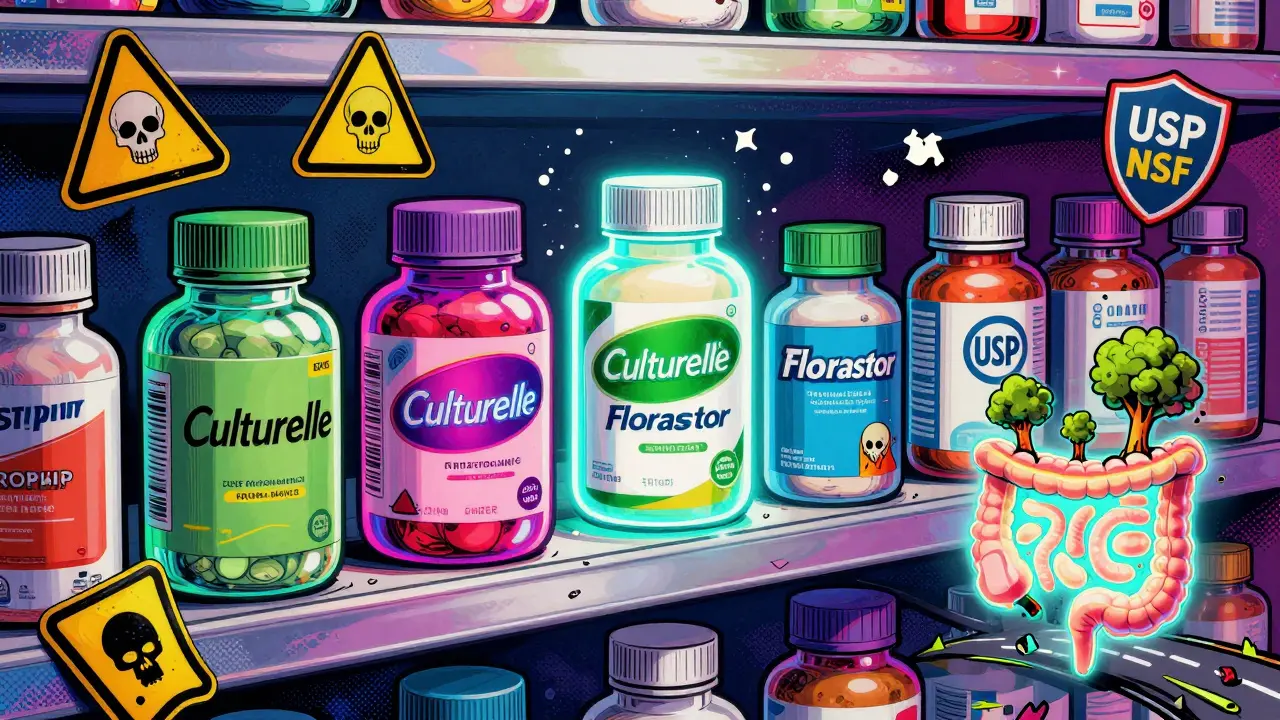
The Wild West of Probiotic Supplements
Here’s the ugly truth: most probiotics sold in the U.S. are classified as dietary supplements, not medicines. That means manufacturers don’t have to prove they work or even that they contain what’s on the label. In 2022, ConsumerLab found that 30% of probiotic supplements didn’t contain the number of live organisms claimed. Fifteen percent had unlisted microbes-some potentially harmful.
Brands like Culturelle (L. GG) and Florastor (S. boulardii) are among the most trusted because they’ve been studied in clinical trials. But even popular Amazon products with thousands of reviews can be unreliable. Look for third-party testing seals (like USP or NSF) on the bottle. If it’s not there, you’re guessing.
With the global probiotic market hitting $68 billion, companies are cashing in. But if you’re spending money to protect your gut, you deserve to know what you’re actually taking.
What to Do Next
If you’re about to start antibiotics:
- Ask your doctor or pharmacist: “Is a probiotic right for me?”
- Choose a product with a proven strain: L. GG or S. boulardii.
- Check the label: at least 5 billion CFUs, with strain names clearly listed.
- Take it 2-3 hours after your antibiotic, daily, for at least 2 weeks after finishing the course.
- Stop if you get severe symptoms, and always tell your doctor what you’re taking.
Probiotics won’t fix everything. They’re not a substitute for proper antibiotic use or medical care. But when used correctly, they’re one of the few tools we have to protect your gut while you heal.
What’s Next for Probiotics?
Science is moving fast. In 2023, the NIH invested $12.5 million into research on how specific probiotics interact with specific antibiotics. The goal? Personalized recommendations-like “Take X probiotic with Y antibiotic for Z condition.” The FDA is also working on new rules for live microbial products, but those won’t be finalized until at least 2026.
For now, the best advice is simple: use proven strains, avoid unregulated products, and never skip the conversation with your doctor. Your gut is counting on it.
josh plum
January 5, 2026 AT 02:40Everyone’s just blindly popping probiotics like they’re candy now. Did you know the FDA doesn’t even regulate them? That’s why you get brands with zero live cultures or weird contaminants. People think they’re ‘helping their gut’ but they’re just feeding Big Probiotic’s billion-dollar scam. You’re better off eating yogurt and saving your cash.
John Ross
January 5, 2026 AT 20:08From a microbiome engineering standpoint, the strain-specific modulation of gut microbial ecology via L. rhamnosus GG and S. boulardii demonstrates statistically significant modulation of pathogen colonization resistance and epithelial barrier integrity. The meta-analytic data from Cochrane (2020) supports a pooled RR of 0.41 (95% CI: 0.32–0.52) for AAD reduction. However, temporal dynamics of microbial recolonization post-antibiotic exposure remain under-characterized in human trials.
Ashley Viñas
January 7, 2026 AT 09:42Ugh, I can’t believe people still think probiotics are a ‘solution.’ You’re not fixing anything-you’re just dumping random bacteria into a system that’s already in chaos. If you’re on antibiotics, your body needs rest, not more supplements. Real healing comes from sleep, hydration, and cutting out sugar-not popping pills because you saw a YouTube ad. You’re just making your gut more confused.
Brendan F. Cochran
January 8, 2026 AT 03:37Probiotics? Yeah right. That’s just the pharma industry’s way of keeping you hooked. They don’t want you to heal naturally-they want you buying their overpriced powders. And don’t get me started on ‘yeast probiotics’-Saccharomyces? That’s like feeding mold to your guts. America’s gone soft. Eat some sauerkraut like our grandparents did. No labels. No CFUs. Just real food.
Connor Hale
January 8, 2026 AT 08:55It’s fascinating how we treat the gut like a garden you can just replant with store-bought seeds. But what if the soil itself is poisoned? Antibiotics don’t just kill good bacteria-they alter the entire ecosystem’s chemistry. Maybe the real issue isn’t missing probiotics, but the fact that we’ve been overusing antibiotics for minor infections in the first place. The fix might be less intervention, not more.
Roshan Aryal
January 8, 2026 AT 17:19Western medicine is a joke. You think some fancy lab-grown bacteria from a bottle in Walmart can fix what Big Pharma broke? In India, we’ve been using fermented foods like kanji and buttermilk for centuries-no patents, no FDA, no BS. You people pay $30 for a capsule while we’ve been healing ourselves with kitchen scraps. Your ‘science’ is just capitalism with a lab coat.
Catherine HARDY
January 10, 2026 AT 07:40Have you ever wondered what’s really in those probiotic capsules? Like… what if they’re secretly carrying GMOs or nanoparticles? I read this one forum post where someone traced a brand back to a Chinese factory that also makes vaccine components. And the ‘third-party testing’? Totally fake. They just print the seal. Your gut is a battlefield, and you’re handing the enemy a new weapon.
bob bob
January 12, 2026 AT 05:43I started taking L. GG with my amoxicillin last month and honestly? My stomach didn’t even flinch. I was scared I’d be running to the bathroom every hour, but it was smooth sailing. Just take it 2 hours after your antibiotic and don’t overthink it. Your gut will thank you. Also, drink water. Always drink water.
Vicki Yuan
January 14, 2026 AT 05:14Important clarification: the 2020 Cochrane review found a 60% reduction in AAD, but only when probiotics were administered within 48 hours of antibiotic initiation. Delayed initiation reduces efficacy significantly. Also, the 5–10 billion CFU range is optimal; doses above 20 billion show no additional benefit and may induce transient dysbiosis. Always verify strain nomenclature-L. rhamnosus GG is not interchangeable with L. rhamnosus LC705.
en Max
January 14, 2026 AT 20:11While the empirical evidence supporting probiotic administration during antibiotic therapy is statistically significant in aggregate, the heterogeneity of study design, strain specificity, and individual microbiome baseline variability necessitates a highly personalized, clinically-informed approach. The notion of a universal protocol is, in my view, epistemologically unsound.
Angie Rehe
January 16, 2026 AT 16:35Wait-so you’re telling me I should just trust some random guy on the internet who says ‘take it 2 hours after’? What if that’s wrong? What if the probiotic kills me? I’m not taking any chances. I’m going to my doctor, making her sign a waiver, and then I’m getting a stool test before, during, and after. I need data. I need proof. I need to know exactly what’s living in my colon now.
Enrique González
January 18, 2026 AT 15:49I’ve been on antibiotics three times this year. Started probiotics every time. Didn’t get sick once. Not saying it’s magic-but it’s the one thing I do that actually helps. No drama. No hype. Just consistency. And yeah, I take mine with a glass of water on an empty stomach. Works for me.
Aaron Mercado
January 19, 2026 AT 09:56YOU’RE ALL WRONG!!! PROBIOTICS AREN’T ENOUGH!!! YOU NEED PREBIOTICS TOO!!! AND FERMENTED FOODS!!! AND KETO!!! AND INTERMITTENT FASTING!!! AND DON’T FORGET TO SLEEP 8 HOURS!!! AND DON’T TOUCH GLUTEN OR DAIRY OR SUGAR OR… OH MY GOD WHY WON’T YOU LISTEN TO ME I’M THE ONLY ONE WHO KNOWS THE TRUTH!!!