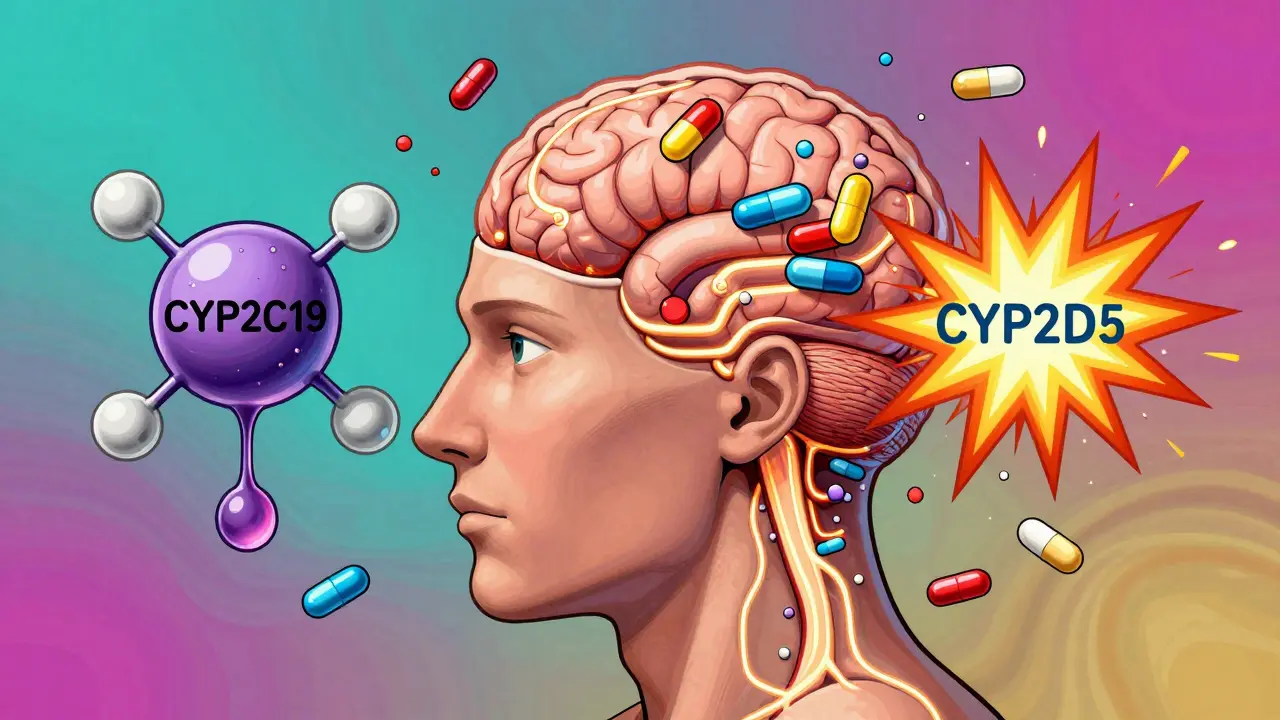
When you start an SSRI like sertraline or escitalopram, you don’t know how your body will react. One person feels better within weeks. Another ends up with nausea, dizziness, or insomnia so bad they quit. Why? The answer isn’t just about depression severity or lifestyle-it’s often hidden in your genes. Specifically, in two enzymes: CYP2C19 and CYP2D6.
What CYP2C19 and CYP2D6 Do to Your Antidepressants
These enzymes are part of your body’s drug-processing system. They break down SSRIs so your body can get rid of them. But not everyone has the same version of these enzymes. Some people have gene variants that make them slow metabolizers, others fast, and some barely work at all. That changes how much of the drug stays in your blood-and that’s what drives side effects.
CYP2C19 handles citalopram (Celexa), escitalopram (Lexapro), and sertraline (Zoloft). CYP2D6 processes fluoxetine (Prozac), paroxetine (Paxil), and venlafaxine (Effexor). If your CYP2C19 enzyme is slow, escitalopram builds up in your system. Studies show poor metabolizers can have 2.3 to 3.5 times higher blood levels than normal. That’s not a small difference-it’s enough to cause dizziness, fatigue, or even heart rhythm changes.
On the other end, ultrarapid metabolizers break down the drug too fast. One woman in a clinical case study took 20mg of escitalopram daily for months with no improvement. Her test showed she was an ultrarapid metabolizer. When her dose was doubled to 40mg, her depression lifted. She didn’t need a new drug-she just needed the right dose for her genes.
How Testing Works-and What It Reveals
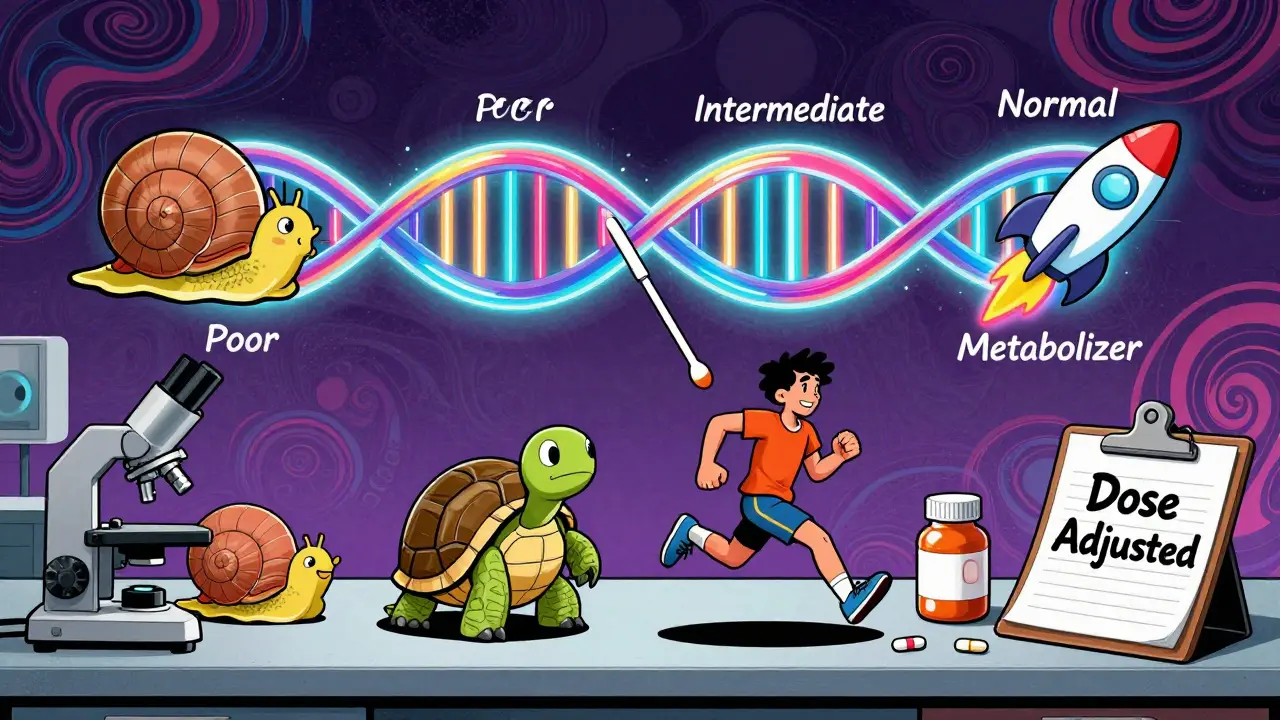
Pharmacogenomic testing looks at your DNA to see which versions of CYP2C19 and CYP2D6 you inherited. It’s not a blood test. It’s usually done with a cheek swab or saliva sample. The lab checks for specific gene variants, then assigns you a metabolizer category:
- Poor metabolizer (PM)
- Intermediate metabolizer (IM)
- Normal metabolizer (NM)
- Ultrarapid metabolizer (UM)
- Rapid metabolizer (RM)-specific to CYP2C19
These categories aren’t guesses. They’re based on over 100 known variants for CYP2D6 and 35 for CYP2C19. A single change in your gene can flip you from normal to poor metabolizer. That’s why standard dosing fails so often. A 75mg dose of venlafaxine might be fine for a normal metabolizer but dangerous for a poor one. In fact, poor metabolizers are 2.7 times more likely to have serious side effects from venlafaxine.
Testing accuracy is high-95% to 99% depending on the platform. But not all tests are equal. Standard genome-wide tests (like those from 23andMe) miss key variants, especially for CYP2D6, because of complex gene structures and pseudogenes. You need a targeted pharmacogenetic panel for reliable results.
Real-Life Impact: Side Effects You Can Avoid
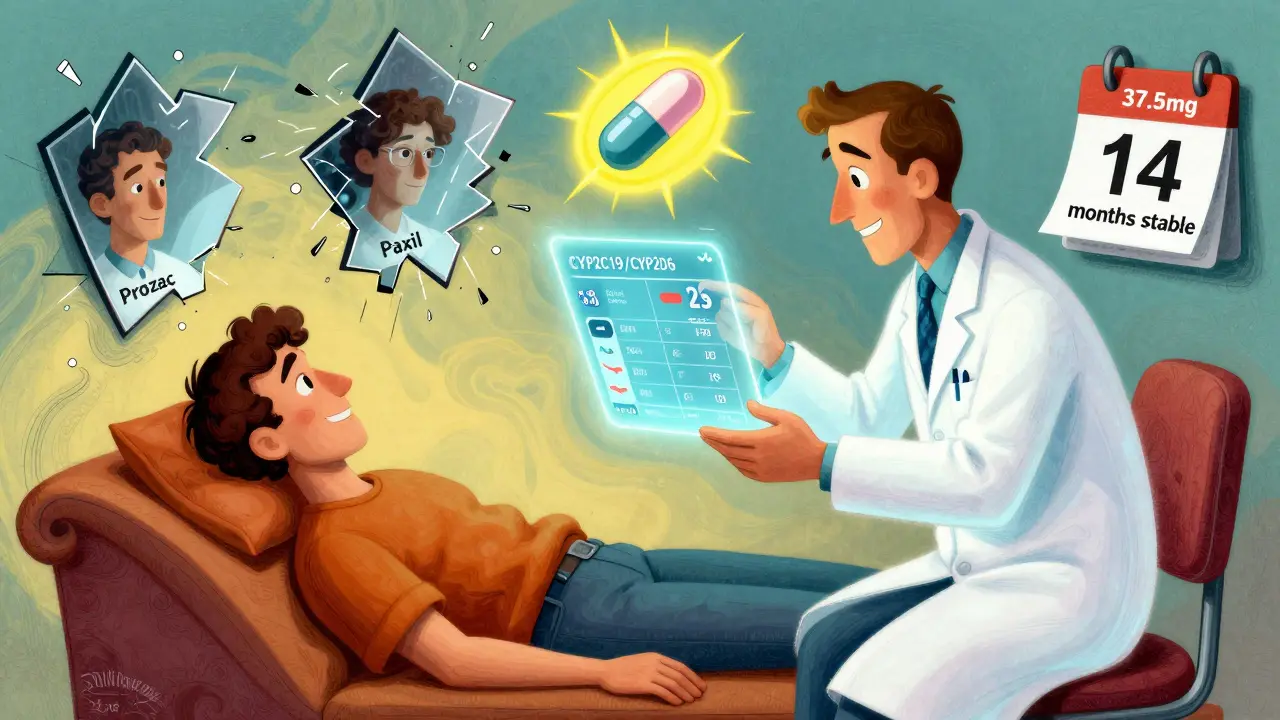
A 45-year-old woman in a 2023 study was prescribed 75mg of venlafaxine for anxiety. Within days, she couldn’t sleep, felt constantly nauseous, and had pounding headaches. Her doctor assumed she was “just sensitive.” She switched to three other SSRIs-all with similar issues. Only after pharmacogenomic testing did they find she was a CYP2D6 poor metabolizer. Her dose was cut in half to 37.5mg. Within two weeks, her side effects vanished. She stayed on the drug for over a year.
Another patient, a 32-year-old man, tried four antidepressants over two years. He kept quitting because of brain zaps and sweating. His test showed he was a CYP2C19 ultrarapid metabolizer. His body was clearing sertraline and citalopram too fast. He was never getting enough drug in his system. When he switched to escitalopram and doubled the dose, his symptoms improved. He’s been stable for 14 months.
These aren’t rare cases. Patient surveys show CYP2D6 poor metabolizers are 3.2 times more likely to report severe side effects with paroxetine. CYP2C19 poor metabolizers report 2.8 times more side effects with citalopram. That’s not coincidence-it’s biology.
Why Testing Isn’t a Magic Bullet
Here’s the catch: having the right gene doesn’t guarantee you’ll feel better. Studies show that while metabolizer status strongly affects drug levels, it doesn’t always predict whether someone responds to treatment. One large study of over 5,800 people found no consistent link between CYP2C19 genotype and improvement in depression symptoms. So even if your escitalopram levels are high, you might still not respond.
That’s because depression isn’t just about one enzyme. It’s about brain chemistry, stress, sleep, trauma, and other genes like SLC6A4 and HTR2A. Pharmacogenomic testing gives you one piece of the puzzle-not the whole picture. As one psychiatrist put it: “It tells you how your body handles the drug, not whether the drug will fix your brain.”
Also, the evidence is stronger for tricyclic antidepressants (TCAs) than SSRIs. Guidelines from the Clinical Pharmacogenetics Implementation Consortium (CPIC) rate CYP2D6 and TCAs as “Level A” evidence-strong enough to change practice. For SSRIs? Only “Level B.” That means the data is promising but not yet definitive.
Who Benefits Most-and Who Might Not
You’re most likely to gain from testing if:
- You’ve tried two or more antidepressants with bad side effects
- You’re on a drug known to be heavily metabolized by CYP2C19 or CYP2D6 (like sertraline, escitalopram, or venlafaxine)
- You have a family history of poor drug tolerance
- You’re starting treatment and want to avoid the trial-and-error phase
But if you’re responding well to your current SSRI with no side effects, testing won’t help. And if you’re on a drug not handled by these enzymes-like fluvoxamine or bupropion-it won’t matter.
Also, about 30% of people report no real change after testing. Some say it helped them avoid one bad drug. Others say it didn’t change anything. That’s normal. It’s not a failure-it’s just how complex biology works.
Cost, Coverage, and Getting Tested
Testing costs $200 to $500 out-of-pocket. Insurance coverage is patchy. In the U.S., only 62% of major insurers cover it for antidepressants as of 2024. Medicare and Medicaid rarely cover it unless you’ve failed multiple treatments.
Most tests take 1 to 3 weeks. You order the kit from a lab like Mayo Clinic, Genomind, or OneOme. You do the swab at home, mail it in, and get a report with your metabolizer status and suggested dose adjustments.
Doctors need training to interpret these reports. The American Psychiatric Association offers a 6-hour course. But many still don’t know how to use them. That’s why working with a pharmacogenetics-certified pharmacist can make a big difference. There are about 1,200 in the U.S. alone.
CPIC has free online tools that translate your genotype into dosing advice. You can plug in your gene results and get a recommendation for which SSRI to use and how much. It’s not magic, but it’s science.
The Future: Bigger, Smarter, More Personal
Right now, testing looks at just CYP2C19 and CYP2D6. But the latest CPIC guidelines (April 2023) now include SLC6A4 and HTR2A-genes linked to serotonin transport and receptor function. That means future tests will combine enzyme activity with brain chemistry signals.
A major NIH-funded trial called GUIDED-2 is tracking 5,000 people with treatment-resistant depression. Results are due in 2027. If it shows clear improvement in outcomes, testing could become standard before prescribing any SSRI.
By 2026, some clinics will start using polygenic risk scores-combining your CYP genes with dozens of other markers to predict not just side effects, but who’s likely to respond to which drug. That’s the next leap.
Bottom Line: Is It Worth It?
If you’ve struggled with antidepressant side effects, pharmacogenomic testing for CYP2C19 and CYP2D6 isn’t just science fiction-it’s a practical tool. It won’t fix your depression. But it can stop you from wasting months on drugs that make you feel worse. For some, it’s the difference between giving up and finally finding relief.
You don’t need to test before your first SSRI. But if you’ve been through two or more with bad reactions, it’s one of the most logical next steps. Talk to your doctor. Ask for a referral. Get the test. And if the result says you’re a poor metabolizer? Don’t panic. Just ask: “What dose should I start with?”
What SSRIs are affected by CYP2C19 and CYP2D6?
CYP2C19 primarily metabolizes citalopram (Celexa), escitalopram (Lexapro), and sertraline (Zoloft). CYP2D6 handles fluoxetine (Prozac), paroxetine (Paxil), venlafaxine (Effexor), and duloxetine (Cymbalta). Other SSRIs like fluvoxamine and vortioxetine are also affected, but to a lesser extent. Knowing which enzyme processes your drug helps predict side effect risk.
Can I get tested without seeing a psychiatrist?
Yes. Many direct-to-consumer labs offer pharmacogenomic testing with a physician order. You can get tested through services like Genomind, OneOme, or Labcorp’s GeneSight. Your primary care doctor or pharmacist can order it. You don’t need a psychiatrist, but you do need someone to interpret the results and adjust your treatment plan.
Do I need to retake the test if I switch medications?
No. Your genes don’t change. Once you’ve been tested for CYP2C19 and CYP2D6, the results are lifelong. You can use them for any future antidepressant, even if you switch drugs years later. The test only needs to be done once.
Are there risks to pharmacogenomic testing?
The test itself is low-risk-just a cheek swab. But the main risk is misinterpretation. If you get a result saying you’re a poor metabolizer and stop your medication without medical advice, you could have withdrawal symptoms. Always work with a provider who understands the guidelines. Also, results don’t guarantee outcomes-some people still don’t respond even with perfect dosing.
Is pharmacogenomic testing covered by insurance in the UK?
As of 2026, the NHS does not routinely cover pharmacogenomic testing for SSRIs. It’s available privately through some clinics and research programs, but not yet part of standard care. In the U.S., coverage is improving, but in the UK, it’s still considered experimental. Some private insurers may cover it if you’ve failed multiple treatments.
Agbogla Bischof
March 24, 2026 AT 13:02As someone who’s worked in pharmacogenomics for over a decade, I’ve seen this play out in real clinics: patients who’ve been misdiagnosed as “non-compliant” or “treatment-resistant” are often just poor metabolizers. The data is clear-CYP2C19 PMs on escitalopram have 3x the AUC. No magic, just math. Labs need to standardize reporting; right now, some report “intermediate” when they mean “reduced function.” It’s sloppy.
Pat Fur
March 26, 2026 AT 06:45I’ve been on three SSRIs. Two made me feel like my brain was stuffed with cotton. The third? Zero side effects. Turns out I’m a CYP2C19 ultrarapid. My doc doubled the dose-boom. Relief. No more crying in the shower. Just biology.
Chris Crosson
March 26, 2026 AT 12:05So if you’re a fast metabolizer, does that mean you need higher doses forever? Or does your body eventually adapt? I’ve heard conflicting things. My cousin’s on 80mg of sertraline and still says it’s barely working. She’s been on it for five years. I wonder if her genes are the whole story.
Jesse Hall
March 26, 2026 AT 18:47This is why I love science. Not the hype. Not the pills. But the quiet, stubborn truth that your body has its own rules. You don’t have to suffer through trial and error. There’s a map. You just have to ask for it. Thank you for writing this.
Stephen Alabi
March 26, 2026 AT 20:56While the genetic data is statistically significant, the clinical utility remains overstated. A 2022 meta-analysis in JAMA Psychiatry showed no significant improvement in remission rates when using pharmacogenomic-guided prescribing for SSRIs. The CPIC Level B recommendation exists for a reason. We are conflating pharmacokinetics with pharmacodynamics. One does not guarantee the other. The industry pushes this because it’s profitable-not because it’s proven.
Elaine Parra
March 27, 2026 AT 06:35Let’s be real. This isn’t about genes. It’s about Big Pharma pushing expensive tests so they can sell more drugs. Your body doesn’t need a $500 swab to tell you if Prozac works. If it makes you feel worse, stop. If it helps, keep going. Stop letting corporations turn mental health into a DNA lottery.
Anil Arekar
March 28, 2026 AT 22:36As a clinician in India, I’ve prescribed SSRIs for over 15 years without testing. We don’t have access to these labs. Yet, we manage patients successfully through careful titration and monitoring. Genetic testing may be useful in high-resource settings, but it is not a global solution. We must not create a two-tier system where only the wealthy get personalized care.
Caroline Dennis
March 29, 2026 AT 18:33Pharmacogenomics is not destiny. It’s a risk stratifier. A CYP2D6 poor metabolizer on paroxetine has elevated exposure, but response still depends on HTR2A polymorphisms, SERT expression, and neuroinflammation markers. The field is moving toward polygenic scores-combining enzyme activity with receptor sensitivity. That’s where the real predictive power lies.
Donna Fogelsong
March 31, 2026 AT 03:12They’re testing your DNA so they can sell you a new drug. The FDA approved this test because the pharmaceutical lobby wrote the guidelines. CYP2C19? That’s just the front. Next, they’ll test for serotonin transporter variants and charge $1,200. You’ll be told your depression is genetic-and your insurance won’t cover it. Wake up.
Sean Bechtelheimer
March 31, 2026 AT 16:22My cousin got tested. They told her she was a “fast metabolizer.” She doubled her dose. Two weeks later, she had a seizure. Now she’s on disability. The lab got it wrong. Who’s liable? Who checks the results? This isn’t science. It’s a gamble with your brain.
Seth Eugenne
April 2, 2026 AT 15:45Thank you for sharing this. I’ve been in therapy for years, and this is the first time I’ve felt like someone finally understood why nothing worked before. I got tested last year-CYP2C19 poor metabolizer. My doctor cut my escitalopram dose in half. Within days, my anxiety dropped. No more dizziness. No more brain fog. I’m not “fixed,” but I’m finally stable. This matters.
Natasha Rodríguez Lara
April 2, 2026 AT 23:21I love how this post balances hope with realism. Yes, genes matter. But so does sleep. So does trauma. So does having someone who listens. Testing doesn’t replace therapy-it informs it. I’m a therapist, and I now routinely ask patients if they’ve been tested. It’s not a magic bullet. But it’s a compass.