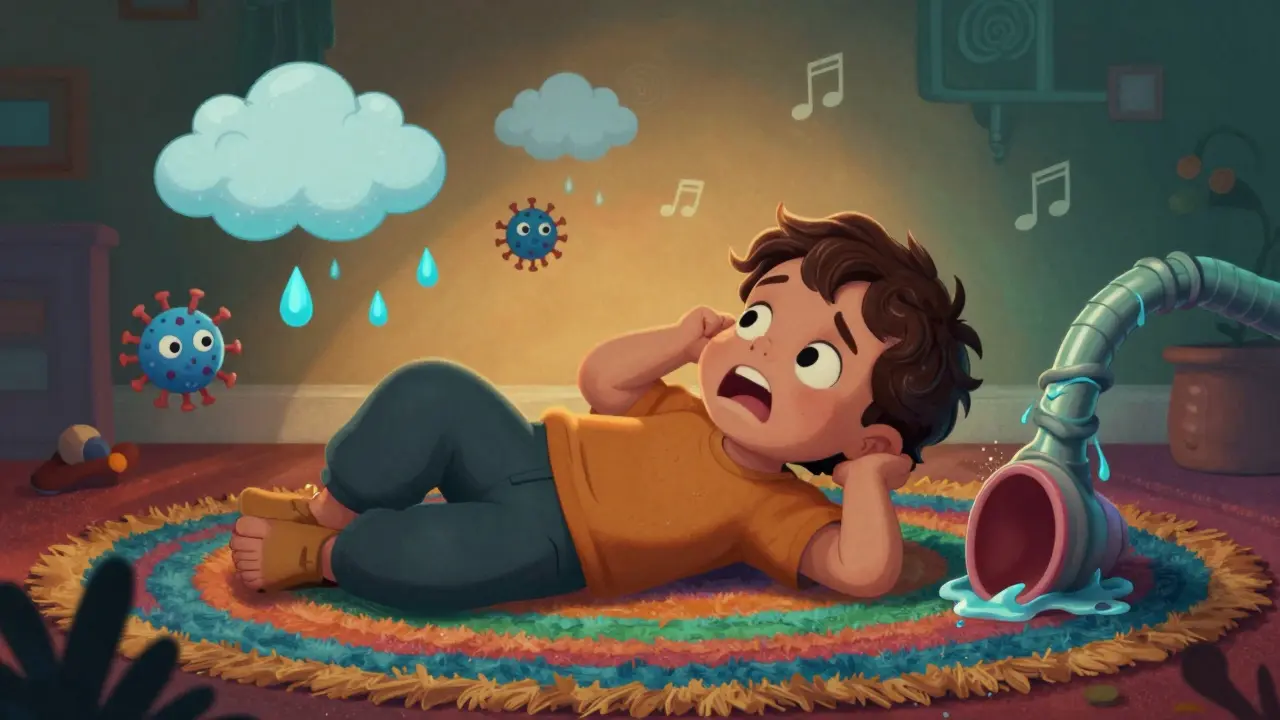
When your child suddenly starts crying, tugging at their ear, and won’t lie down without screaming, it’s hard not to panic. Is it an ear infection? Do they need antibiotics right away? The truth is, otitis media - or middle ear infection - is one of the most common reasons parents rush to the doctor, but not every case needs antibiotics. In fact, most clear up on their own.
Otitis media happens when fluid builds up behind the eardrum, often after a cold or allergy flare-up. The Eustachian tube - a small passage that connects the middle ear to the back of the throat - gets blocked. In kids, this tube is shorter, more horizontal, and less developed than in adults, so fluid doesn’t drain as easily. That trapped fluid becomes a breeding ground for bacteria or viruses. The result? Pain, fever, irritability, and sometimes temporary hearing loss.
According to the Children’s Hospital of Philadelphia, over 80% of kids will have at least one ear infection by age 3. The peak time? Between 3 months and 3 years old. That’s why so many parents feel like they’re in a loop: one infection clears, then another hits a few weeks later. And yes, daycare, secondhand smoke, and bottle-feeding while lying down all raise the risk. Kids in daycare are 2 to 3 times more likely to get ear infections than those who stay home.
How Do You Know It’s an Ear Infection?
Not every ear tug means infection. Some kids just like pulling at their ears - especially when they’re tired or teething. The real signs of acute otitis media (the infectious kind) are:
- Fever above 38°C (100.4°F)
- Intense ear pain that doesn’t improve with pain relief
- Fussiness or trouble sleeping
- Fluid draining from the ear (this can mean the eardrum has burst - still not an emergency, but needs checking)
- Loss of balance or dizziness (rare, but serious)
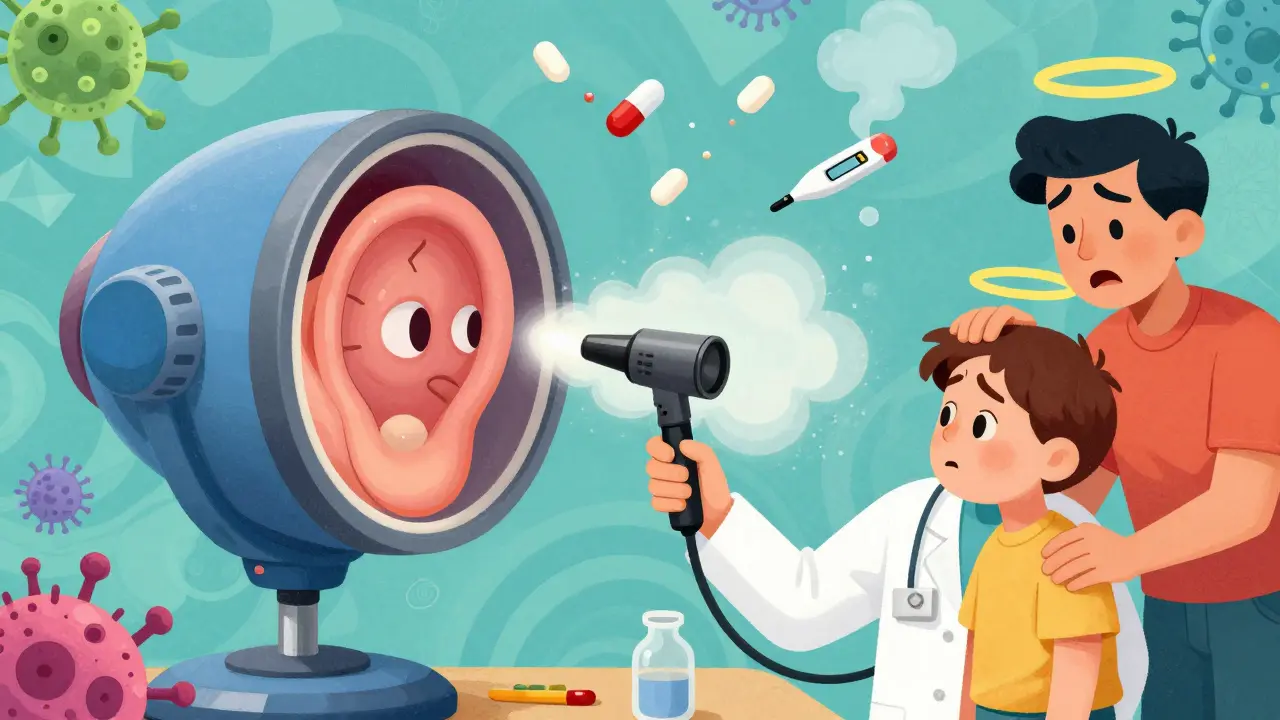
Doctors use a tool called a pneumatic otoscope to check. It blows a puff of air into the ear and watches how the eardrum moves. If it’s stiff and bulging, that’s a classic sign of pressure from fluid and infection. A red eardrum alone isn’t enough - it can happen after crying or even from a warm bath.
Antibiotics: Not Always the Answer
Here’s where things get confusing. For decades, doctors prescribed antibiotics for almost every ear infection. Today, guidelines have changed - and for good reason.
Studies show that 80% of kids with mild to moderate ear infections get better in 2 to 3 days without antibiotics. That’s right. The body’s immune system often handles it. The problem with overusing antibiotics? Side effects - diarrhea, rashes, vomiting - and the growing threat of antibiotic-resistant bacteria. The CDC says 30-50% of the most common ear infection bacteria, Streptococcus pneumoniae, are now resistant to penicillin. That doesn’t mean amoxicillin doesn’t work - it just means we need to use it smarter.
The American Academy of Pediatrics (AAP) and the American Academy of Family Physicians (AAFP) now recommend a watchful waiting approach for many kids:
- For children 6 months to 2 years with unilateral (one ear) infection and mild symptoms: wait 48-72 hours before starting antibiotics.
- For children 2 years and older with mild symptoms: observation is often the best first step.
- For children under 6 months, or anyone with severe pain, high fever (over 39°C), or both ears infected: antibiotics are recommended right away.
Amoxicillin is still the first choice - usually at 80-90 mg per kg of body weight, split into two doses a day. For kids allergic to penicillin, alternatives like cefdinir or azithromycin are used. But even when antibiotics are needed, the course isn’t always 10 days anymore. For kids under 2, it’s 10 days. For older kids with mild cases? Just 5-7 days can be enough.
What About Pain Relief?
Before you even think about antibiotics, focus on pain control. That’s what makes the biggest difference in how your child feels. Ibuprofen (5-10 mg per kg every 6-8 hours) or acetaminophen (10-15 mg per kg every 4-6 hours) are both safe and effective. Many parents report that once pain is managed, their child sleeps, eats, and calms down - even if the infection hasn’t cleared yet.
Warm compresses on the ear can help too. Some doctors recommend over-the-counter ear drops like Auralgan, but never use them if you see fluid leaking from the ear - that means the eardrum might be ruptured. And no, putting oil or garlic in the ear doesn’t help. It can make things worse.
When to Skip Antibiotics - And When Not To
Here’s a real-life example: One parent on Reddit shared that after 48 hours of ibuprofen and waiting, their 18-month-old’s infection cleared on its own. No antibiotics. No diarrhea. No fuss. Another parent in Ohio, though, waited 72 hours - then their child spiked a 104°F fever and ended up in the ER with a ruptured eardrum. Was the delay the problem? Maybe. But it’s hard to say.
The key is knowing the red flags that mean you should act fast:
- Fever above 104°F (40°C)
- Pain that doesn’t improve with medicine
- Drainage of pus or blood from the ear
- Facial weakness or drooping
- Extreme lethargy or difficulty waking up
If any of these happen, don’t wait. Go to the doctor - or the ER. These can signal complications.
What About Recurrent Infections?
Some kids get ear infections over and over - three or more in six months. That’s called recurrent otitis media. It’s frustrating, expensive, and exhausting. For these kids, doctors may suggest:
- Getting the pneumococcal vaccine (PCV15 or PCV20) - it reduces ear infections by up to 34%
- Avoiding smoke exposure
- Switching from bottle-feeding to cup-feeding
- Considering ear tubes (tympanostomy tubes) if infections keep coming
Ear tubes are small implants placed in the eardrum during a quick outpatient procedure. They let fluid drain and reduce pressure. Studies show they cut infection rates by 50% in kids with frequent infections. They usually fall out on their own in 6-12 months.

What About Otitis Media With Effusion (OME)?
After an infection clears, fluid can stay behind the eardrum for weeks or even months. This is called otitis media with effusion (OME). It’s not an infection - no fever, no pain. But it can cause temporary hearing loss of 15-40 decibels. That’s like listening through a pillow.
Here’s the big takeaway: OME does not need antibiotics. Giving antibiotics for OME doesn’t help. It just adds side effects and contributes to resistance. Most fluid clears on its own within 3 months. If hearing loss lasts longer than 3 months, especially in kids learning to talk, then a hearing test and possible ear tubes are considered.
What’s New in Treatment?
Technology is helping parents and doctors make better decisions. The FDA approved smartphone otoscopes like CellScope Oto - you can take a picture of your child’s eardrum and send it to the doctor. Studies show these are 85% accurate. Some clinics now use tympanometry - a quick, painless test that measures eardrum movement - and it’s cut unnecessary antibiotic prescriptions by 22% in young kids.
On the horizon? Point-of-care tests that can tell if an infection is bacterial or viral in minutes. Dr. Peter Roland from UT Southwestern says these could reduce broad-spectrum antibiotic use by 30-40% in the next five years.
And vaccines? The newer 15-valent pneumococcal vaccine (Vaxneuvance) is showing even better protection than older versions. It’s not yet standard in all countries, but it’s coming.
Final Thoughts
Otitis media is common, often painful, and usually harmless in the long run. But it’s also one of the most over-treated conditions in pediatrics. The goal isn’t to eliminate every infection - it’s to manage symptoms, avoid unnecessary antibiotics, and prevent complications.
If your child has ear pain, start with pain relief. Wait 48-72 hours. Watch for red flags. Talk to your doctor about whether antibiotics are truly needed. And remember: every time you avoid an unnecessary antibiotic, you’re helping protect not just your child - but the whole community - from the growing threat of drug-resistant infections.
Joe Grushkin
February 16, 2026 AT 19:35Antibiotics aren’t a sledgehammer-they’re a scalpel. And if you’re avoiding them because you’re scared of ‘resistance,’ you’re ignoring the real crisis: children who can’t hear their mother’s voice clearly because someone thought patience was a virtue. The data doesn’t care about your ideology. The eardrum does.
Daniel Dover
February 17, 2026 AT 11:18Chiruvella Pardha Krishna
February 18, 2026 AT 04:01Perhaps the Eustachian tube is not a passage of anatomy, but a metaphor for the unspoken. When we listen-not with a scope, but with presence-we may find the infection was never bacterial at all.
Virginia Kimball
February 19, 2026 AT 00:45Also-ear tubes? My kid got them. Best. Decision. Ever. She’s a different child. Talkative. Confident. No more ‘what?’ five times a minute. It’s like someone turned up the volume on her whole personality.
Sarah Barrett
February 20, 2026 AT 18:23Erica Banatao Darilag
February 21, 2026 AT 00:51Charlotte Dacre
February 22, 2026 AT 08:08Meanwhile, the pharmaceutical industry is quietly laughing as we all become amateur diagnosticians with YouTube otoscopes and Pinterest warm compresses. Next stop: homeopathic ear candles for meningitis.
Esha Pathak
February 24, 2026 AT 01:14When I held my daughter as she cried through the night, I realized: medicine doesn’t heal. Presence does. Antibiotics? They are a bandage on a wound that may not even be infected. The body knows how to mend. We just forgot to listen.
Still, I gave her ibuprofen. And held her. And whispered: ‘I am here. You are safe.’
She slept. The fever broke. No pills needed.
Maybe that’s the real cure.
Mike Hammer
February 25, 2026 AT 18:33None of us turned out deaf. None of us became antibiotic-resistant monsters. We just… got better. Sometimes, the best medicine is time, warmth, and a hug. No fancy otoscope needed. Just common sense and a little patience.
Kapil Verma
February 26, 2026 AT 19:40