Every year, millions of people take vaccines and medications without issue. But when something goes wrong-when a fever won’t break, a rash spreads, or a hospital visit follows a shot-it’s natural to wonder: Who tracks this? And more importantly, how do you make sure it gets seen?
The answer isn’t one system. It’s two: MedWatch and VAERS. They sound similar. Both deal with side effects. Both are run by U.S. health agencies. But they’re not the same. Mixing them up could mean your report goes nowhere-or worse, gets lost in the wrong system.
What Is VAERS?
VAERS stands for Vaccine Adverse Event Reporting System. It’s the go-to place for anything linked to vaccines. If you got a flu shot and ended up in the ER three days later, that belongs in VAERS. Same if your child had a seizure after their MMR vaccine. Even if you’re not sure the vaccine caused it-report it anyway.
VAERS is run jointly by the CDC and FDA. It’s designed to catch early warning signs. Think of it like a national alarm system for vaccines. It doesn’t prove causation. It doesn’t say, "This shot caused that reaction." But it flags patterns. If 50 people report the same rare symptom after getting a new shingles vaccine, that’s a signal. That signal triggers deeper studies-using systems like the Vaccine Safety Datalink, which tracks millions of medical records to find real connections.
Anyone can file a VAERS report: patients, parents, doctors, nurses, pharmacists. You don’t need proof. You don’t even need a diagnosis. Just describe what happened, when, and which vaccine was given. The form asks for details like vaccine lot number, date of shot, age, and medical history. That’s because timing matters. If a headache started five minutes after the shot? That’s different than if it started five days later.
But here’s the catch: VAERS is passive. That means it relies on people to report. Studies show less than 1% of actual vaccine side effects get reported. Many people don’t know about it. Others think it’s too complicated. Some assume their doctor already filed it. They didn’t. And if you don’t report it, that data point disappears.
What Is MedWatch?
MedWatch is the FDA’s system for everything else: prescription drugs, over-the-counter medicines, medical devices, dietary supplements, and even tobacco products. If you had a bad reaction to your blood pressure pill, your insulin pen malfunctioned, or you got a rash from a new skin cream-MedWatch is where you send it.
Unlike VAERS, MedWatch covers a much wider range of products. It’s not just about vaccines. It’s about every FDA-approved medical product that isn’t a vaccine. That includes antibiotics, chemotherapy drugs, pacemakers, contact lenses, and even weight-loss teas sold as supplements.
Healthcare providers and manufacturers are legally required to report serious events to MedWatch. If a hospital sees five patients with liver failure after taking a new cholesterol drug, the hospital must file a report. The drugmaker has to file too. That’s not optional. It’s federal law.
But the public can report too. If you took a new painkiller and started having trouble breathing, you can file a MedWatch report yourself. You don’t need a lawyer. You don’t need a doctor’s note. Just go to the FDA’s website, fill out the form, and describe what happened.
MedWatch reports are reviewed by FDA scientists in different centers-drug safety experts, device specialists, toxicologists. They look for trends. If 200 people report the same rare heart rhythm issue after taking a new antidepressant, the FDA might issue a warning, update the label, or even pull the drug from the market.
Key Differences Between MedWatch and VAERS
Here’s the simplest way to tell them apart:
- VAERS = vaccines only. No exceptions.
- MedWatch = everything else. Drugs, devices, supplements, tobacco.
If you’re unsure, ask yourself: Was it a shot? If yes, use VAERS. If it was a pill, patch, inhaler, or implant-use MedWatch.
There are other differences too:
| Feature | MedWatch | VAERS |
|---|---|---|
| Managed by | FDA only | FDA and CDC |
| What it covers | Drugs, devices, supplements, tobacco | Vaccines only |
| Who must report | Manufacturers, hospitals, healthcare providers (legally required) | Manufacturers and certain providers (required); public encouraged |
| Public reporting | Yes, encouraged | Yes, strongly encouraged |
| Key data collected | Drug name, dosage, condition treated, reaction timeline | Vaccine name, lot number, date given, symptoms, timing after shot |
| Can it prove causation? | No | No |
| Follow-up systems | FDA BEST, Sentinel Initiative | Vaccine Safety Datalink (VSD), CISA |
One big mistake people make? Sending a vaccine reaction to MedWatch. It won’t get lost-but it won’t be seen by the right team. VAERS has specialists who know vaccine patterns. MedWatch doesn’t. If you report a fever after a COVID shot to MedWatch, it might sit there for weeks before being forwarded. By then, the signal could be missed.
Why Reporting Matters
These systems aren’t just paperwork. They save lives.
In 2010, VAERS flagged a spike in intussusception (a dangerous bowel condition) in infants after a rotavirus vaccine. The CDC and FDA investigated. They found the risk was real-only in the first week after the first dose. The vaccine was pulled from the market. New versions were developed with safer profiles. That’s how VAERS works: spotting danger, then fixing it.
MedWatch did the same with the diabetes drug rosiglitazone. Reports of heart attacks started piling up. The FDA reviewed the data, found a pattern, and added a black box warning. Later, access was restricted. Without those reports, the risk might have gone unnoticed for years.
But here’s the truth: these systems only work if people use them. If you had a bad reaction and didn’t report it, you’re not just staying quiet-you’re removing a piece of the puzzle. That piece might be the one that helps someone else avoid the same fate.
How to Report Correctly
Reporting is easy. But you have to pick the right system.
If it’s a vaccine:
- Go to vaers.hhs.gov
- Click "Report an Adverse Event"
- Fill out the form. Even if you’re unsure, report it.
- Include: vaccine name, lot number (if you have it), date of shot, symptoms, when they started.
- Submit. You’ll get a confirmation number.
If it’s a drug, device, or supplement:
- Go to fda.gov/medwatch
- Download Form 3500 or report online
- Include: product name, dose, reason for use, symptoms, when they started, how long they lasted.
- Submit. You’ll get a receipt.
You can also call: 1-800-FDA-1088 for either system. A live person will help you file.
Don’t wait. Don’t assume someone else will do it. Your report could be the one that starts a safety investigation.
What Happens After You Report?
Nothing dramatic. No one will call you. No one will tell you if your report "mattered." That’s how these systems work. They’re quiet, behind-the-scenes tools.
But here’s what happens behind the scenes:
- Reports are grouped by product and symptom.
- Statisticians look for clusters-unusual spikes in certain reactions.
- If a pattern emerges, scientists dig deeper using more controlled data sources.
- If a real risk is confirmed, the FDA may update labels, issue warnings, or restrict use.
It’s slow. It’s not personal. But it’s powerful.
And here’s something most people don’t realize: VAERS and MedWatch data are public. You can search them. You can see what others have reported. That’s how researchers find clues. That’s how journalists investigate. That’s how patients learn what to watch for.
Common Misconceptions
Let’s clear up a few myths:
- Myth: If I report, I’ll get a call from the FDA.
Truth: You won’t. They don’t have the staff to follow up on every report. - Myth: VAERS proves vaccines cause autism.
Truth: VAERS collects reports. It doesn’t prove anything. Multiple large studies have found no link. - Myth: If my doctor reported it, I don’t need to.
Truth: Doctors miss reports all the time. They’re busy. Report it yourself. - Myth: Only serious reactions count.
Truth: Even mild, unusual reactions matter. A rash that never happened before? Report it.
The goal isn’t to scare you. It’s to empower you. Your report is data. Data leads to action. Action saves lives.
What If You’re Not Sure?
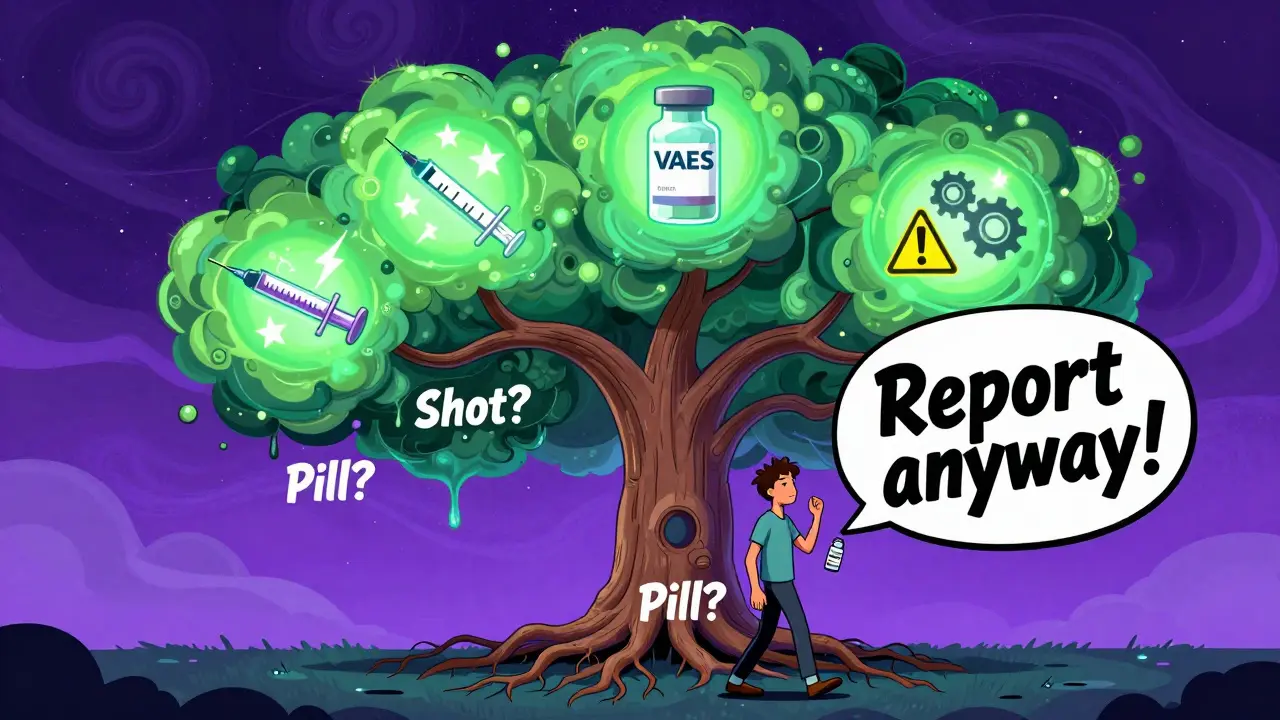
Still confused? Here’s a quick decision tree:
- Did you get a shot? → Go to VAERS.
- Did you take a pill, use a patch, or wear a device? → Go to MedWatch.
- Was it a supplement like turmeric or collagen? → MedWatch.
- Was it a COVID, flu, or HPV shot? → VAERS.
- Still unsure? Call 1-800-FDA-1088. They’ll tell you which form to use.
Don’t overthink it. Just report. Even if you’re wrong, the system will redirect it. But if you don’t report at all? That’s the only guaranteed way your voice won’t be heard.
Can I report a side effect if I’m not a doctor?
Yes. Both VAERS and MedWatch welcome reports from patients, parents, and caregivers. You don’t need medical training. You just need to describe what happened, when, and what product was involved. Your report is just as valuable as a doctor’s.
Do I need proof that the product caused the reaction?
No. Neither system requires proof of causation. The whole point is to catch unusual patterns early-even if the connection isn’t clear yet. If you suspect a link, report it. Experts will sort out whether it’s real later.
Can I report a reaction that happened years ago?
Yes, but it’s less useful. Reporting soon after the event gives better data-especially for timing and symptoms. Still, if you remember a serious reaction from years ago, report it. It could help identify long-term risks.
What if I report to the wrong system?
It’s not a disaster. If you send a vaccine report to MedWatch, it will eventually be forwarded to VAERS. But it might take weeks. To speed things up, always report to the correct system. If unsure, call 1-800-FDA-1088.
Are these systems safe and private?
Yes. Both VAERS and MedWatch protect your personal information. Names, addresses, and contact details are kept confidential. Reports are anonymized before being shared publicly. Your privacy is built into the system.
Can I report a side effect from a vaccine I got outside the U.S.?
Yes. VAERS accepts reports from any vaccine administered anywhere in the world, as long as it’s licensed in the U.S. or was given to a U.S. resident. International reports are valuable for global safety monitoring.
Final Thought
These systems aren’t perfect. They’re slow. They’re messy. They don’t give you answers right away. But they’re the best tool we have to catch problems before they become epidemics.
Every report you file adds to a safety net that protects millions. You might never know if your report made a difference. But someone else might-because you spoke up when no one else did.
Phil Hillson
January 20, 2026 AT 06:10Jacob Hill
January 21, 2026 AT 21:04Astha Jain
January 23, 2026 AT 05:40Malikah Rajap
January 24, 2026 AT 04:28sujit paul
January 26, 2026 AT 03:52Lydia H.
January 26, 2026 AT 21:23Josh Kenna
January 28, 2026 AT 04:29Erwin Kodiat
January 30, 2026 AT 00:08Valerie DeLoach
January 30, 2026 AT 08:24Christi Steinbeck
January 31, 2026 AT 00:42Lewis Yeaple
January 31, 2026 AT 01:47Jackson Doughart
February 1, 2026 AT 05:06