Menopause Hormone Therapy Risk Calculator
This tool estimates your personalized risk of serious health outcomes from hormone therapy based on your age and time since menopause. Calculations are based on data from the Women's Health Initiative study.
Your Risk Profile
Heart Attack Risk
Stroke Risk
Breast Cancer Risk
Blood Clot Risk
Alternative Options
Good option if you have blood clot risk
Good for those with estrogen contraindications
Local treatment with no systemic effects
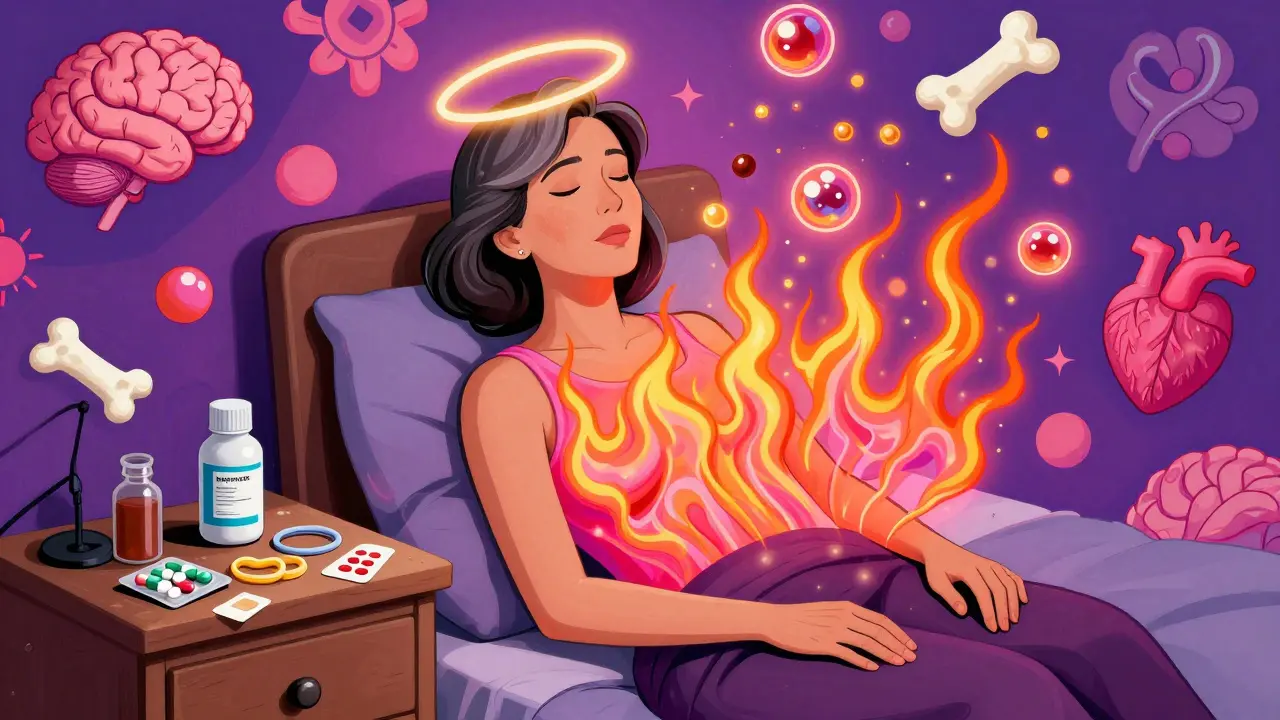
Menopause isn’t just about hot flashes and sleepless nights. For many women, it’s when the body’s relationship with medication changes-sometimes dramatically. What worked before might now carry new risks. What felt like a simple fix could trigger unexpected side effects. Understanding how hormone-related medications behave during this phase isn’t optional-it’s essential.
What Hormone Therapy Actually Does
Hormone replacement therapy (HRT) replaces estrogen and sometimes progesterone that your body stops making after menopause. These hormones don’t just control periods-they affect your brain, bones, heart, skin, and even your bladder. When they drop, symptoms like hot flashes, vaginal dryness, mood swings, and bone thinning show up. HRT helps by bringing those levels back up, but not the same way your body used to. That’s where side effects come in.
There are two main types: estrogen-only therapy for women who’ve had a hysterectomy, and combination therapy (estrogen + progestin) for those with a uterus. Why the difference? Estrogen alone can cause the lining of the uterus to thicken, raising cancer risk. Progestin keeps that lining in check. The form matters too. Pills, patches, gels, sprays, and vaginal rings all deliver hormones differently. A patch avoids the liver on the way in, which lowers blood clot risk compared to swallowing a pill. That’s why more women are switching to patches-usage has grown 22% since 2018.
The Real Risks: Numbers You Can’t Ignore
The fear around HRT started with the Women’s Health Initiative study in 2002. It showed clear links between combination HRT and serious problems: a 29% higher risk of heart attack, a 41% higher chance of stroke, and a 26% increase in breast cancer after five years. Those numbers sound scary, but context changes everything.
For a healthy woman in her early 50s-within 10 years of menopause onset-the absolute risk is small. Out of 10,000 women, estrogen-progestin therapy might raise breast cancer cases from 30 to 38 per year. Stroke risk goes from 21 to 29 cases. That’s a real increase, but it’s not a guarantee. The same study found that for women starting HRT after 60, or more than 10 years past menopause, the risks jump significantly. The heart and brain are more vulnerable as we age. Timing matters more than you think.
Other risks include blood clots-two to four times more likely with oral HRT. Gallbladder disease increases by 77%. Dementia risk doubles for women 65 and older. And yes, vaginal bleeding happens in 30-50% of users during the first six months. It’s usually not cancer. It’s your body adjusting. But if it continues past that window, you need to check in with your doctor.
Common Side Effects and What to Do About Them
Not every woman gets every side effect. But many get a few. Here’s what shows up most often:
- Breast tenderness (20-40% of users): Feels like swelling or soreness. Usually fades after a few weeks. If it doesn’t, talk about lowering your dose.
- Headaches (10-25%): Often tied to estrogen levels. Switching from pills to patches can cut these by half.
- Bloating and fluid retention (15-25%): You might feel puffy, especially in your hands or feet. This is common with oral estrogen. Transdermal forms like gels or patches often help.
- Mood changes (20-25%): Irritability, sadness, anxiety. Hormones affect serotonin. If this hits hard, your doctor might switch you to a different type or add a low-dose SSRI.
- Leg cramps (10-15%): Could be from fluid shifts or magnesium loss. A simple supplement might help.
- Hair thinning (5-8%): Sometimes linked to hormonal shifts, not just aging. Rarely permanent.
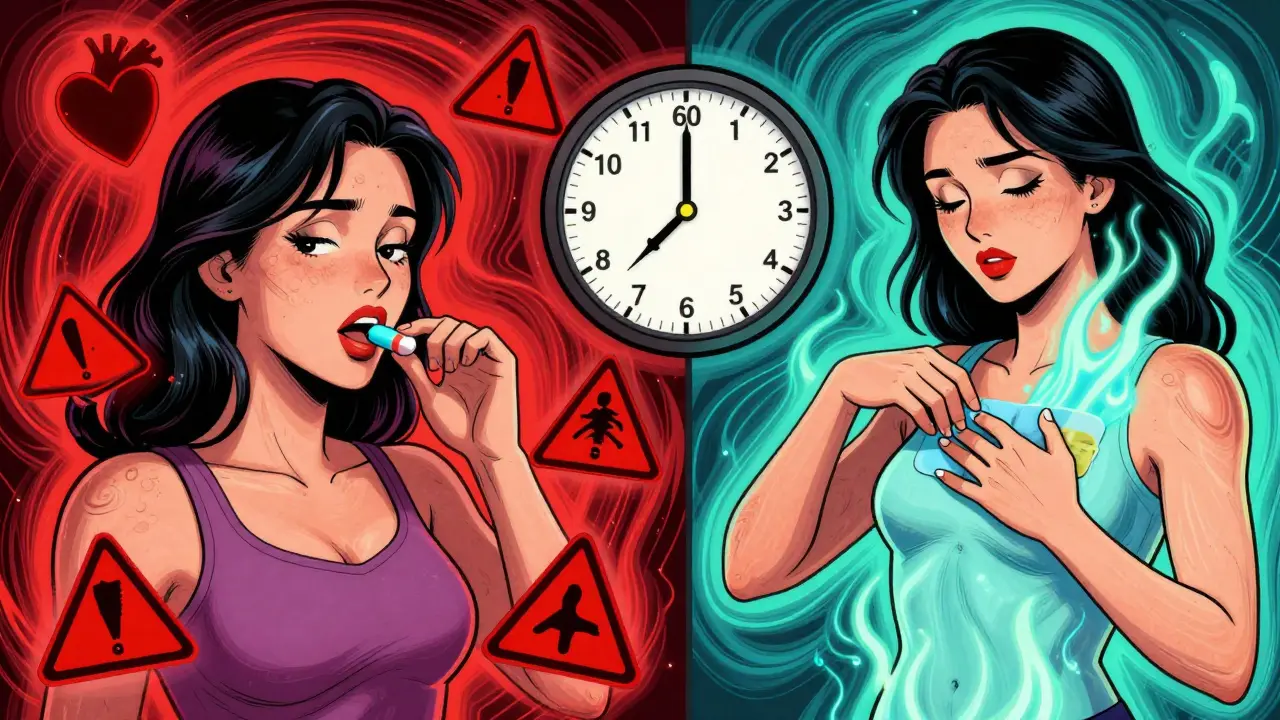
Here’s what most women don’t realize: side effects often improve after three months. That’s why doctors tell you to stick with it. If you quit too soon, you’ll never know if your body would’ve adapted. But if something feels wrong-severe pain, sudden swelling, chest tightness, vision changes-don’t wait. Call your doctor.
Alternatives That Actually Work
You don’t have to choose between suffering and hormones. There are other options, and many are backed by solid data.
- SSRIs and SNRIs: Medications like escitalopram or venlafaxine reduce hot flashes by 50-60% in 60% of users. No hormones. No breast cancer risk.
- Gabapentin: Originally for seizures, it cuts hot flashes by 45%. Great for women who can’t take hormones due to blood clot risks.
- Clonidine: A blood pressure drug that reduces hot flashes by 46%. Can cause dry mouth or dizziness, but useful for some.
- Vaginal DHEA (Intrarosa): A tiny insert that helps with painful sex. It stays local-doesn’t enter your bloodstream. Works for 70% of users.
- Vaginal moisturizers and lubricants: Used by 45% of menopausal women. Over-the-counter, safe, and effective for dryness. Look for products with hyaluronic acid or hyaluronan.
- Fezolinetant: A new drug approved in 2024, it blocks brain signals that trigger hot flashes. In trials, it cut moderate-to-severe hot flashes by over 50%. No hormones. No breast cancer risk.
Herbal supplements? Black cohosh, red clover, soy isoflavones-studies show mixed results. Some women swear by them. Others feel nothing. And because they’re not regulated like drugs, quality and safety vary. Stick with what’s proven.
How to Find Your Best Fit
There’s no one-size-fits-all. Your best option depends on your history, symptoms, and goals.
- Start low, go slow. Use the lowest dose that helps. Most women do fine on 0.3 mg of estradiol daily or a 25 mcg patch.
- Choose delivery method wisely. If you have migraines, liver issues, or clotting risks, avoid pills. Patches, gels, or sprays are safer.
- Timing is everything. Starting before 60 or within 10 years of menopause lowers heart risks. Waiting until 70? Probably not worth it.
- Review every year. Don’t just refill your prescription. Ask: Are symptoms better? Any new side effects? Do I still need this?
- Track your triggers. Hot flashes often spike with caffeine, alcohol, spicy food, or stress. Cutting back helps even with HRT.
And if you’re unsure? Talk to a menopause specialist. Not every OB-GYN is trained in this. Look for someone certified by The North American Menopause Society. They know the latest data and can help you weigh options without pushing one solution.
What to Do If You Miss a Dose
It happens. You forget. You’re traveling. You’re sick.
For pills: Take the missed dose as soon as you remember. If it’s almost time for the next one, skip it. Never double up. For patches: Apply a new one right away if you forget for less than 24 hours. If it’s been longer, skip the missed patch and resume your schedule. Don’t wear two at once.
For vaginal rings: If it falls out for less than three hours, rinse and reinsert. If it’s been out longer, use backup protection (like condoms) for seven days. If you’re unsure, call your doctor.
Drug interactions matter too. Duavee, for example, can’t be taken with other estrogen or progestin products. About 12% of adverse events linked to HRT come from mixing medications. Always tell your pharmacist you’re on hormone therapy.
Is It Worth It?
Let’s be honest: the headlines scared a lot of women off HRT. But for many, the trade-off is worth it. If hot flashes keep you awake every night, if vaginal dryness makes sex painful, if brain fog is stealing your focus at work-then HRT might be the best tool you’ve got.
It’s not for everyone. But for healthy women under 60, starting within 10 years of menopause, the benefits often outweigh the risks. The goal isn’t to live forever-it’s to live well. To sleep. To feel like yourself again. To not dread the next hot flash.
The key is personalization. Not blanket advice. Not fear. Not ignoring the science. Just clear, honest conversation-with your body, your history, and your doctor.
Can hormone therapy cause weight gain?
Hormone therapy doesn’t directly cause weight gain. But menopause does. As estrogen drops, your body tends to store more fat around the abdomen. Some women feel bloated on HRT due to fluid retention, which can feel like weight gain. The solution? Focus on movement, protein intake, and sleep-not stopping HRT. Most women maintain their weight fine with the right lifestyle.
How long should I stay on hormone therapy?
There’s no fixed timeline. Many women use HRT for 3-5 years to get through the worst symptoms. Others need it longer for bone or vaginal health. The key is yearly reviews. If your hot flashes are gone and your bones are stable, you might taper off. If symptoms return, you can restart at a lower dose. Long-term use (over 10 years) increases breast cancer risk slightly, so it’s only recommended if benefits clearly outweigh risks.
Is HRT safe if I have a family history of breast cancer?
It depends. If you carry a BRCA mutation or had a close relative with estrogen-receptor-positive breast cancer, HRT is usually not recommended. But if your family history is distant or involves non-hormone-sensitive cancers, your doctor might still consider low-dose, transdermal estrogen with careful monitoring. Genetic counseling and mammograms are essential before starting.
Can I use HRT if I’ve had a blood clot?
No. If you’ve had a deep vein thrombosis (DVT), pulmonary embolism, or stroke, oral HRT is unsafe. Even patches carry some risk. Your doctor will likely recommend non-hormonal options like SSRIs, gabapentin, or vaginal DHEA. Lifestyle changes-quitting smoking, staying active, managing blood pressure-are even more critical.
Do I need to take progesterone if I’ve had a hysterectomy?
No. If your uterus was removed, you don’t need progesterone. Estrogen-only therapy is safe and often preferred because it avoids the side effects of progestin-like bloating, mood swings, and breast tenderness. Always confirm with your surgeon or gynecologist that your uterus was fully removed before starting.
If you’re considering HRT, don’t rush. Don’t ignore it either. Talk to someone who understands the full picture. Your symptoms matter. Your safety matters. And you deserve a plan that fits your life-not someone else’s fear.
Lee M
December 31, 2025 AT 20:00Hormone therapy isn't medicine-it's a corporate hack disguised as science. The WHI study got twisted into fear, but the real story? Pharma wanted you hooked on pills because patches don't make as much money. They profit from your confusion. You think you're healing, but you're just feeding a system that doesn't care if you live well-only if you keep buying.
They'll tell you 'timing matters' like it's some sacred ritual. Nah. It's a loophole they created so they can say 'it's safe if you start before 60' while quietly burying the fact that long-term use still raises cancer risk. The numbers look small, but small risks multiplied by millions of women? That's not science. That's a business model.
And don't get me started on 'alternatives.' SSRIs for hot flashes? You're treating a symptom with a drug that numbs your soul. Gabapentin? A seizure med for menopause? That's like using a sledgehammer to hang a picture. They're not solutions-they're Band-Aids on a bullet wound.
The real answer? Stop listening to doctors who get paid by drug reps. Start listening to your body. Eat real food. Move daily. Sleep like your life depends on it. Because guess what? Your body didn't break. It evolved. And no pill can replace that wisdom.
They sell you a pill. I sell you truth. Choose wisely.
Kristen Russell
January 1, 2026 AT 15:48I started HRT at 52 and it literally saved my life. No more 3 a.m. panic sweats. No more avoiding intimacy because it hurt. I was a zombie before this. Now I sleep, laugh, and actually enjoy my mornings again.
Side effects? Yeah, I had breast tenderness for two weeks. Then it vanished. I switched to a patch. Done. No drama. No fear. Just relief.
To anyone scared: talk to a menopause specialist. Not your general OB. Find one. You’ll feel seen. And you deserve that.
Bryan Anderson
January 2, 2026 AT 17:01This is one of the most balanced, well-researched pieces on menopause I’ve read in years. Thank you for grounding the conversation in data rather than fear or hype.
I appreciate the emphasis on delivery methods-many patients don’t realize transdermal options significantly reduce clotting risk. The distinction between relative and absolute risk is also crucial. A 26% increase sounds alarming, but when you contextualize it with baseline rates, the picture changes dramatically.
I also think the point about yearly reviews is vital. Hormone therapy isn’t a one-time prescription-it’s a dynamic process that requires ongoing evaluation. Too many women stay on the same dose for a decade without reassessment, and that’s where things can go off track.
Finally, the inclusion of non-hormonal options like fezolinetant is encouraging. It signals a shift toward personalized, evidence-based care rather than one-size-fits-all solutions.
Well done.
Matthew Hekmatniaz
January 4, 2026 AT 04:23As someone who’s helped women across cultures navigate menopause-from rural Texas to Lagos-I’ve seen how fear and misinformation spread faster than facts.
In Nigeria, many women avoid HRT because they think it’s ‘Western medicine’ that ‘poisons the blood.’ In the U.S., women avoid it because they think it’ll give them cancer. Both are wrong.
The truth? Menopause is universal. The fear? It’s cultural. What we need isn’t more pills or more panic-it’s better access to trained specialists who can talk plainly, listen deeply, and tailor care without bias.
And yes, vaginal moisturizers? Life-changing. No stigma. No prescription. Just dignity.
Let’s stop making this a battle between ‘hormones vs. nature’ and start making it about what actually helps women live well.
Liam George
January 4, 2026 AT 15:48They told you HRT was dangerous in 2002, then they quietly reversed it in 2017. Why? Because the FDA and Big Pharma realized they’d scared off 80% of the market. So they rebranded the same drugs with new labels and called it ‘timing.’
But here’s what they won’t tell you: estrogen metabolizes into carcinogenic compounds. The liver processes pills into 16-alpha-hydroxyestrone-the bad one. Patches? Still get absorbed. Still metabolized. Still risk.
And fezolinetant? That’s just another SSRI with a fancy name. They’re not curing anything. They’re masking symptoms with neurochemical suppression. The real cause? Endocrine disruption from environmental estrogens-plastics, pesticides, glyphosate. You’re not supposed to know that.
Why aren’t we talking about detoxing the body? Why aren’t we regulating endocrine disruptors? Because it’s cheaper to sell you a patch than fix the water supply.
Wake up. This isn’t medicine. It’s manipulation dressed in white coats.
Richard Thomas
January 6, 2026 AT 08:21There’s a deeper philosophical layer here that most discussions miss. Menopause isn’t a medical condition-it’s a metaphysical threshold. The body, after decades of cyclical surrender to reproductive imperatives, suddenly detaches from that rhythm. The hormones don’t just decline-they retreat, like a tide pulling back from a shore that no longer needs its presence.
What we call ‘symptoms’ are not failures of biology but signals of transformation. The hot flashes? The body’s last protest against a system that once defined its purpose. The brain fog? The mind’s recalibration, shedding the hormonal noise that once drowned out inner stillness.
HRT, in this light, is not a cure-it’s a postponement. A technological pause button pressed on the natural unfolding of post-reproductive identity. And yet, in a society that equates vitality with youth, who can blame women for reaching for it?
The real question isn’t whether to take hormones, but whether we, as a culture, are ready to honor the woman who no longer needs to be fertile to be whole.
Maybe the greatest medicine isn’t estrogen or gabapentin-but the quiet, unapologetic space we create for her to simply be.
Paul Ong
January 7, 2026 AT 05:49Just took my first patch yesterday. No more waking up soaked. No more avoiding my kids because I’m embarrassed. I’m 54. This is my second chapter. I’m not fighting my body. I’m honoring it.
Low dose. Patch. One year review. Done.
Also started walking every morning. Best decision ever.
Stop overthinking. Start living.
Olukayode Oguntulu
January 9, 2026 AT 05:05How quaint. You Americans treat menopause like a pharmacological glitch to be optimized. In Lagos, women don’t ‘manage’ symptoms-they transcend them. We have elders who live with dignity past 80 without a single hormone pill. Their secret? Community. Ritual. Silence. Not a patch. Not a pill. Not a ‘specialist.’
You’ve turned the natural into a market segment. You’ve commodified aging into a product lineup: estrogen gel, vaginal inserts, fezolinetant capsules. How many VC-funded startups are chasing this? Five? Ten?
Meanwhile, the real solution-the village that holds space for the woman who’s no longer fertile-is buried under clinical guidelines and insurance codes.
Menopause isn’t broken. Your civilization is.