Liver Drug Clearance & Dosing Estimator
Hepatic Impairment Adjustment Tool
Estimated Findings:
Imagine taking a standard dose of a sedative, but instead of a gentle drift into sleep, you fall into a deep, unresponsive stupor. For most people, the liver acts like a high-efficiency filtration system, breaking down medications and clearing them from the body. But when that system breaks down due to chronic illness, the rules of pharmacology change. With over 22 million Americans dealing with chronic liver disease, understanding how liver disease drug metabolism shifts is not just a theoretical exercise-it is a critical safety requirement to prevent toxic drug accumulation.
Key Takeaways for Clinicians and Patients
- Liver impairment reduces the body's ability to clear drugs, often prolonging half-lives by 1.5 to 2.5 times.
- Low-extraction drugs (like lorazepam) are more prone to accumulation than high-extraction drugs.
- Portosystemic shunting can bypass the liver, increasing the amount of drug that hits the bloodstream directly.
- Dosing adjustments typically rely on the Child-Pugh-Turcotte scale rather than a single lab test.
- Cerebral sensitivity to opioids and sedatives increases by 30-50% in chronic liver disease.
How Liver Disease Actually Slows Down Drug Clearance
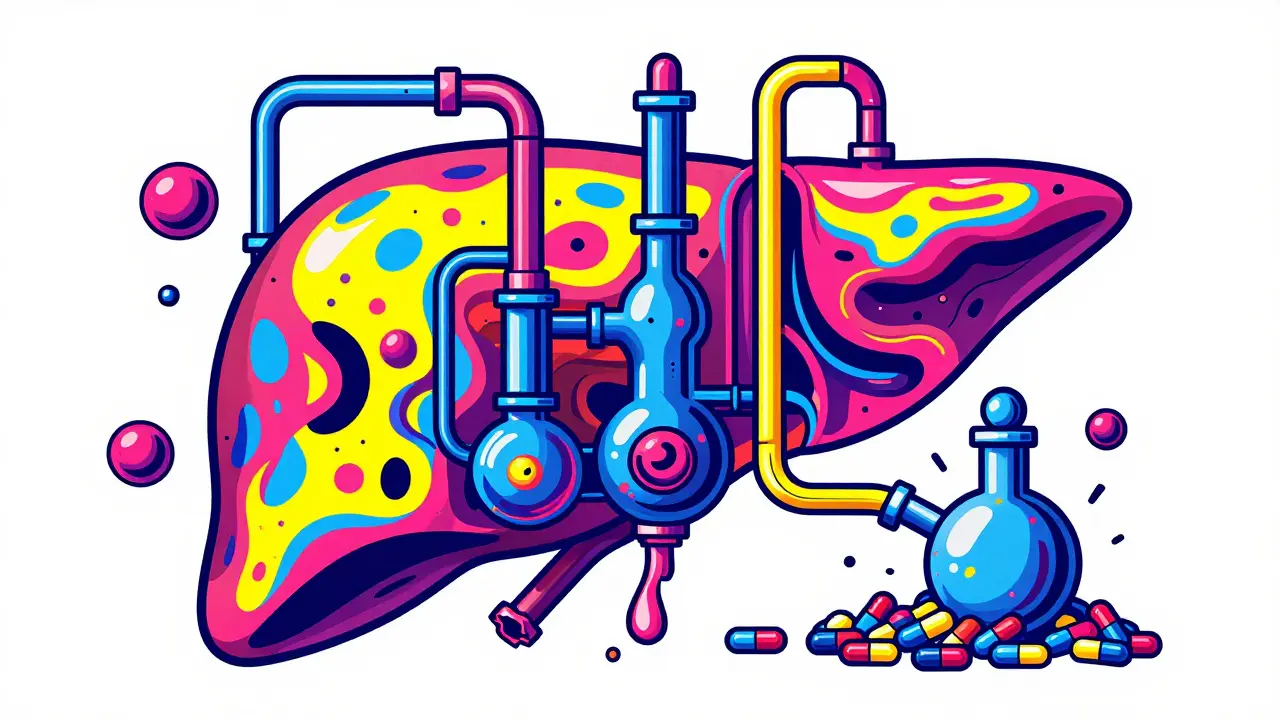
The liver isn't just one big filter; it's a complex chemical plant. When liver disease sets in, several things go wrong at once. First, there is a physical change. In cirrhosis, the liver's architecture scars, which creates Portosystemic Shunting. This is where blood literally takes a detour around the liver. If 20-40% of your blood is bypassing the liver, the "first-pass metabolism"-the process where the liver grabs a drug immediately after it's absorbed from the gut-doesn't happen. This means a much higher percentage of the drug enters the systemic circulation than intended.
Then there is the cellular level. The liver uses enzymes to chop up drugs into smaller, water-soluble pieces that the kidneys can flush out. In advanced cirrhosis, the expression of Cytochrome P450 enzymes drops significantly. For example, CYP2E1 activity can plunge by 40-60%, and CYP3A4-one of the most important enzymes for a huge variety of medications-often drops by 30-50%. When these enzymes are missing, the drug stays in your system longer, effectively increasing the dose every time you take another pill.
Finally, transport proteins like OATP1B1, which act as the "doors" letting drugs into liver cells, can see their function reduced by up to 70%. If the drug can't even get into the cell, the enzymes can't touch it, and the drug lingers in the blood.
The Extraction Ratio: Why Some Drugs Are Riskier
Not all drugs are processed the same way. Pharmacologists split them into categories based on their extraction ratio. This ratio tells us whether the drug's clearance depends more on how much blood reaches the liver or how fast the liver can process the drug.
| Category | Extraction Ratio | Primary Driver of Clearance | Examples | Effect of Liver Disease |
|---|---|---|---|---|
| High Extraction | > 0.7 | Liver Blood Flow | Fentanyl, Morphine | Clearance drops as blood flow decreases |
| Low Extraction | < 0.3 | Enzyme Capacity | Lorazepam, Diazepam | High risk of accumulation due to enzyme loss |
About 70% of common drugs are low-extraction. This is where the danger lies. Because their clearance is limited by metabolic capacity, any drop in enzyme activity leads to a direct and often linear increase in drug levels. For instance, while a high-extraction drug might be cleared faster if blood flow is okay, a low-extraction drug will accumulate regardless if the enzymes are gone.
Real-World Clinical Implications: From Opioids to Warfarin
This isn't just about numbers on a chart; it's about patient outcomes. One of the most dangerous areas is sedative use. People with chronic liver disease experience an increased cerebral sensitivity to opioids and benzodiazepines. When you combine this heightened brain sensitivity with a 30-50% reduction in the liver's ability to clear the drug, a standard dose can easily trigger Hepatic Encephalopathy-a state of mental confusion or unconsciousness caused by toxin buildup in the brain.
Take Warfarin, the common blood thinner. In patients with cirrhosis, the clearance of this drug can drop by 30-50%. If a doctor doesn't reduce the dose by 25-40%, the patient's INR levels can skyrocket, leading to dangerous internal bleeding. This shows why a "one size fits all" dose is a gamble in special populations.
Interestingly, not every drug needs a tweak. If a drug is excreted almost entirely by the kidneys-like sugammadex, which is 96% renally excreted-you generally don't need to lower the dose for liver issues. However, the body's overall response can still be sluggish; research shows that even when the drug is cleared, the recovery time from neuromuscular blockade can be 40% longer in liver transplant patients.
How to Systematically Adjust Dosing
You can't just look at a single ALT or AST lab result to decide a dose. Those tests tell you if the liver is currently inflamed, not how well it's actually functioning. Instead, professionals use the Child-Pugh-Turcotte Classification. This system looks at bilirubin, albumin, and INR to grade the severity of impairment from Class A (mild) to Class C (severe).
For drugs with high hepatic extraction, the general rules of thumb are:
- Child-Pugh Class B: Reduce dose by 25-50%.
- Child-Pugh Class C: Reduce dose by 50-75%.
Some specialists also use the MELD Score (Model for End-Stage Liver Disease). A useful heuristic here is that for every 5-point jump in a MELD score above 10, drug clearance typically drops by about 15%. This allows for a more granular adjustment than the broad categories of the Child-Pugh scale.
The Future: Precision Dosing and PBPK Modeling
We are moving away from "guess and check" dosing. The new gold standard is Physiologically Based Pharmacokinetic (PBPK) Modeling. This is a computer-based approach that simulates how a drug moves through a specific body. Instead of using a population average, PBPK models can input a patient's specific liver blood flow (which may have dropped from 1.5 L/min to 0.8 L/min) and their estimated percentage of portosystemic shunting.
These models can predict drug exposure with 85-90% accuracy. In the coming years, we expect most new drug labels to move away from "use caution" and instead provide model-based dosing recommendations. We are even starting to see the impact of early-stage fatty liver (MASLD), where CYP3A4 activity can drop by 15-25% before any scarring is even visible on an ultrasound. This means we might need to start adjusting doses much earlier in the disease progression than we ever thought.
Do all drugs need a dose reduction in liver disease?
No. Dose adjustments are generally not required for drugs that are excreted entirely via the kidneys (renal route) or drugs that are minimally metabolized by the liver (less than 20%) and have a wide therapeutic window.
Why is the Child-Pugh score preferred over standard liver enzymes?
Standard enzymes (like ALT and AST) indicate liver cell damage or inflammation but not functional capacity. The Child-Pugh score uses markers of actual liver function-like albumin production and blood clotting (INR)-to better predict how the liver will handle drug metabolism.
What is the danger of using benzodiazepines in cirrhotic patients?
Benzodiazepines can accumulate due to reduced enzyme activity, and the brain becomes more sensitive to them. This combination can precipitate hepatic encephalopathy, causing severe confusion or coma. Drugs with active metabolites, like diazepam, typically require more aggressive dose reductions (50-70%) than those without.
How does "shunting" affect oral medications?
Portosystemic shunting allows blood to bypass the liver entirely. This reduces "first-pass metabolism," meaning a higher concentration of the drug reaches the systemic bloodstream, which can lead to unexpected toxicity even if the dose seems standard.
Can fatty liver affect drug metabolism even without cirrhosis?
Yes. Recent research into MASLD (metabolic dysfunction-associated steatotic liver disease) suggests that early-stage fatty liver can reduce the activity of the CYP3A4 enzyme by 15-25%, potentially altering the clearance of many common medications before fibrosis is evident.
Next Steps and Troubleshooting
If you are managing a patient with known hepatic impairment, start by calculating their Child-Pugh and MELD scores. For any drug with a narrow therapeutic index (where a small change in dose can be toxic), prioritize therapeutic drug monitoring-actually measuring the blood levels of the drug-rather than relying on guidelines alone.
Be particularly vigilant during "shock states" or severe infections. These conditions can cause an additional 25-35% drop in both hepatic and renal clearance due to poor organ perfusion, meaning a dose that was safe last week might suddenly become toxic today.