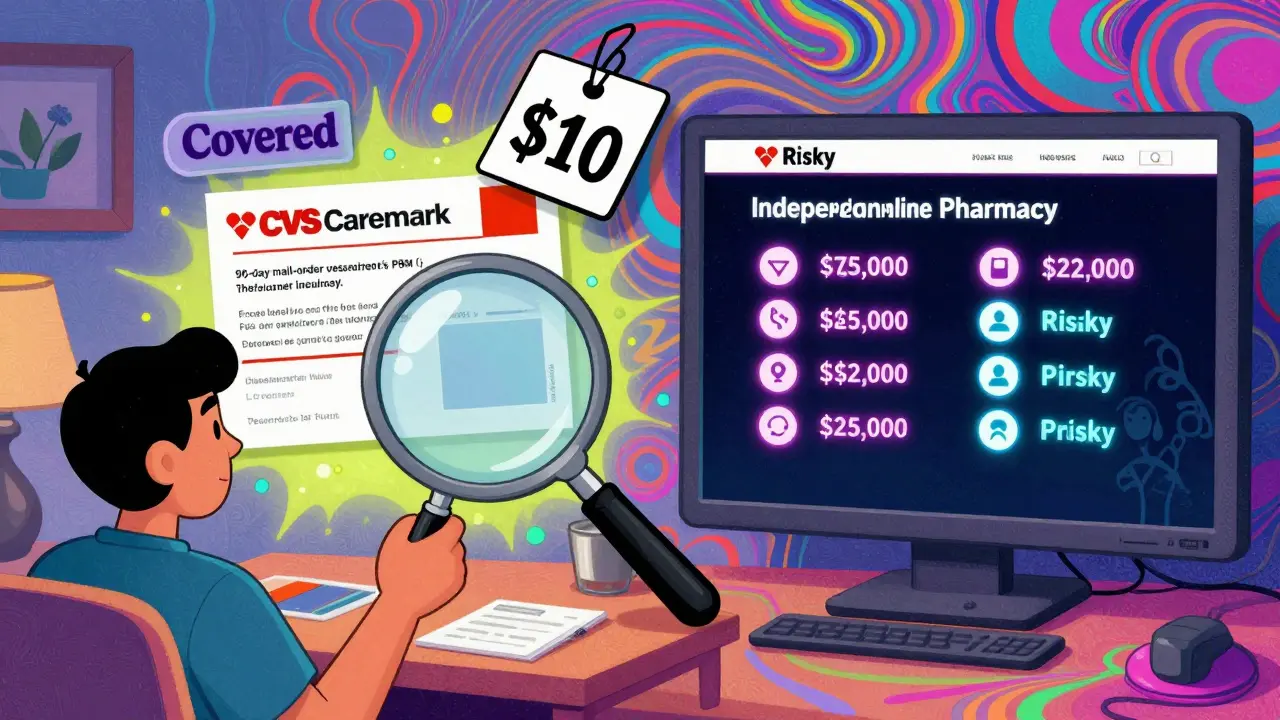
When you buy generic medications from an online pharmacy, your insurance might cover it - or it might not. It’s not as simple as just entering your insurance card details at checkout. Many people assume that if a pharmacy is online and sells generics, insurance will work the same way as at your local drugstore. That’s not true. The difference between a mail-order pharmacy run by your insurer and a random website selling pills can cost you hundreds a year - or even put your health at risk.
How Insurance Actually Covers Online Pharmacy Generics
Your insurance doesn’t treat all online pharmacies the same. There are two main types: mail-order pharmacies that are part of your plan’s network, and independent online pharmacies that operate like Amazon or eBay. Only the first kind is guaranteed to work with your insurance.
Mail-order pharmacies are run by your Pharmacy Benefit Manager (PBM) - companies like CVS Caremark, Express Scripts, or Optum Rx. These are the same organizations your insurer hires to manage your drug benefits. When you use them, your copay is locked in by your plan’s formulary. For example, if your plan charges $5 for a 30-day generic supply at a retail pharmacy, you’ll likely pay $10 for a 90-day supply through mail order. That’s not a mistake - it’s a discount. You’re paying less per pill because you’re buying in bulk.
Independent online pharmacies? They’re different. Some accept insurance. Many don’t. Others might say they do, but only if you pay upfront and file for reimbursement yourself. That means you pay full price, then wait weeks for your insurer to decide if they’ll refund part of it - if they even recognize the pharmacy as in-network. If they don’t, you’re out the money.
Formularies and Tiers: The Hidden Rules
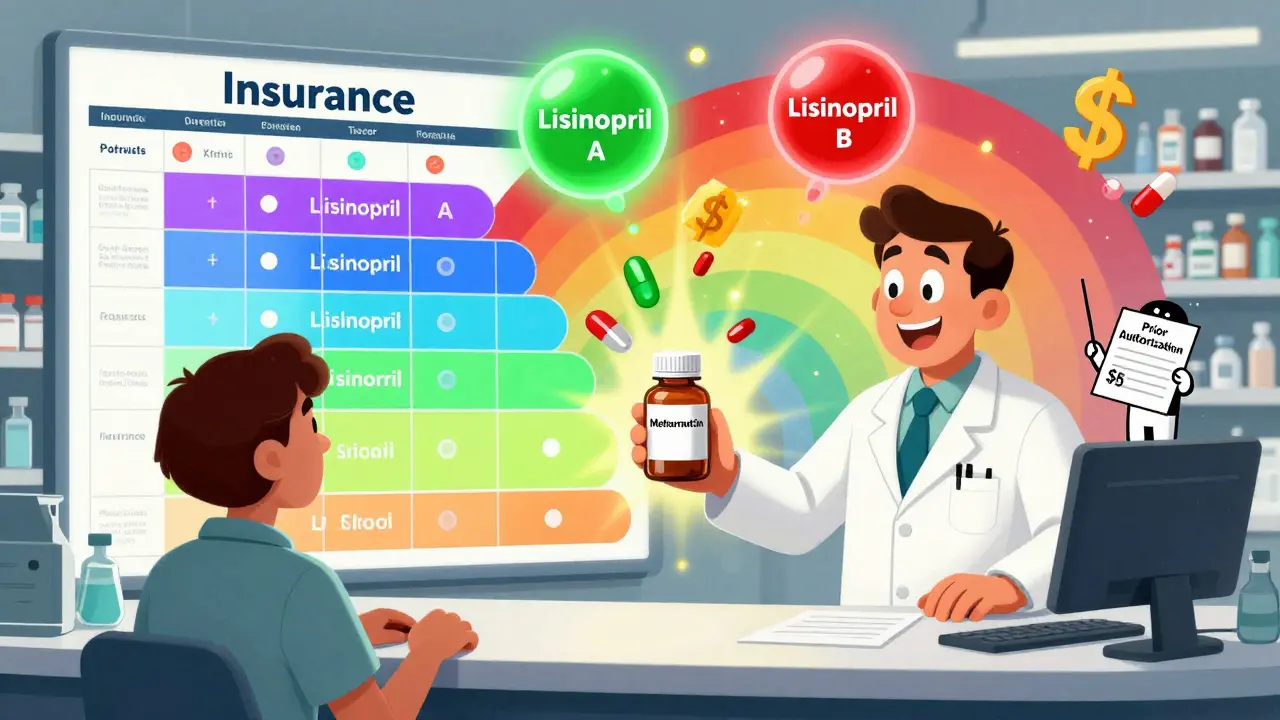
Every insurance plan has a drug list called a formulary. It’s divided into tiers. Generics are almost always Tier 1 - the cheapest. But not all generics are treated equally. Your plan might cover lisinopril (a blood pressure drug) at $5, but require $15 for a different generic version of the same medicine. Why? Because the PBM has a contract with one manufacturer over another.
Some plans even have a “generic-only” tier. If your doctor prescribes a brand-name drug for a condition where a generic exists, your insurance will deny coverage unless your doctor files a prior authorization. This is called non-medical switching. It’s legal. It’s common. And it’s happening more every year. In 2023, 68% of large employers required generic substitution when available, according to the Kaiser Family Foundation. That means if your doctor says you need the brand, your insurer might say no - unless you prove it’s medically necessary.
Mail-Order vs. Retail vs. Independent Online
Let’s compare three ways to get your generics:
- Mail-order (through your insurer): $10 for 90 days of metformin. Delivery takes 5-7 days. You need a 90-day prescription from your doctor. Best for stable, long-term meds.
- Retail pharmacy (like CVS or Walmart): $5 for 30 days. Same insurance copay. Instant pickup. Good for new prescriptions or when you need it now.
- Independent online pharmacy (like a random website): $8 for 90 days - but only if you pay out-of-pocket. Insurance won’t cover it. No guarantee the pills are real. Risky.
Here’s the kicker: Walmart and Costco often sell 90-day generic supplies for $10 - no insurance needed. If you have a high-deductible plan, paying cash might be cheaper than your $15 copay. Always check GoodRx or SingleCare before using insurance.
Amazon RxPass and Other New Models
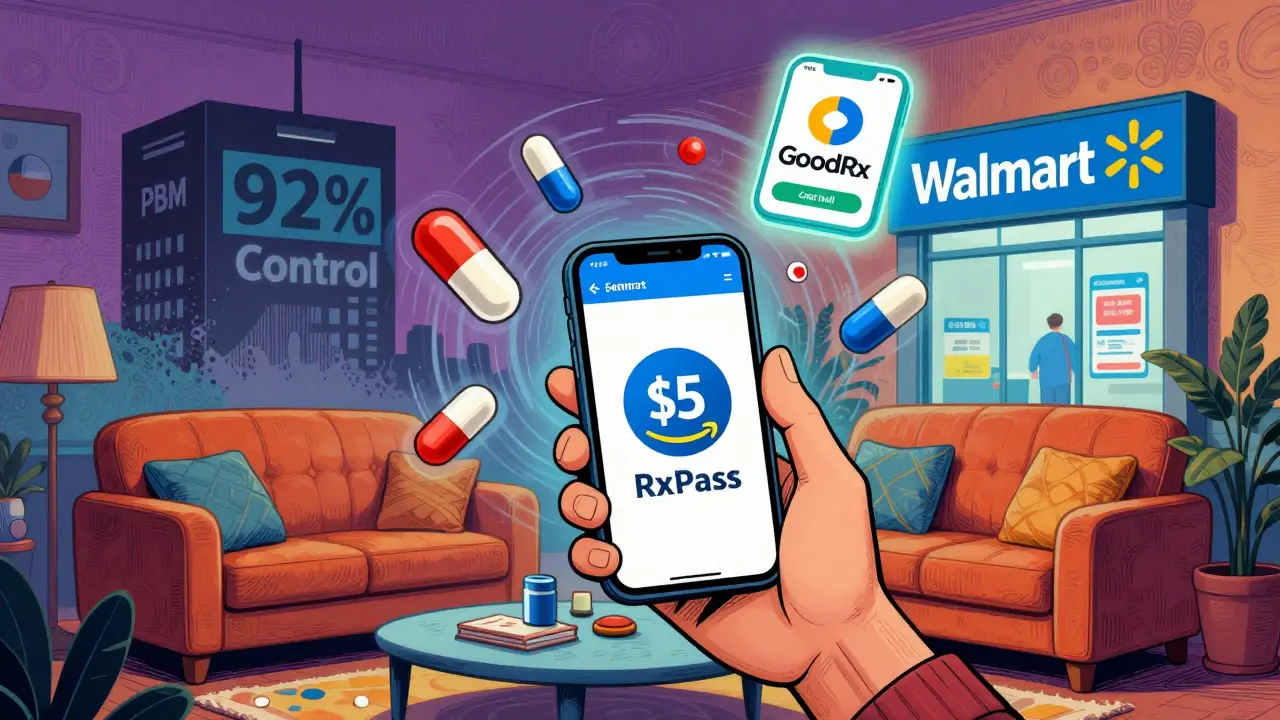
Amazon Pharmacy’s RxPass is changing the game. For $5 a month, Prime members get unlimited access to over 100 common generic medications - no copays, no deductibles, no insurance required. It covers drugs like atorvastatin, metformin, levothyroxine, and sertraline. It’s not insurance. It’s a subscription. And it’s growing fast.
But it’s not perfect. It doesn’t cover specialty meds, controlled substances, or less common generics. If you take a drug that’s not on the list, you’re back to square one. Still, for people on multiple generics, it’s a bargain. One user on Trustpilot said, “I pay $5/month for my blood pressure, cholesterol, and thyroid meds. My old insurance copays were $45 a month.”
Other companies like Honeybee Health are testing direct-to-consumer pricing too. But they’re still tiny. PBMs still control 92% of U.S. prescription drug plans.
What to Do Before You Order
Don’t just click “buy now.” Follow these steps:
- Check your plan’s formulary. Use your insurer’s online tool - Aetna, Blue Cross, or whatever you have. Search by the generic name. See what tier it’s on and what your copay is.
- Confirm if your plan offers mail-order. If yes, call your doctor and ask for a 90-day prescription. Some require prior authorization - give them time.
- If you’re looking at an independent online pharmacy, call them. Ask: “Do you accept my insurance plan? What’s your network?” Don’t trust their website. Ask for the pharmacy license number and verify it with your state board.
- Compare prices. Use GoodRx. Compare the cash price at Walmart, your insurance copay, and the online pharmacy’s price. Sometimes cash wins.
- If your insurer switches your brand to a generic without telling you, call your doctor. You can request a formulary exception if it causes side effects.
Real Stories: Savings and Surprises
One Reddit user in Ohio said: “I pay $10 for 90 days of metformin through Express Scripts. My local CVS charges $15 with the same insurance. I save $20 every three months.”
Another user in Texas shared: “My insurance switched me from Copaxone to a generic without warning. I had seizures. I had to go to the ER. They didn’t tell me the generic was different. It took three months to get my old drug back.”
And a Medicare beneficiary in Florida: “I used to pay $35 a month for insulin. Now, thanks to the Inflation Reduction Act, it’s $35 for the whole year. My insurance didn’t change - the law did.”
What’s Changing in 2026
By 2025, 45% of generic maintenance meds will be delivered by mail or home delivery, up from 32% in 2022. More insurers are pushing mail-order to cut costs. More states are capping copays for generics - 28 states already have laws limiting out-of-pocket costs to $10 or less.
Medicare’s new drug price negotiation program is starting to affect commercial plans. If Medicare negotiates a lower price for a drug, your private insurer might follow. That could bring down prices across the board.
But the biggest shift? Consumers are learning to bypass insurance altogether. More people are using cash-price apps, subscription models, and discount cards. Insurance isn’t dead - but it’s no longer the only way to save.
When to Call Your Insurance
If you’re confused, call your plan’s pharmacy help line. Most have 24/7 nurse lines. For example, MHBP members can call 1-800-556-1555. Ask:
- Is this generic covered under my plan?
- What’s my exact copay for mail-order vs. retail?
- Is there a preferred generic version?
- Can I get an exception if the generic causes side effects?
They’re paid to answer these questions. Use them.
Bottom Line
Insurance coverage for online pharmacy generics isn’t magic. It’s rules, contracts, and hidden tiers. Mail-order through your insurer? Usually the cheapest. Independent online pharmacy? Risky unless you verify everything. Cash prices at Walmart? Often better than your copay. And subscription services like Amazon RxPass? A game-changer if your meds are on the list.
Your best move? Know your plan. Check your formulary. Compare prices. Don’t assume. And never order from a site you can’t verify. Your health - and your wallet - depend on it.
Do all online pharmacies accept insurance?
No. Only mail-order pharmacies tied to your insurer’s Pharmacy Benefit Manager (PBM) - like Express Scripts or CVS Caremark - automatically accept your insurance. Independent online pharmacies may or may not accept insurance. Many require you to pay upfront and file for reimbursement, which can take weeks and often fails if the pharmacy isn’t in-network.
Is it cheaper to use insurance or pay cash for generics?
It depends. For people with high-deductible plans, paying cash at Walmart or Costco can be cheaper than a $15 copay. A 90-day supply of metformin costs $10 cash at Walmart - less than many insurance copays. Always check GoodRx or SingleCare for cash prices before using insurance.
What is non-medical switching?
Non-medical switching happens when your insurance forces you to switch from a brand-name drug to a generic - even if your doctor says you should stay on the brand. It’s done to save money, not because it’s medically better. If the switch causes side effects, you can request a formulary exception with a letter from your doctor.
Can I use Amazon RxPass instead of insurance?
Yes - if you’re a Prime member and your medications are on the RxPass list (over 100 common generics). For $5 a month, you get unlimited refills without copays or deductibles. But it doesn’t cover specialty drugs, controlled substances, or rare generics. It’s a supplement, not a replacement, for insurance.
How do I know if an online pharmacy is safe?
Look for the VIPPS seal (Verified Internet Pharmacy Practice Sites) on the website. Check the pharmacy’s license number with your state’s board of pharmacy. Never buy from sites that don’t require a prescription or offer drugs at prices that seem too good to be true. If you can’t verify who’s selling it, don’t buy it.
Why does my insurance cover one generic but not another for the same drug?
Your insurer’s Pharmacy Benefit Manager (PBM) has contracts with specific drug manufacturers. They choose which generic versions to cover based on price deals, not quality. Two different generics for the same medicine might have identical ingredients, but only one is on your plan’s formulary. Ask your pharmacist which version your plan prefers.
Juan Reibelo
January 24, 2026 AT 19:37Wow. This is the most comprehensive guide I’ve ever read on insurance and online generics. I’ve been burned before-paid $80 for a 90-day supply of metformin, only to find out later my PBM had a $10 copay. I wish I’d known this six months ago.
Mail-order isn’t just convenient-it’s a financial lifeline if you’re on multiple meds. And yes, Walmart’s $10 cash price? Still king.
Marlon Mentolaroc
January 24, 2026 AT 21:44Let’s be real-PBMs are the real villains here. They don’t care about your health, only profit margins. They’ll switch you to a generic that’s chemically identical but ‘less preferred’ because the manufacturer gave them a better kickback. It’s not healthcare-it’s corporate arbitrage.
And don’t get me started on ‘non-medical switching.’ That’s just insurance companies playing doctor without a license.
Gina Beard
January 24, 2026 AT 23:54Insurance isn’t protection. It’s a maze designed to confuse you into paying more.
And yet, we keep playing the game.
Don Foster
January 25, 2026 AT 18:20Most people don’t even know what a formulary is and yet they expect insurance to magically work for them. You think your plan covers everything? Nah. You think Amazon RxPass is a scam? It’s the only sane option for anyone with a 90-day script. And yes, I’ve checked every single drug on their list-every one’s FDA-approved. Stop being lazy and do your homework.
siva lingam
January 25, 2026 AT 23:23So basically... pay cash or suffer. Got it. Thanks for the 2000-word essay on what everyone already knows.
Shelby Marcel
January 27, 2026 AT 05:04wait so if i use goodrx and its cheaper than my copay… i just pay cash?? no insurance at all??
i think i just had a revelation
blackbelt security
January 27, 2026 AT 16:47You’ve got the power here. Not the insurance company. Not the PBM. YOU. Know your formulary. Compare prices. Use cash. Call your pharmacist. This isn’t complicated. It’s just inconvenient. And inconvenience is the price of taking control.
Josh McEvoy
January 27, 2026 AT 23:01my insurance switched me to a generic and i had a panic attack for 3 days 😭
turns out it was the filler in the pill not the active ingredient
now i only buy from CVS Caremark or pay cash. no more risks.
also amazon rxpass is my new best friend 🙏💊
Sawyer Vitela
January 28, 2026 AT 21:57Amazon RxPass isn’t a game-changer. It’s a band-aid. The real issue is PBMs controlling 92% of the market. That’s monopoly-level control. And it’s legal because Congress lets them.
Shanta Blank
January 29, 2026 AT 12:18They’re not selling pills-they’re selling psychological warfare. One day you’re stable on your brand, next day you’re sweating through a seizure because some bean counter decided lisinopril A is cheaper than lisinopril B. And you’re supposed to be grateful? Nah. I’m done playing nice.
Chloe Hadland
January 30, 2026 AT 20:37thank you for writing this. i’ve been terrified to switch meds for years. knowing there’s a process to fight back feels like a weight lifted.
also-walmart’s $10 metformin? i’m switching tomorrow.
Dolores Rider
February 1, 2026 AT 19:42what if the pharmacy is fake?? what if the pills are laced?? what if the 'verified' seal is fake?? what if the feds shut it down and i get arrested for buying from a rogue site??
also i think my insurance is tracking my searches. i keep getting ads for 'affordable generics' from sites that don't even exist. i'm not safe anywhere.
Vatsal Patel
February 3, 2026 AT 15:07You think this is about money? It’s about control. The system wants you dependent. Not because it’s efficient. But because dependence is profitable. You pay for the illusion of care. Meanwhile, the real medicine is free-it’s called knowledge.
And knowledge? It’s the only thing they can’t take from you.
Himanshu Singh
February 5, 2026 AT 14:11Hey, if you're on a high-deductible plan, cash is your secret weapon. I pay $12 for 90 days of sertraline at Costco. My copay was $35. I used to feel guilty for not using insurance. Now I feel smart. You don't need a PBM to be healthy. You just need to look.
And if you're scared of online pharmacies? Stick with mail-order or cash. But don't let fear stop you from saving. You're worth it.