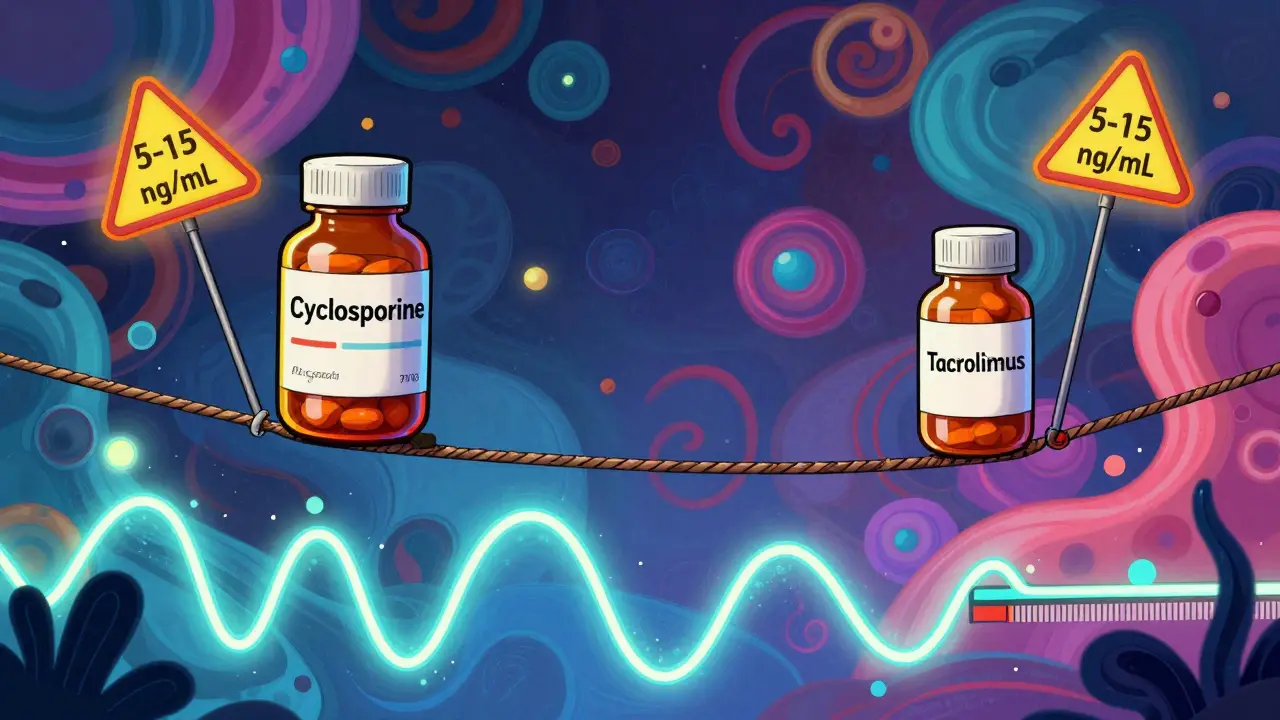
When you’ve had a kidney, liver, or heart transplant, your life becomes a tightrope walk between staying alive and avoiding rejection. The drugs that keep your immune system from attacking your new organ aren’t just medicine-they’re lifelines. Two of those lifelines are cyclosporine and tacrolimus. Both are calcineurin inhibitors. Both work in similar ways. But when it comes to generics, things get messy-fast.
Why These Two Drugs Are Different, Even Though They Do the Same Thing
Cyclosporine and tacrolimus both block the same immune signal: interleukin-2. That’s the chemical your T-cells use to sound the alarm and start attacking foreign tissue. But how they get there is completely different. Cyclosporine is a big molecule-1,203 grams per mole. It’s sticky, slow to absorb, and its levels swing wildly depending on what you eat, what time you take it, or even the brand you’re on. Back in the 90s, the original version, Sandimmune, was so unpredictable that doctors had to check blood levels every few days. The newer microemulsion version, Neoral, helped-but not enough. Tacrolimus? Tiny by comparison. Just 804 g/mol. It slips into cells easier, works at 20 to 100 times lower doses, and has more consistent absorption. A typical daily dose? Around 5 mg twice a day. For cyclosporine? You’re looking at 150 mg twice a day. That’s not just a number difference-it’s a clinical one. Studies from the early 2000s showed patients on tacrolimus had half the rejection rates in the first six months after transplant compared to those on cyclosporine. Two years later, their kidney function was noticeably better. That’s why today, over 85% of new transplant patients in the U.S. start on tacrolimus. Cyclosporine? Mostly used now when tacrolimus causes too much diabetes or nerve problems.The Generic Problem: It’s Not Just About Price
The big selling point of generics is cost. Brand-name Prograf (tacrolimus) used to cost $1,200 to $1,500 a month. Generic versions? $300 to $500. Neoral (cyclosporine) dropped from $800 to $150-$300. That’s life-changing for people on Medicare or without good insurance. But here’s the catch: these aren’t aspirin. These are narrow therapeutic index (NTI) drugs. That means the difference between a dose that works and one that kills you is tiny. For tacrolimus, the safe range is 5-15 ng/mL. Go below 5? Your body might start rejecting the organ. Go above 15? You risk kidney damage, seizures, or even death. Generic manufacturers don’t have to prove their product works the same in transplant patients. They just have to prove it works the same in healthy volunteers. That’s a huge problem. Healthy people absorb drugs differently than someone who just had a liver transplant and is on 12 other medications. A 2022 survey of transplant centers found that 73% of them had to change their monitoring protocols after patients switched between different generic brands. One patient in a Reddit thread went from a stable tacrolimus level of 8.5 ng/mL to 5.2 ng/mL after switching generics-and ended up hospitalized for mild rejection.Why Switching Generics Can Be Dangerous
It’s not just about switching from brand to generic. It’s about switching between different generics. There are 14 FDA-approved generic tacrolimus products from 8 different companies. Eleven generic cyclosporine versions from 7 companies. Each has a slightly different filler, coating, or oil base. Even small changes in how the drug dissolves can throw off your blood levels. The European Medicines Agency warned in 2024 that switching between different generic tacrolimus products without monitoring could lead to rejection or toxicity. The FDA’s approval standard? Bioequivalence within 80-125% of the brand. That’s a 45% window. For a drug where your target is a 10 ng/mL range? That’s a huge gap. Transplant centers now recommend: once you’re on a specific generic brand, stay on it. No switching. No substitutions. Even if your insurance tries to push you to a cheaper version, your doctor may say no. A 2023 survey of 1,247 transplant recipients found 42.7% noticed side effects change after switching to a generic. Almost 1 in 5 had to get their blood levels adjusted because of instability.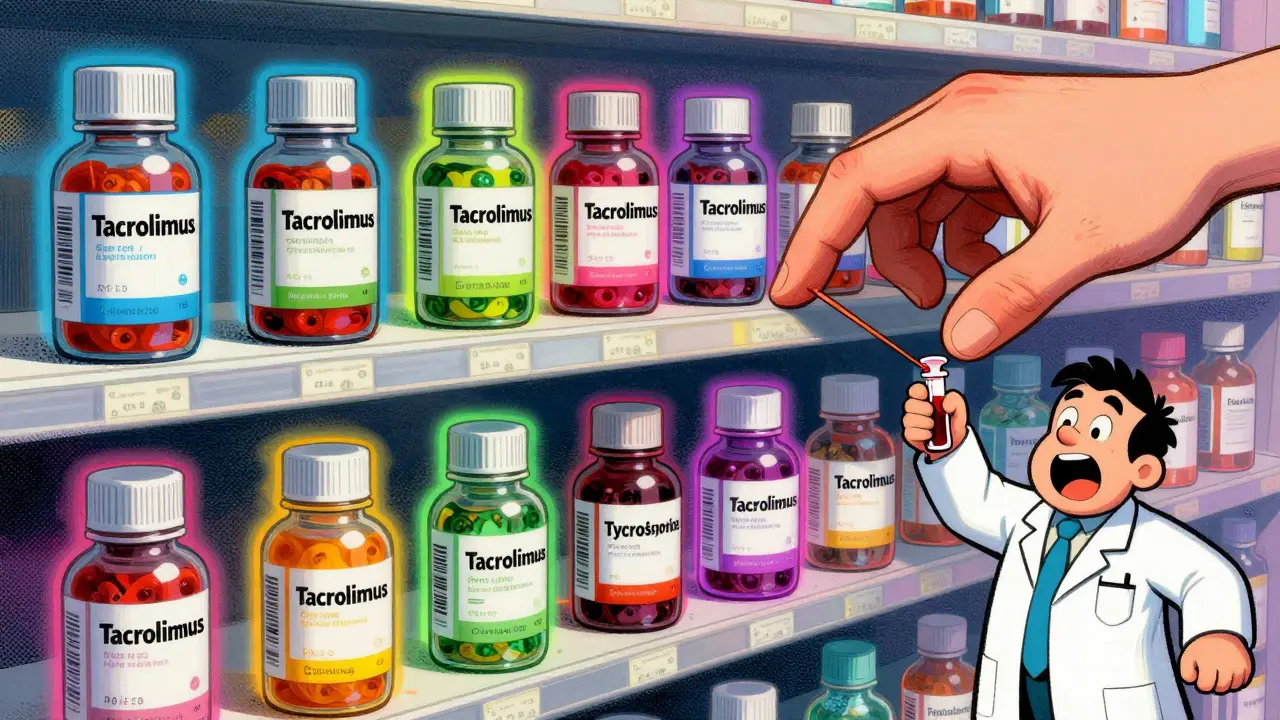
What Patients Are Really Saying
On transplant forums, the stories are raw. One woman wrote: “I switched from Prograf to a generic. My levels dropped. My creatinine went up. My nephrologist said I had a subclinical rejection. I was lucky it was caught early.” Another said: “I saved $900 a month on generic tacrolimus. My levels have been stable for 18 months. No issues.” There’s no single answer. Some people do fine. Others don’t. The difference? Consistency. The most successful patients are the ones who stick to one generic brand, take their dose at the same time every day, avoid grapefruit (it interferes with absorption), and get their blood drawn religiously.How Doctors and Pharmacies Are Trying to Fix This
Transplant pharmacists now treat generic switches like a medical event. They don’t just send a new prescription-they schedule follow-up blood tests every week for the first month. Some centers require a 4- to 6-week monitoring window after any switch. Many hospitals now use “single generic source” contracts. That means they buy one brand of generic tacrolimus and one brand of generic cyclosporine-and stick to them. No switching. No substitutions. It’s not cheaper for the hospital, but it’s safer. The American College of Clinical Pharmacy recommends that any switch to a new generic must be documented, approved by the transplant team, and followed by therapeutic drug monitoring. And yet, only 42% of generic manufacturers provide detailed bioequivalence data to clinicians. Most just give a one-page sheet saying “bioequivalent.” That’s not enough.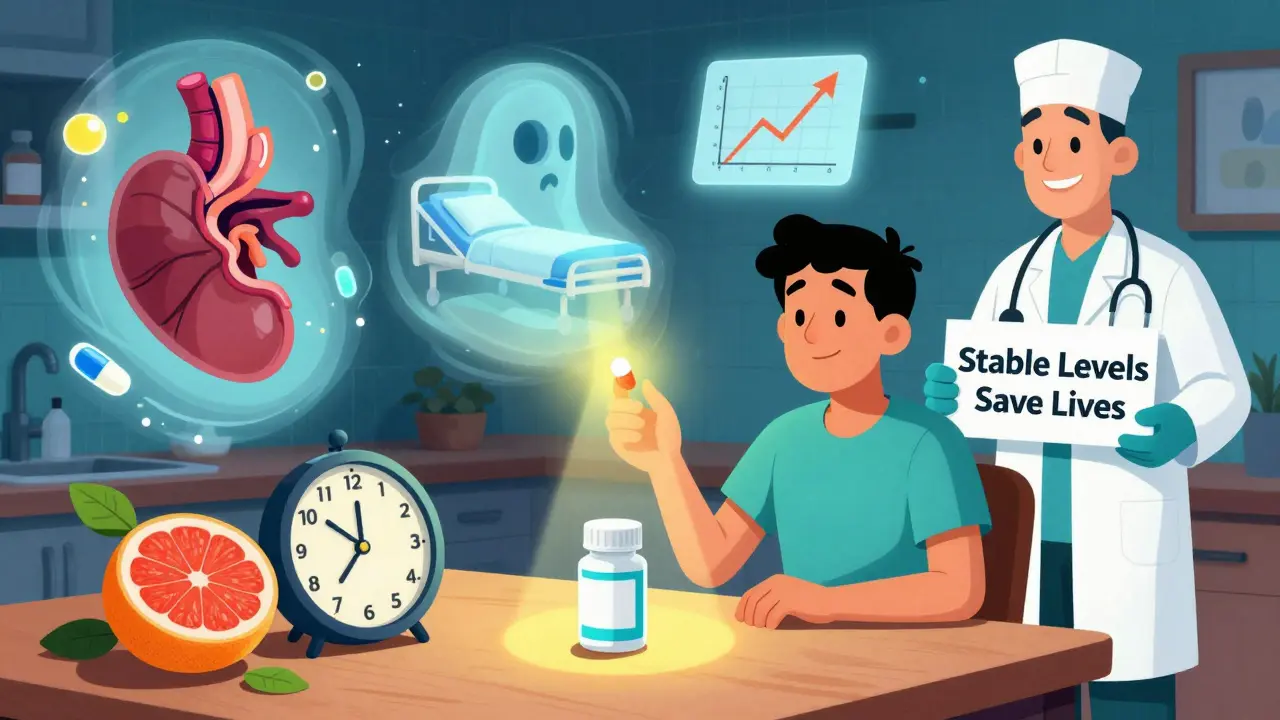
The Future: Better Formulations, Better Monitoring
There’s hope. In late 2023, Astellas got FDA approval for a new extended-release tacrolimus (LCP-tacrolimus). It smooths out the peaks and valleys in blood levels. That could mean fewer fluctuations-and fewer problems when switching generics. Meanwhile, genetic testing is becoming more common. Some patients have a CYP3A5 gene variant that makes them metabolize tacrolimus faster. If you’re one of them, you need a higher dose. Testing for this can cut the time to reach stable levels by 63%, according to a 2023 JAMA study. The International Transplant Society’s 2024 statement says it clearly: “Generic immunosuppressants save money-but they must be managed like precision tools, not commodities.”What You Need to Do Right Now
If you’re on cyclosporine or tacrolimus:- Know which generic brand you’re on. Write it down. Keep the bottle.
- Never switch brands without talking to your transplant team.
- Take your dose at the same time every day-within one hour.
- Avoid grapefruit, pomelo, Seville oranges. They interfere with absorption.
- Get your blood levels checked right after any switch, then again at 7 and 14 days.
- If you feel off-tremors, headaches, nausea, fatigue-get your levels checked immediately.
Final Thought: Cost vs. Control
Generic drugs are essential. Without them, many transplant patients couldn’t afford their meds. But you can’t treat a life-saving drug like a bottle of ibuprofen. The goal isn’t just to lower costs. It’s to keep you alive. And that means treating cyclosporine and tacrolimus with the precision they demand-not the convenience we want.Stable levels save organs. Stable organs save lives.
Meghan Hammack
January 8, 2026 AT 18:12Just got my generic tacrolimus refill and my levels dropped like a rock. My transplant nurse made me switch back to the brand I was on before. Don't mess with these meds. Your new organ doesn't care about your insurance deductible.
RAJAT KD
January 9, 2026 AT 12:07Stable levels save organs. Stable organs save lives. This is not a suggestion-it’s a biological imperative.
Angela Stanton
January 11, 2026 AT 08:57Let’s be real: the FDA’s 80–125% bioequivalence window is a joke for NTI drugs. It’s like saying two different brands of insulin are interchangeable because they both ‘look white.’ You wouldn’t do that with cancer chemo-why are we doing it with transplant meds? 🤦♀️
Lindsey Wellmann
January 12, 2026 AT 03:01OMG I switched generics and my hands started shaking like I was in a cold shower 😱 I thought I was having a panic attack-but it was my tacrolimus crashing. Now I have a sticky note on my pill bottle that says ‘DO NOT SWITCH.’ I’m alive because I listened. 💪❤️
Jeffrey Hu
January 13, 2026 AT 03:14People think generics are just cheaper versions of the same thing. Nope. Cyclosporine’s microemulsion formulation alone has over 12 different excipients that affect absorption. The FDA doesn’t require comparative studies in transplant recipients because it’s ‘too expensive.’ That’s not science-that’s corporate cost-cutting dressed up as regulation. And don’t get me started on how the EMA’s stricter standards are ignored in the U.S. because of lobbying.
There’s a reason transplant centers in Europe don’t have the same rejection spikes we do. They track every single batch. Here? You get whatever the pharmacy’s contract says. And if your doctor doesn’t push back? You’re a walking statistical outlier.
I’ve seen patients go from 10.2 ng/mL to 3.8 ng/mL after a pharmacy substitution. No warning. No consent. Just a new bottle with a different logo. That’s not healthcare. That’s Russian roulette with immunosuppression.
And yes, some people do fine. But you’re not a statistic-you’re a person with a new liver. And if your insurance company decides your brand is ‘too expensive,’ they don’t care if you end up back on the transplant list. They just want to hit their quarterly savings targets.
The extended-release tacrolimus from Astellas? That’s the future. It’s not perfect, but it reduces peak-trough swings by 40%. Why isn’t this the default? Because generics make more money for PBMs and pharmacies. The system is rigged.
My advice? If you’re on a generic, write down the manufacturer name. Call your pharmacy every time you refill. Ask if it’s the same batch. If they say ‘it’s bioequivalent,’ ask them if they’d swap their insulin or warfarin without telling them. They’ll shut up.
And if you’re lucky enough to have access to therapeutic drug monitoring? Use it. Every single time. Not just ‘when you feel off.’ Get tested after 7 days. After 14. After 30. Because your body doesn’t care about your insurance plan. It only cares about concentration gradients.
Jacob Paterson
January 13, 2026 AT 12:56So let me get this straight-you’re mad because you saved $900 a month and now you have to actually monitor your blood levels? Welcome to medicine, sweetheart. If you want to live, you do the work. No one’s forcing you to take the generic. But if you do, stop acting like you’re entitled to a free pass. Your life isn’t a Netflix show. It’s biology. Deal with it.
Pooja Kumari
January 15, 2026 AT 06:34I switched generics and I cried for three days. Not because I was scared-I was just so tired. Tired of being a patient. Tired of being a number. Tired of having to remember every pill, every blood test, every pharmacy change. I just wanted to be normal. But I can’t. And now I’m afraid to even leave the house in case I miss a dose. I don’t know how much longer I can do this.
Why does it have to be this hard? Why can’t someone just fix this? I’m not asking for miracles. Just consistency.
Diana Stoyanova
January 16, 2026 AT 17:42Listen-I’m a transplant survivor. 12 years post-liver. I’ve been on every generic under the sun. Some worked. Some nearly killed me. But here’s the truth: the ones who survive long-term? They’re the ones who treat their meds like sacred rituals. Same time. Same brand. No grapefruit. No skipping. No ‘I’ll just take it later.’
And yes, it’s exhausting. But you know what’s more exhausting? Being back in the hospital. Being on dialysis again. Watching your kid grow up without you.
I started a spreadsheet. Every pill. Every level. Every note from my nurse. I turned my survival into a data project. And guess what? It worked. I’m still here. Because I refused to let the system win.
You can do this. Not because it’s easy. But because you’re stronger than you think.
And if you’re reading this and you’re healthy? Don’t take your meds for granted. Someone out there is fighting for every single milligram.
Johanna Baxter
January 17, 2026 AT 20:00I switched to generic and my creatinine went up and my doctor said I had rejection and now I have to pay for a private nurse because my insurance won’t cover it and I hate everyone and I just want to die
Phil Kemling
January 18, 2026 AT 06:39It’s ironic, isn’t it? We’ve mastered the science of organ transplantation-yet we treat the drugs that keep them alive like commodities. We’ve mapped the human genome, but we still don’t have a system that respects the biological uniqueness of each patient. We optimize for cost, not care. We reduce life to a spreadsheet. And then we wonder why people suffer.
Maybe the real question isn’t about generics. It’s about what kind of society we want to be. One that values efficiency over humanity? Or one that understands that some things-like a beating heart in a stranger’s chest-can’t be priced.
Drew Pearlman
January 20, 2026 AT 06:15I know it’s scary. I’ve been there. When I first got my transplant, I was terrified of every little change-my diet, my sleep, my meds. But here’s what I learned: you don’t have to be perfect. You just have to be consistent. Pick a brand. Stick with it. Write it down. Talk to your pharmacist. And if you feel weird? Don’t wait. Get checked. You’re not overreacting. You’re being smart.
There are people out there who’ve been on the same generic for 10 years without issue. And there are people like me who had a scare and learned the hard way. Either way-you’re not alone. Reach out. Join a group. Talk to someone who gets it. You’ve already survived the surgery. Now you’ve got this.
Elisha Muwanga
January 20, 2026 AT 09:42Why are we letting Indian generic manufacturers control the lives of American transplant patients? The FDA approves these based on tests done in healthy volunteers-people who don’t have liver failure or 12 other drugs in their system. This is a national disgrace. We should ban all foreign-made immunosuppressants. American patients deserve American-made meds. This isn’t about cost-it’s about sovereignty.
Alicia Hasö
January 20, 2026 AT 16:39To every transplant patient reading this: you are not a burden. You are not a cost. You are not a statistic. You are a miracle-someone who fought to live, who gave someone else a second chance, who wakes up every day and chooses to keep going. Keep taking your pills. Keep tracking your levels. Keep asking questions. You deserve to be heard. And you deserve to be safe.
I see you. I honor you. And I’m rooting for you.
Jerian Lewis
January 20, 2026 AT 22:17My doctor told me to stay on my generic. I did. I’ve been stable for 3 years. No issues. Stop scaring people. Not everyone has problems. The system works if you follow the rules.