When your doctor hands you a prescription, do you ever wonder why the pill looks different from the one you took last time? Maybe it’s a different color, shape, or even has a strange marking on it. If you’ve ever felt unsure whether this new pill will work just as well, you’re not alone. Many people assume that if a medicine costs less, it must be weaker or less safe. But here’s the truth: generic medications are not cheaper because they’re worse-they’re cheaper because the system lets them be.
The FDA requires every generic drug to contain the exact same active ingredient, in the same amount, and work the same way as the brand-name version. That means if you take a generic version of lisinopril for high blood pressure, it’s the same medicine as the brand-name Zestril. The only differences? The color, shape, and inactive ingredients like fillers or dyes. These don’t affect how the drug works in your body.
Still, people worry. Why? Because of myths. One common belief is that generics are made in shoddy factories overseas. But the FDA inspects every facility-whether it’s in the U.S., India, or Germany-that makes generics. In 2023, 98.7% of these facilities passed inspection. That’s the same standard as brand-name drug makers. Another myth? That generics don’t work as well. But a major 2020 study in JAMA Internal Medicine looked at 47 clinical trials comparing generics and brand-name heart medications. The results? No meaningful difference in how well they worked. Not even a tiny one.
Why You Should Ask About Generics
If you’re taking a medication for something like diabetes, high cholesterol, or high blood pressure, switching to a generic could save you hundreds-or even thousands-of dollars a year. The average brand-name prescription costs over $670. The same medicine as a generic? Around $16. That’s not a small difference. For people on fixed incomes or with high deductibles, that gap can mean skipping doses, splitting pills, or going without altogether. And that’s dangerous.
Studies show that patients who take generics stick to their treatment plans 8% to 12% more often than those who stick with brand-name drugs. Why? Because they can afford to. When you don’t have to choose between buying medicine and paying the rent, you’re more likely to take it every day. That’s not just about saving money-it’s about staying healthy.
How to Start the Conversation
Asking your doctor about generics doesn’t mean you’re being cheap. It means you’re being smart. Here’s how to bring it up without sounding awkward:
- Ask: "Is there a generic version of this medication?" Simple. Direct. No shame.
- Ask: "Will it work the same way?" This opens the door for your doctor to explain the science, not just say "yes."
- Ask: "Have other patients had trouble with it?" This lets your doctor share real-world experience, not just textbook answers.
Doctors aren’t pushing brand-name drugs because they’re better. They’re often prescribed because they’re what the patient already knows. But if you ask, they’ll help you understand the options. Some doctors even use something called the "Ask-Tell-Ask" method: they ask what you know, explain the facts, then ask you to repeat it back. This isn’t testing you-it’s making sure you leave the office confident.

What If You’ve Had a Bad Experience?
Sometimes, people say, "I tried a generic, and it didn’t work for me." Maybe you felt more tired, got a rash, or noticed your condition wasn’t as well controlled. In most cases, this isn’t because the generic is weaker. It’s because of the inactive ingredients.
Generics can use different fillers, dyes, or coatings. For 99.9% of people, this makes zero difference. But for a tiny number-like those with thyroid conditions or epilepsy-those small changes can affect how the medicine is absorbed. That’s why the FDA requires tighter testing for these drugs. If you’ve had a problem, tell your doctor. They can switch you back to the brand, or try a different generic manufacturer. Not all generics are made by the same company. Sometimes, switching to another generic brand fixes the issue.
What About Inhalers, Creams, or Injectables?
Some medicines are harder to copy. Inhalers, like those for asthma, or topical creams for eczema, require more complex delivery systems. For these, generics are called "biosimilars" or "complex generics," and they take longer to develop. The FDA still requires them to prove they work the same way, but it’s harder to measure. If your doctor prescribes one of these, ask: "Is this a generic, and how do we know it works like the brand?" You deserve to know.
What You Should Know Before You Leave the Office
Here’s what every patient should walk away with:
- Your generic medicine has the same active ingredient as the brand.
- The FDA tests it to make sure it works the same way.
- Different colors or shapes? That’s just the filler-harmless.
- It’s 80-85% cheaper. That’s real savings.
- If you notice a change in how you feel, tell your doctor. It’s not "all in your head."
And if your pharmacist hands you a new pill and you’re unsure? Ask them. Pharmacists are trained to explain this stuff. In fact, 83% of patient concerns about generics are resolved just by a quick conversation with the pharmacist.
What’s Changing Now?
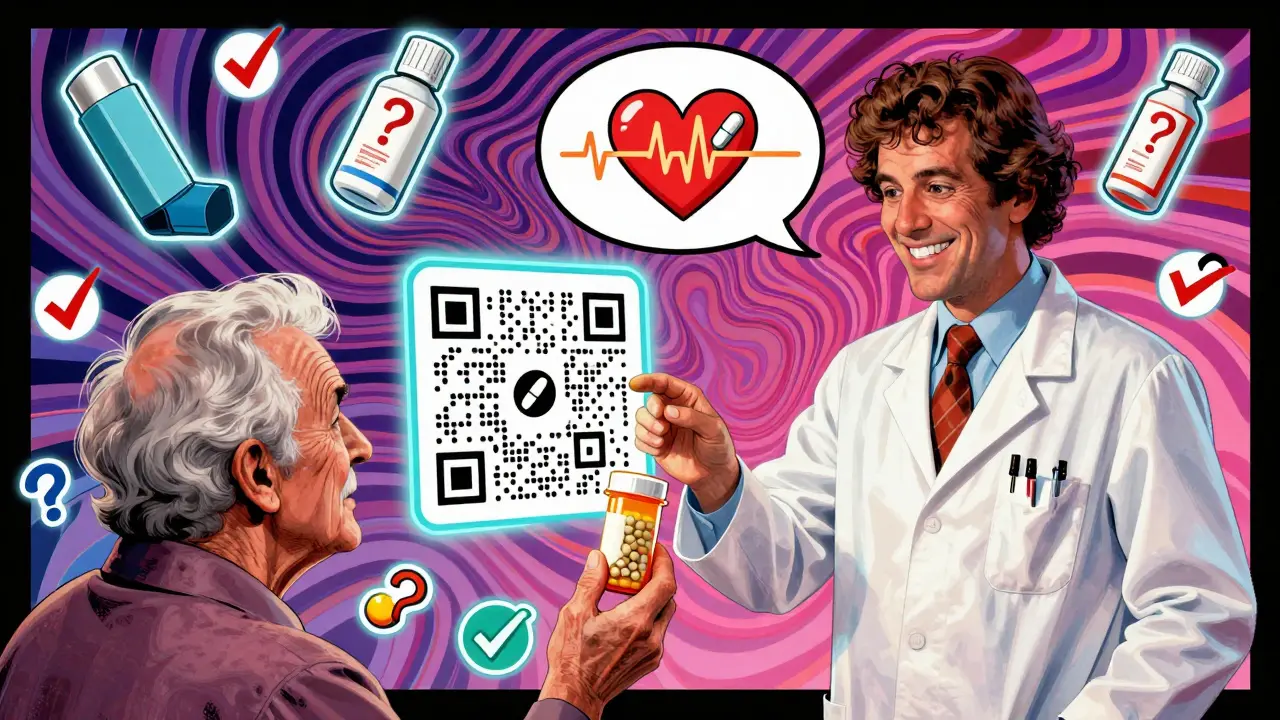
In 2025, Medicare Part D will start covering many generic drugs with $0 out-of-pocket cost. That’s huge. It means if you’re on a fixed income, you might soon pay nothing for your blood pressure or cholesterol meds. The FDA is also rolling out new tools-like QR codes on pill bottles that link to short video explanations in plain language. And by 2026, pharmacists will be required to document that they’ve explained generics to patients, so no one gets left behind.
There’s no reason to fear generics. They’re not second-rate. They’re not experimental. They’re the same medicine, sold at a fair price. The real risk isn’t taking a generic-it’s avoiding it because of a myth.
Next time you get a prescription, ask: "Is there a generic?" You might be surprised how much it changes your health-and your wallet.
Are generic medications as effective as brand-name drugs?
Yes. The FDA requires generic drugs to have the same active ingredient, strength, dosage form, and route of administration as the brand-name version. They must also prove they’re bioequivalent-meaning they work the same way in your body. A 2020 study in JAMA Internal Medicine reviewed 47 clinical trials and found no meaningful difference in effectiveness between generics and brand-name drugs for heart medications.
Why do generic pills look different from brand-name pills?
The difference in color, shape, or markings comes from inactive ingredients like dyes, fillers, or coatings. These don’t affect how the medicine works-they’re just there to make the pill easier to swallow or distinguish. The active ingredient, which does the healing, is identical. The FDA allows these differences because they don’t change the drug’s performance.
Can generic medications cause side effects that brand-name drugs don’t?
Rarely. For most people, no. But in about 0.8% of cases, differences in inactive ingredients can affect how a person tolerates the drug-especially for medications like thyroid pills or epilepsy drugs. If you notice new side effects after switching to a generic, tell your doctor. You may need to try a different generic brand or go back to the brand-name version temporarily. It’s not a sign the generic is unsafe-it just means your body might respond differently to the filler.
Are generics made in unsafe factories?
No. The FDA inspects all manufacturing facilities-whether they’re in the U.S., India, or China-with the same strict standards as brand-name drug makers. In 2023, 98.7% of generic drug facilities passed FDA inspections. That’s higher than the pass rate for many other industries. The FDA doesn’t treat generics differently-they’re held to the same quality rules.
Why do some doctors still prescribe brand-name drugs?
Sometimes, it’s because the patient has been on the brand for years and the doctor assumes they’re comfortable with it. Other times, the brand might be the only option available for complex drugs like inhalers or injectables. But when a generic exists and is appropriate, most doctors will switch you-if you ask. The American Medical Association now recommends doctors actively discuss generics with patients using teach-back methods to ensure understanding.
Will my insurance cover generics?
Almost always, and usually at a much lower cost. Most insurance plans, including Medicare Part D, have lower copays for generics. In fact, many plans require you to try a generic before covering the brand-name version. By 2025, Medicare will cover many generics with $0 out-of-pocket cost. Even if you don’t have insurance, generics are often priced under $15 at pharmacies like Walmart or CVS.
Angie Datuin
February 10, 2026 AT 06:44I used to be terrified of generics until my mom switched to them for her blood pressure meds. She was saving $400 a month-same pill, same results. I didn’t believe it until I saw her energy improve. Turns out, the only thing different was the price tag. No more panic attacks at the pharmacy.
Now I ask every doc I see: "Is there a generic?" It’s not about being cheap-it’s about being smart.
Also, pharmacists are usually way more helpful than doctors on this stuff. Don’t be shy to ask them.
My aunt switched generics and got a rash. Turned out it was the dye. Changed manufacturers, problem gone. So yeah, talk to your pharmacist. They’ve seen it all.
Camille Hall
February 11, 2026 AT 18:29For anyone scared of generics: think of it like buying store-brand cereal. Same ingredients, different packaging. You wouldn’t refuse oatmeal just because it’s not Kellogg’s, right?
Doctors don’t push brands because they’re better-they push them because they’re familiar. But if you ask, they’ll respect you for it. I’ve had docs actually high-five me for asking about generics. Seriously.
And if you’ve had a bad experience? Tell your provider. It’s not you. It’s the filler. One time my thyroid med switched from cornstarch to lactose. I felt like garbage for two weeks. Switched brands, back to normal. Nothing wrong with the drug. Just the junk in the capsule.
Alex Ogle
February 13, 2026 AT 06:47You know what’s wild? The FDA doesn’t even require generics to be bioequivalent across every single batch. They just need to hit a range-80% to 125% of the brand’s absorption rate. That’s a 45% window. I mean, think about that. One pill could be 20% weaker than another, and both are still "approved."
And don’t get me started on manufacturing. Over 80% of generic pills are made overseas. India, China, you name it. The FDA inspects, sure-but they’ve got 7,000 facilities to cover and 400 inspectors. That’s like one person for every 17 factories. And they show up with notice. You think they catch the shady stuff?
Don’t get me wrong-I’m all for saving money. But this isn’t science. It’s a cost-cutting game dressed up as public health. And we’re the ones paying for it with our health.
I’ve seen people get seizures because their epilepsy generic had a different coating. It’s not a myth. It’s a loophole. And nobody’s fixing it.
So yeah, ask your doctor. But also? Stay vigilant. Read the fine print. And if you start feeling weird? Don’t just assume it’s "all in your head."
Jacob den Hollander
February 13, 2026 AT 19:07Okay, so I had this moment last year where I switched my cholesterol med to generic-saved like $500 a year-and then I got this weird tingling in my hands. I panicked. Thought I was having a stroke. Called my doc. She said, "Try a different brand of generic." So I did. And boom. No tingling.
Turns out, the first one had a weird filler that my body didn’t like. Not the drug. The dye. Or the coating. Or whatever they stick in there to make it look pretty.
My point? It’s not about fear. It’s about awareness. You gotta know your body. And if something feels off? Speak up. Don’t just swallow it. Literally.
Also, pharmacists? They’re the real MVPs. They know which generics are made by which company. Ask them. They’ll tell you. They’ve got charts. I swear. I saw one. It was like a spreadsheet from the future.
And if you’re on Medicare? You’re gonna love 2025. Zero out-of-pocket? Yes. Yes. YES.
Also, I misspelled "filler" twice. Sorry. My phone autocorrects me into oblivion.
Andrew Jackson
February 15, 2026 AT 18:27It is an affront to American ingenuity that we have allowed foreign manufacturers to produce the very medications upon which our citizens’ lives depend. The FDA’s inspection regime is laughably inadequate, and to suggest that a pill made in a facility with no OSHA compliance is equivalent to one crafted in a state-of-the-art American lab is not just naive-it is treasonous.
Moreover, the notion that "it’s the same medicine" ignores the fundamental principle of American exceptionalism: if it is not made here, it is not as good. We do not import cars, we do not import steel, and we should not import our pharmaceuticals.
Furthermore, the 80-85% cost reduction is not a benefit-it is a symptom of a broken system that has outsourced our health to the lowest bidder. The Chinese Communist Party does not care if your blood pressure is regulated. They care about profit margins.
Let us not forget: the brand-name drugs were developed by American scientists, with American funding, in American labs. To abandon them for foreign knockoffs is to abandon our heritage.
And yet, somehow, we are told to be "smart" for accepting this. I say: be proud. Demand American-made medicine. Or do not blame the government when your body fails you.
John Watts
February 16, 2026 AT 17:54Let me tell you something real quick: I used to be a skeptic. Then my sister got diagnosed with hypothyroidism. She went through THREE different generics before finding one that didn’t make her feel like a zombie. One had too much lactose. One had a weird coating. One? Just didn’t absorb right.
Here’s the thing: generics aren’t magic. They’re medicine. And medicine is personal.
But here’s the other thing: they’re still 99% effective for 99% of people. And they save lives. Not just money-lives.
My dad skipped his meds for six months because the brand cost $800. He ended up in the ER. Generic? $12. He’s alive today because he switched.
So don’t let fear stop you. But do pay attention. If you feel weird? Tell someone. Don’t suffer silently. Your body talks. You just gotta listen.
And if you’re on Medicare? You’re gonna love what’s coming. $0 copays? That’s not a policy change. That’s a revolution.
Chima Ifeanyi
February 17, 2026 AT 18:34From a systems analysis standpoint, the bioequivalence paradigm is fundamentally flawed. The Cmax and AUC thresholds mandated by the FDA are statistically permissive, and the intra-individual variability in absorption kinetics is not adequately controlled across manufacturing batches-particularly when supply chains are fragmented across geopolitical jurisdictions.
Moreover, the inert excipients used in generics are rarely subject to pharmacokinetic profiling, which introduces unquantified confounders in patient outcomes, especially in polypharmacy cohorts. The 0.8% adverse reaction rate you cite is likely underreported due to lack of mandatory adverse event tracking in non-brand registries.
Additionally, the FDA’s inspection regime operates under a risk-based sampling protocol, which prioritizes facilities with prior violations-creating a perverse incentive for manufacturers to remain under the radar. The 98.7% pass rate is therefore a function of selective auditing, not universal compliance.
And let’s not ignore the regulatory arbitrage: Indian manufacturers exploit the 2003 Drug Price Competition and Patent Term Restoration Act’s loopholes to bypass bioavailability testing for drugs with narrow therapeutic indices. This is not oversight. It’s exploitation.
So yes, ask your doctor. But also audit the manufacturer code on the pill. And if you’re on levothyroxine? Stick with the brand. Or at least demand the same generic brand every refill. Consistency > cost.
Elan Ricarte
February 18, 2026 AT 05:28Bro. I tried a generic for my anxiety med. Felt like my brain was wrapped in wet socks for two weeks. I thought I was losing it. Called my doc. She laughed. Said, "Switch the brand. Different filler."
Did it. Felt like a new person. Not because the drug changed. Because the dye didn’t mess with my gut.
Turns out, some of these generics are made with cornstarch. Others with gluten. Others with sugar. And yeah, for most folks? No big deal. But for me? I’m basically a walking allergy test.
So here’s the real talk: don’t just accept the first generic. Ask for the manufacturer. Write it down. Stick with it. If your doc acts weird? Tell ‘em you’re not a guinea pig.
And if you’re on Medicare? You’re gonna be fine. But if you’re not? Ask for the $15 version at Walmart. It’s the same damn thing.
Also, I’m not mad. I’m just disappointed. We’re smarter than this.
Ritteka Goyal
February 18, 2026 AT 09:19Oh my god I love this so much! I am from India and we use generics ALL THE TIME! My cousin in Mumbai takes the same medicine as my uncle in Texas and it’s the exact same pill! The only difference is the name on the box!
And guess what? In India, generics are so cheap that even rickshaw drivers can afford them. We don’t have this drama here. People just take them and live.
Also, I switched to generic for my diabetes and saved 8000 rupees a month! That’s like a new phone every year!
And I told my American friend and she cried. She said, "But what if it doesn’t work?" I said, "Sis, it’s the same molecule. The same science. The same FDA. You’re not being cheap. You’re being wise."
And yes, I misspelled "rupees" and "molecule" but whatever. I’m typing on my phone while my baby naps. I’m a busy mom. I’m proud of this comment.
Also, Walmart? They have the same generics as in Delhi. I checked. I’m not lying.
Monica Warnick
February 18, 2026 AT 21:27I had a panic attack when my pharmacist handed me a blue pill instead of the white one. I thought I was being poisoned. I called my mom. She called the doctor. The doctor called the pharmacist. The pharmacist called the manufacturer. It took three days.
Turns out? Same drug. Different color. Because the factory ran out of white dye.
I felt so stupid. Like, emotionally. Like I’d been gaslit by a pill.
Now I keep a photo of my pill on my phone. Every time I get a new one? I take a picture. And I ask: "Is this the same as last time?"
My therapist says I have pill anxiety. I say I have trauma. One time I took a generic and felt like I was underwater for a week. I didn’t know if it was the drug or my soul.
So yeah. Ask questions. Take pictures. Be weird. Your body deserves it.
Ashlyn Ellison
February 20, 2026 AT 02:07My doctor asked if I wanted a generic. I said yes. Saved $500. Took it. Felt fine. Done.
Also, pharmacists are geniuses. Ask them.
Jonah Mann
February 20, 2026 AT 12:13Okay, so I switched my generic for my blood pressure med last month. Took it. Felt weird. Thought I was gonna pass out. Called my pharmacist. She said, "That’s the one made by Teva. Try the one from Sandoz." I did. Instantly better.
She even printed me a little chart: "Which generic is which, by manufacturer." I framed it. It’s on my fridge next to my kid’s drawing.
Also, I misspelled "Sandoz" as "Sandox" in my notes. My wife laughed. I cried. Then I took my pill. And I’m fine.
And yeah, Medicare’s gonna be $0 in 2025? I’m crying. I’m so ready. My blood pressure is stable. My wallet is happy. My soul is at peace.
Also, I think I typed "pharmacist" as "pharmasist". Sorry. My fingers are tired.