
When you or a loved one is taking multiple medications, it’s easy to feel overwhelmed. Maybe you’ve forgotten what one pill is for. Or you’re worried about side effects you didn’t know were possible. Maybe you’re taking pills at different times, and some days you just can’t keep track. You’re not alone. Nearly 89% of adults over 65 take at least two prescription drugs. One in seven takes five or more every day. That’s a lot to manage - and a lot that can go wrong.
But here’s the good news: you don’t have to figure it out alone. Talking clearly and confidently with your healthcare provider can prevent hospital visits, reduce dangerous side effects, and even help you feel more in control of your health. It’s not about being perfect. It’s about being prepared.
Bring Everything - Not Just a List
Doctors don’t guess what you’re taking. They need to see it. Too many people show up with a handwritten list and think that’s enough. But lists get outdated. Pills get switched. Supplements get added without telling anyone. That’s why bringing all your medications in a bag - every bottle, every box, every jar - is the single most effective thing you can do.
Studies show that when seniors bring their actual medications to appointments, providers find discrepancies in 25% of cases. Maybe the label says 10 mg, but the pill is 5 mg. Maybe you stopped taking one because it made you dizzy, but no one knew. Maybe you’re taking a supplement that interacts with your blood thinner. These aren’t small mistakes. They’re preventable risks.
Don’t just dump the bag on the table. Take out each item one by one. Say: “This is for my blood pressure. This one I take with breakfast. This vitamin I started last month because my friend said it helps.” Be specific. Your provider will thank you.
Prepare Three Things Before Your Appointment
Going in blind is like walking into a storm without an umbrella. You need a plan. Here’s what works:
- Write down your top concerns. Don’t just say “I feel off.” Say: “I’ve been dizzy every morning since I started the new pill.” Or: “I’ve had trouble sleeping since my doctor added the muscle relaxer.” Specifics help.
- Bring a companion. It’s not about not being able to speak for yourself. It’s about having a second set of ears. One person remembers the questions. The other remembers the answers. A 2023 study found seniors with someone accompanying them had 18% fewer adverse drug events.
- Bring pen and paper. Or a phone with notes. Don’t rely on memory. Write down the name of each medication, why it’s prescribed, the dose, and when to take it. If your doctor says “Take this twice a day,” write: “With breakfast and dinner.”
These three steps alone cut down on confusion and make your visit more productive. You’re not being difficult. You’re being smart.
Ask These Four Questions Every Time
You don’t need to be an expert. But you do need to ask the right questions. Here are the four that matter most:
- How does this medication specifically help manage my health condition? Sometimes, a pill is prescribed out of habit, not necessity. If you have high blood pressure and your doctor prescribes a new drug, ask: “Will this lower my risk of stroke, or just my number?”
- What are the potential side effects and adverse reactions? Don’t just accept “common side effects.” Ask: “Which ones are serious enough to call you?” For example, if you’re taking a statin, muscle pain isn’t just inconvenient - it could be a sign of something dangerous.
- What are the drug interactions and potential conflicts? This includes prescription drugs, over-the-counter meds like ibuprofen or antacids, and even herbal supplements like ginkgo or St. John’s wort. Some of these can be dangerous when mixed.
- What should I do if I miss a dose? This sounds simple, but it’s not. Some pills you skip. Some you take as soon as you remember. Others you never double up. Ask now, before you forget.
These aren’t hard questions. They’re basic ones. If a provider seems annoyed, that’s a red flag. You deserve clear answers.

Use Tools to Stay on Track
Memory fails. Routines break. That’s why tools aren’t optional - they’re essential.
Physical pill organizers - the kind with compartments for morning, noon, night, and weekend - are simple, reliable, and cheap. If you take eight pills a day, you’ll know right away if you missed one.
Apps like Medisafe or Round Health send reminders, track when you’ve taken your meds, and even alert caregivers if you miss a dose. They’re especially helpful if you live alone.
Some pharmacies now offer medication synchronization. That means all your prescriptions are set to refill on the same day each month. No more juggling five different pickup dates. One trip. One bill. One less thing to worry about. Over 74% of independent U.S. pharmacies now offer this - ask your pharmacist.
And here’s a pro tip: tie your pills to daily habits. Take your morning meds after brushing your teeth. Take your evening ones after dinner. Your brain links routines. That’s more reliable than an alarm.
Review Everything - Regularly
Polypharmacy - taking five or more medications - isn’t always necessary. Sometimes, pills are added over years without ever being re-evaluated. A 2022 study found that 27% of seniors could safely reduce their medication load with a careful review.
Ask for a full medication review at least once a year. Bring your bag again. Say: “I’d like to go through everything. Are all these still needed? Is there anything I can stop?”
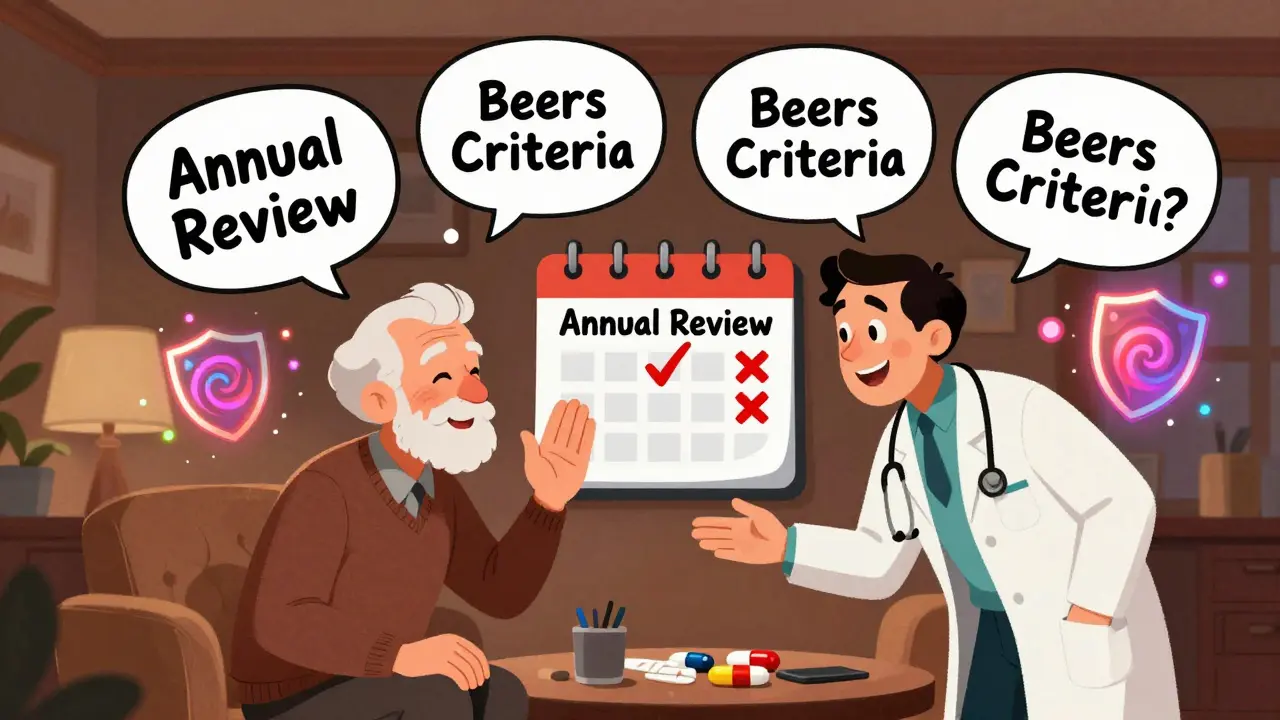
Some drugs are riskier for older adults. The American Geriatrics Society’s Beers Criteria (updated in 2023) lists 30 medication classes that should be avoided or used with extreme caution in seniors. These include certain antihistamines, sleep aids, and muscle relaxers. If you’re on any of them, ask why - and if there’s a safer alternative.
Medicare now requires comprehensive medication reviews for beneficiaries taking eight or more drugs. If you’re on that list, you’re entitled to a free session with a pharmacist. Use it.
Speak Up - Even If It’s Hard
Many seniors don’t speak up because they don’t want to bother their doctor. Or they’re afraid they’ll sound silly. Or they’ve been told “you’re old, this is normal.” That’s wrong.
Speak slowly. Use simple words. Say: “I’m confused.” Or: “I didn’t understand.” Or: “Can you explain that again?”
Doctors are trained to talk fast. They use terms like “hypertension” or “polypharmacy.” Ask them to say it in plain English. “High blood pressure” is fine. “Taking too many pills” is fine too.
And if you’re not sure you understood - ask them to use the teach-back method. That means: “Can you tell me in your own words what I just explained?” Studies show this improves adherence by 31%.
It’s not about being right. It’s about being safe.
What Happens When You Do This Right
When seniors communicate clearly about their medications:
- Hospital visits for drug reactions drop by up to 22%.
- Medication errors fall by 35%.
- People feel more confident, less anxious, and more in control.
It’s not magic. It’s practice. It’s preparation. It’s asking the questions others are too shy to ask.
You’re not just managing pills. You’re managing your health - and your independence. And that’s worth every minute of effort.
What if I’m taking over-the-counter meds or supplements?
You must tell your provider about every OTC medicine, vitamin, herb, or supplement you take - even if you think it’s harmless. Many seniors take ibuprofen daily for joint pain, but it can raise blood pressure and harm the kidneys. Others take ginkgo for memory, but it can thin the blood and interact with warfarin. These aren’t trivial. They’re part of your full medication picture. Bring them all.
Can I stop a medication if I think it’s not helping?
Never stop a prescription without talking to your doctor first. Some medications need to be tapered slowly. Stopping suddenly can cause rebound effects - like high blood pressure spikes or seizures. But you absolutely should ask: “Is this still necessary?” If a pill was prescribed years ago for a condition that’s now under control, it might be safe to discontinue. Your provider can help you decide.
How often should I review my medications?
At least once a year - and every time there’s a change in your health. If you’ve been hospitalized, started seeing a new specialist, or had a fall, schedule a review. Also, if you’re taking eight or more medications, Medicare requires a formal review. Don’t wait for them to call - ask for it.
What if my doctor dismisses my concerns?
If your provider brushes off your worries - says “it’s just aging” or “you’re fine” without checking - it’s time to find someone new. Good doctors welcome questions. They use tools like the teach-back method. They know that 1.3 million emergency visits each year among seniors are caused by medication errors. You have a right to clear, respectful care. Don’t settle for less.
Are there apps that help track medications for seniors?
Yes. Apps like Medisafe, Round Health, and MedAdherence Pro are designed specifically for older adults. They have large buttons, simple interfaces, voice reminders, and caregiver alerts. The FDA has cleared 12 such apps since early 2023. Many are free or low-cost. Try one for a month. If it helps, keep it. If not, go back to a pill organizer. The goal isn’t tech - it’s consistency.
Aileen Nasywa Shabira
March 16, 2026 AT 16:01Also, 'ask your pharmacist' like they're not already drowning in 12-hour shifts and 400 refills. I love how these articles treat healthcare like a DIY project you can fix with a checklist and a smile.
Kendrick Heyward
March 17, 2026 AT 16:18And if you think 'it's just aging' when you're dizzy? That's not aging. That's negligence. Get your act together.
lawanna major
March 18, 2026 AT 10:43Bringing your actual medications-not a list-is an act of radical accountability. It says: I am responsible for my body, and I will not rely on memory or assumption. Writing things down is not weakness-it is reverence for the complexity of the human system. Asking questions is not defiance; it is partnership.
And to those who say, 'I don't want to bother my doctor'-you are not a bother. You are the reason the system exists. Your voice is not noise. It is data. It is dignity.
May we all be so brave.
Ryan Voeltner
March 20, 2026 AT 04:36Furthermore, the emphasis on clarity, documentation, and follow-up questions aligns with established best practices in geriatric care. These are not suggestions. They are standards of care.
It is imperative that these protocols be normalized across all healthcare settings.
Lauren Volpi
March 21, 2026 AT 10:39This whole thing reads like a brochure for rich people who still have their hearing aids and a driver's license. Real talk: if your grandma can't read the tiny print on her bottles, you're not gonna fix it with a 'pill organizer'.
Shameer Ahammad
March 23, 2026 AT 00:24Alexander Pitt
March 23, 2026 AT 18:49Bring the bag. Write it down. Ask the questions. It's not rocket science. It's just common sense. And if your doctor rolls their eyes? Find a new one.
Manish Singh
March 24, 2026 AT 15:45That said, bringing the bag? Still the best thing you can do. Simple. Human. Effective.
Nilesh Khedekar
March 25, 2026 AT 02:20Also, why do all doctors say 'take with food'? That's just so you buy more snacks. It's all a scheme.
jared baker
March 25, 2026 AT 07:58Michelle Jackson
March 26, 2026 AT 08:36It's not about advice. It's about courage. And family.
Paul Ratliff
March 27, 2026 AT 01:13SNEHA GUPTA
March 27, 2026 AT 21:13Let us not mistake simplicity for insignificance.
Gaurav Kumar
March 29, 2026 AT 09:54lawanna major
March 31, 2026 AT 02:16