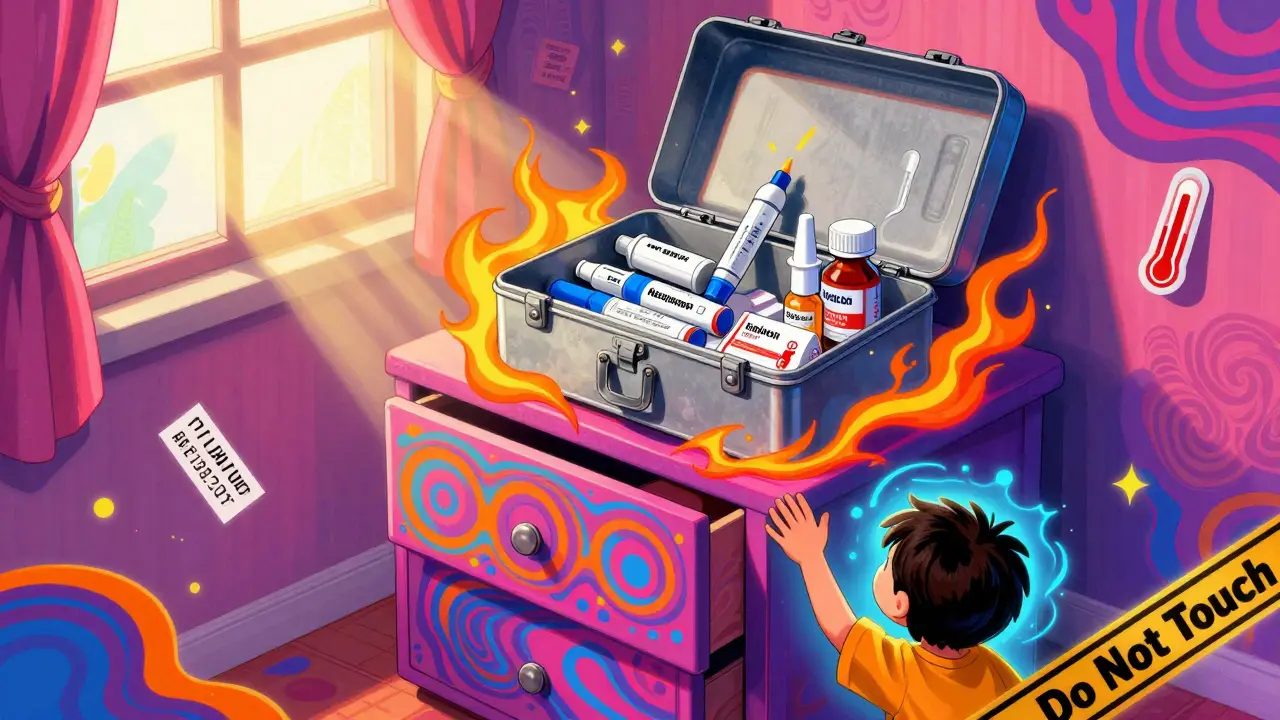
Keeping emergency medications like epinephrine, naloxone, or nitroglycerin both accessible and secure isn’t just a good idea-it’s a life-or-death balance. You need them within seconds during a cardiac arrest, allergic reaction, or overdose. But you also can’t leave them where a child can grab them, a visitor can steal them, or heat can ruin them. This isn’t about theory. It’s about real-world decisions that affect real people.
Understand What Counts as an Emergency Medication
Not all meds are created equal. Emergency medications are those meant for sudden, life-threatening events. Think: epinephrine auto-injectors for anaphylaxis, naloxone for opioid overdoses, albuterol inhalers for severe asthma attacks, and nitroglycerin for heart-related chest pain. These aren’t daily pills. They’re tools you hope you never need-but can’t afford to be without when you do.Controlled substances like fentanyl patches or high-dose opioids are also included here, even if they’re not used for acute emergencies. The DEA classifies them as Schedule II or III, meaning they’re tightly regulated because of abuse risk. That changes how you store them.
Storage Rules Vary by Setting
Where you keep these meds matters as much as how you keep them. The same epinephrine pen has different rules in a hospital, a school, an ambulance, or your kitchen cabinet.In hospitals, emergency carts are often kept in unlocked rooms but behind tamper-evident locks. Staff know where they are, and the system is designed for speed. In operating rooms, medications are stored in locked drawers that can be broken open quickly if needed-no time for keys or codes during a code blue.
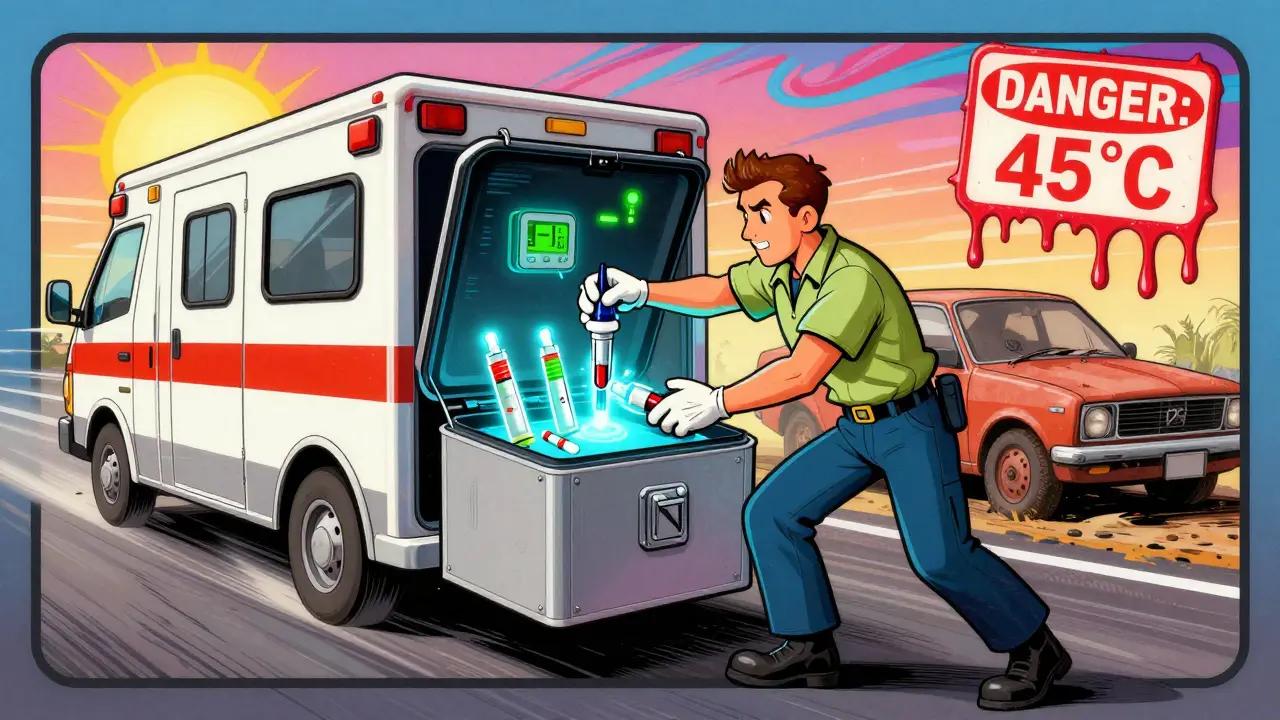
For EMS vehicles, regulations like 18VAC110-20-700C require lockable cabinets. Keys or access codes are only given to paramedics and supervisors. Temperature control is critical: meds must stay between 2°C and 8°C if refrigerated, or 20°C to 25°C at room temperature. Exceed 40°C? You risk losing potency.
Childcare centers follow different rules. Epinephrine and antihistamines for kids with severe allergies don’t need to be locked up-but they must be out of children’s reach. That means high shelves, locked cabinets in the nurse’s office, or even locked drawers in staff-only areas. Routine meds? Locked. Emergency meds? Accessible, but not child-accessible.
Home Storage: The Most Common-and Riskiest-Setting
Most people store emergency meds at home. And most get it wrong.The EPA says: lock them up. But what does that mean? A locked medicine cabinet? A small safe? A drawer with a childproof lock? All of those work-if they’re truly secure. A bathroom cabinet? No. Humidity and heat from showers degrade meds fast. A kitchen counter? Absolutely not. That’s where visitors, teens, or toddlers find them.
Best practice? Use a dedicated medicine safe. They’re affordable-under $50-and come with digital locks, biometrics, or key combinations. If you don’t want to buy one, use a locked filing cabinet, a high shelf in a bedroom closet, or even a locked toolbox. Just make sure it’s not easily found or broken into.
And don’t forget temperature. Epinephrine auto-injectors? Most manufacturers say room temperature (15°C-30°C). But some say refrigerate. Check the label. If it says “do not freeze,” don’t put it in the fridge. If it says “store at room temperature,” keep it away from the stove, radiator, or sunny windowsill. A drawer in a cool bedroom is ideal.
Security vs. Speed: The Tightrope Walk
The biggest mistake? Over-securing. A locked box that takes 30 seconds to open during a seizure or cardiac arrest is worse than no lock at all.A 2022 National EMS Survey found 17.3% of paramedics had delayed life-saving treatment because a locked cabinet was too hard to access. That’s not a glitch-it’s a system failure.
So how do you win both sides? Use the “one-touch” rule. If you need to open it in an emergency, you should be able to do it in one motion: pull a latch, press a button, turn a knob. No fumbling with keys, codes, or combinations under stress.
For families with children: use a lockbox with a simple code you can remember under pressure. Tell your partner, your teen, your neighbor-anyone who might need to help in a crisis. Practice opening it once a month. Make it muscle memory.
Temperature Control Is Non-Negotiable
Heat kills meds. Cold can too. Epinephrine loses potency if exposed to temperatures above 30°C for too long. Naloxone degrades faster in direct sunlight. Even insulin pens-often kept in emergency kits-can fail if frozen.Here’s what works: Buy a small, battery-powered temperature monitor like TempTraq. Stick it in your emergency kit. It alerts you via phone if temps go outside safe range. The FDA-approved device is accurate to 99.2% in field tests. It’s not expensive, and it’s worth every penny.
If you’re traveling? Keep meds in a padded case with a cold pack (not frozen) during summer. Never leave them in a car. Even on a 20°C day, a parked car can hit 45°C in 30 minutes.
Training and Documentation Matter
Most people never get trained on how to store these meds properly. That’s a gap.Studies show healthcare staff need 4-6 hours of training to get it right. And even then, 85% only master it after two sessions. At home? You’re on your own.
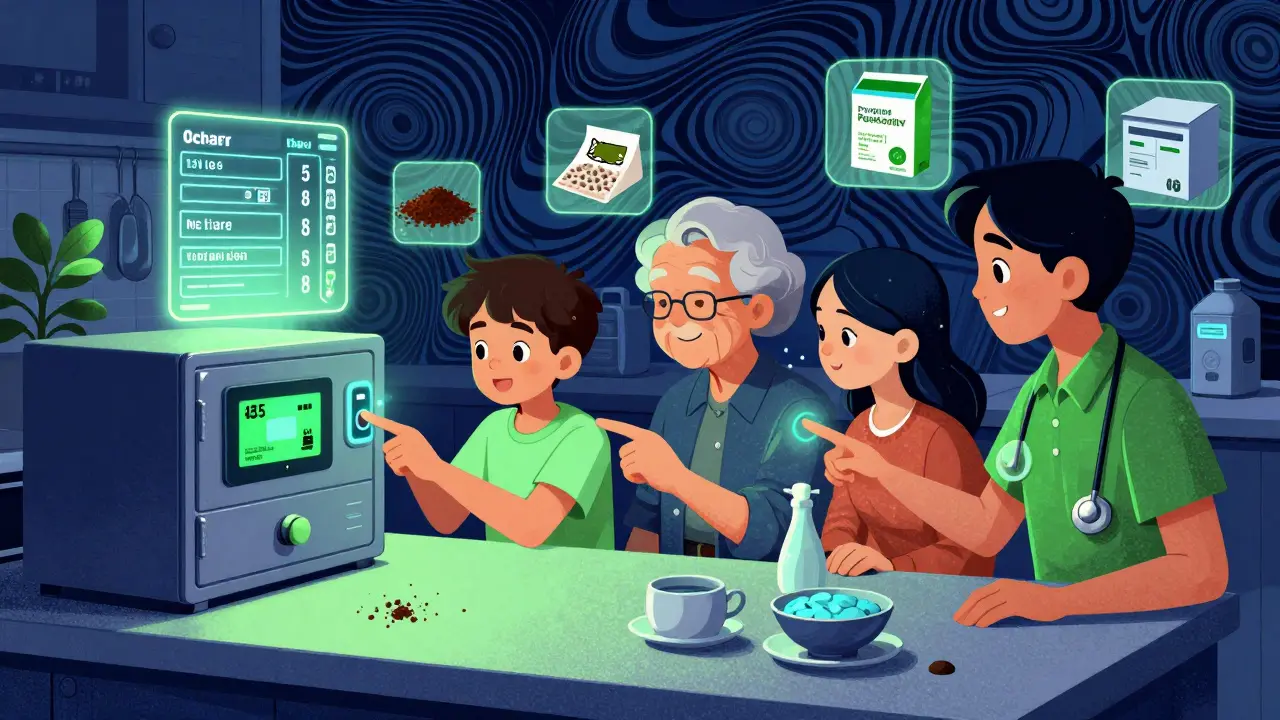
Fix this: Write down your storage plan. Where is the epinephrine? Who knows the code? What’s the expiration date? Put it on the fridge. Share it with family. Keep a printed copy in your wallet. If you’re a caregiver for someone with chronic conditions, make this part of your emergency plan-just like fire drills.
Hospitals use electronic logs. You can do the same with a simple spreadsheet or note app. Log: date checked, temp reading, condition of packaging, expiration date. It takes 60 seconds a month. But if something goes wrong? You’ll know you did everything right.
What About Disposal?
Expired or unused meds? Don’t flush them. Don’t toss them in the trash. The EPA and FDA recommend drug take-back programs. Pharmacies, hospitals, and police stations often have drop boxes.If no take-back is available, mix pills with coffee grounds or cat litter in a sealed bag. Throw it in the trash. Remove labels or scratch out personal info first. This keeps your meds from ending up in waterways or in the hands of someone who shouldn’t have them.
Auto-injectors? Bring them to a pharmacy. They’re hazardous waste. Never cut them open or try to remove the needle yourself.
What’s New in 2026?
The CDC is rolling out updated home storage guidelines in late 2024 focused on naloxone and epinephrine. They’re pushing for “smart storage”-devices that alert you when meds are nearing expiration or when someone opens the box. By 2027, Gartner predicts 65% of healthcare facilities will use AI systems that adjust access based on real-time risk. That’s coming to homes too.For now, the rules are simple: lock it, know where it is, check the temp, train your people, and dispose of it right.
This isn’t about paranoia. It’s about preparedness. The right storage doesn’t slow you down. It gives you confidence-knowing that when every second counts, your meds are ready, safe, and working.
Can I keep emergency meds in my car?
No. Cars get extremely hot in summer-even on mild days, temperatures inside can exceed 40°C, which can destroy epinephrine, insulin, and other sensitive medications. Always store them at home or in a temperature-controlled environment. If you must carry them in the car, use an insulated cooler with a cold pack and never leave them parked in direct sunlight.
Should I lock up my child’s epinephrine pen?
Not in a locked cabinet they can’t reach. Keep it in a secure, high location-like a locked drawer in the kitchen or a medicine safe in the bedroom-that caregivers and school staff can access quickly. The goal is to prevent kids from playing with it, not to make it hard to find during a reaction. Practice opening it with your child’s teacher or babysitter so there’s no delay in an emergency.
How do I know if my medication has gone bad?
Check the color, clarity, and expiration date. Epinephrine should be clear and colorless. If it’s brown, cloudy, or has particles, throw it out. Naloxone should be clear; if it’s discolored or has sediment, it’s not safe. Always replace meds before their expiration date-even if they look fine. Heat exposure can damage them without visible signs.
Can I use a regular lockbox from the hardware store?
Yes, if it’s sturdy and has a reliable lock. A small, metal tool box with a padlock or combination lock works fine. The key is that it’s not easily broken into and keeps out moisture and children. Avoid plastic boxes that can be crushed or pried open. Look for ones labeled as fire-resistant or tamper-evident if possible.
What if I live with someone who uses opioids? How do I store naloxone safely?
Store naloxone separately from the opioids, but in a place everyone knows. Use a lockbox with a shared code or key kept with the person’s emergency contacts. Never hide it in a place only you know. If an overdose happens, someone else might need to act. Make sure your partner, roommate, or family member knows where it is and how to use it. Keep it in the same place every time-consistency saves lives.
Do I need to refrigerate all emergency meds?
No. Only if the label says so. Most epinephrine pens, naloxone sprays, and albuterol inhalers are fine at room temperature (15°C-30°C). Refrigeration is only needed for some insulin pens or specific formulations. Always check the manufacturer’s instructions. Storing meds in the fridge when they don’t need it can cause condensation, which may damage the packaging or medication.
Akshaya Gandra _ Student - EastCaryMS
January 3, 2026 AT 16:16so i just kept my dad's naloxone in his sock drawer lmao guess i was lucky
Dee Humprey
January 4, 2026 AT 19:06Temperature monitoring is a game-changer. I use a little Bluetooth sensor that pings my phone-no more guessing if the epinephrine survived the summer heat. 📊
en Max
January 5, 2026 AT 07:49It is imperative to acknowledge that the pharmacokinetic integrity of emergency medications is contingent upon adherence to manufacturer-specified environmental parameters. Deviations from the prescribed thermal range-particularly above 30°C-may result in irreversible degradation of active pharmaceutical ingredients, thereby compromising clinical efficacy in life-threatening scenarios.
Jacob Milano
January 6, 2026 AT 06:59Why are we still using physical locks? Why not just embed a biometric scanner in the medicine cabinet? The FDA should mandate this. People are dying because we’re still living in the Stone Age of medication storage.
saurabh singh
January 6, 2026 AT 22:28in india we keep emergency meds in the kitchen almirah-away from kids, but easy for aunties to grab. no fancy boxes, just common sense. also, everyone knows the code because we don’t hide things like secrets here 😊
John Wilmerding
January 7, 2026 AT 20:33Thank you for outlining such a comprehensive framework. I would like to add that consistent documentation of storage conditions, coupled with periodic verification by a secondary caregiver, significantly reduces the likelihood of human error during acute events. A simple logbook, maintained monthly, is an underutilized but critical tool.
Peyton Feuer
January 8, 2026 AT 05:16My mom keeps her nitro in a locked jewelry box on her nightstand. It’s not perfect, but she knows it’s there, and so do we. One-touch access, no fuss. Sometimes the simplest solutions are the ones that work.
Angie Rehe
January 8, 2026 AT 09:45Why are you all still talking about lockboxes? The real problem is that people don’t train their families. I had a neighbor who had naloxone but no one knew how to use it. That’s not storage-that’s negligence. Someone should’ve sued her.
Enrique González
January 9, 2026 AT 09:06Just got my first epinephrine auto-injector last month. Took me 3 weeks to stop being terrified of it. Now I keep it in a small safe in the bedroom with a 4-digit code I can remember even if I’m crying. Practice opening it once a week. Muscle memory saves lives.
Shanna Sung
January 10, 2026 AT 04:08They’re watching you. The pharmaceutical companies want you to buy expensive smart boxes so they can track your medication use. Don’t fall for it. Just keep it in the freezer. Cold kills germs-and the government.
Jay Tejada
January 11, 2026 AT 12:26so you’re telling me i should spend $50 on a safe… but my kid already opened the bathroom cabinet and ate three aspirin last year? yeah ok. i’ll get the safe. but honestly? i’m just gonna keep it under the couch.
melissa cucic
January 11, 2026 AT 20:17There is, perhaps, a philosophical undercurrent to this issue: the tension between autonomy and safety, between accessibility and control. We lock away life-saving tools out of fear-yet fear, in its excess, becomes its own kind of death. The solution, then, is not merely logistical, but ethical: to trust, but verify; to secure, but not imprison.
Vikram Sujay
January 12, 2026 AT 20:00In many rural Indian households, emergency medications are stored in a small cloth pouch, tied to the wall near the entrance-accessible to all adults, out of children’s reach. The key is not the container, but the shared knowledge. Culture, not technology, often ensures readiness.
Siobhan Goggin
January 14, 2026 AT 06:54My sister uses a locked drawer in her dresser for her daughter’s epinephrine. She labels it ‘Emergency-Do Not Move’ and has a printed card taped to the front with the code. Simple, effective, and no tech required. Brilliant.
Aaron Mercado
January 15, 2026 AT 17:20And yet, people still keep meds in the bathroom. I’ve seen it. It’s disgusting. Heat, steam, mold-it’s a science experiment in medication decay. You’re not being careful-you’re being stupid. And if your kid dies because you were lazy? That’s on you.