Every year, thousands of people end up in the hospital not because their condition got worse, but because two medicines they were taking clashed in ways no one expected. One might be a common painkiller. The other, a heart medication. Together, they don’t just cancel each other out-they can cause dangerous spikes in blood pressure, muscle breakdown, or even life-threatening bleeding. This isn’t rare. It’s drug-drug interactions-and understanding how they work could save your life.
What Exactly Is a Drug-Drug Interaction?
A drug-drug interaction (DDI) happens when one medication changes how another works in your body. It’s not about side effects from a single drug. It’s about what happens when two or more drugs meet inside you. Sometimes the effect is harmless. Other times, it’s deadly.There are two main types: pharmacokinetic and pharmacodynamic. One changes how your body handles the drug. The other changes how the drug acts on your body. Both matter. Both can be dangerous.
Pharmacokinetic Interactions: How Your Body Moves the Drug
Think of your body like a delivery system. Drugs need to be absorbed, carried around, broken down, and flushed out. If one drug messes with any of those steps, the other drug might build up to toxic levels-or vanish before it can help.The biggest player here is the liver. Specifically, a family of enzymes called cytochrome P450 (CYP). There are five major ones: CYP3A4, CYP2D6, CYP2C9, CYP2C19, and CYP1A2. Together, they handle about 70-80% of all drug metabolism. CYP3A4 alone processes half of all prescription medications.
Here’s how it breaks down:
- Inhibitors slow down these enzymes. That means the other drug sticks around longer. Higher levels. More risk.
- Inducers speed up enzyme production. The drug gets broken down too fast. Less effect. Treatment fails.
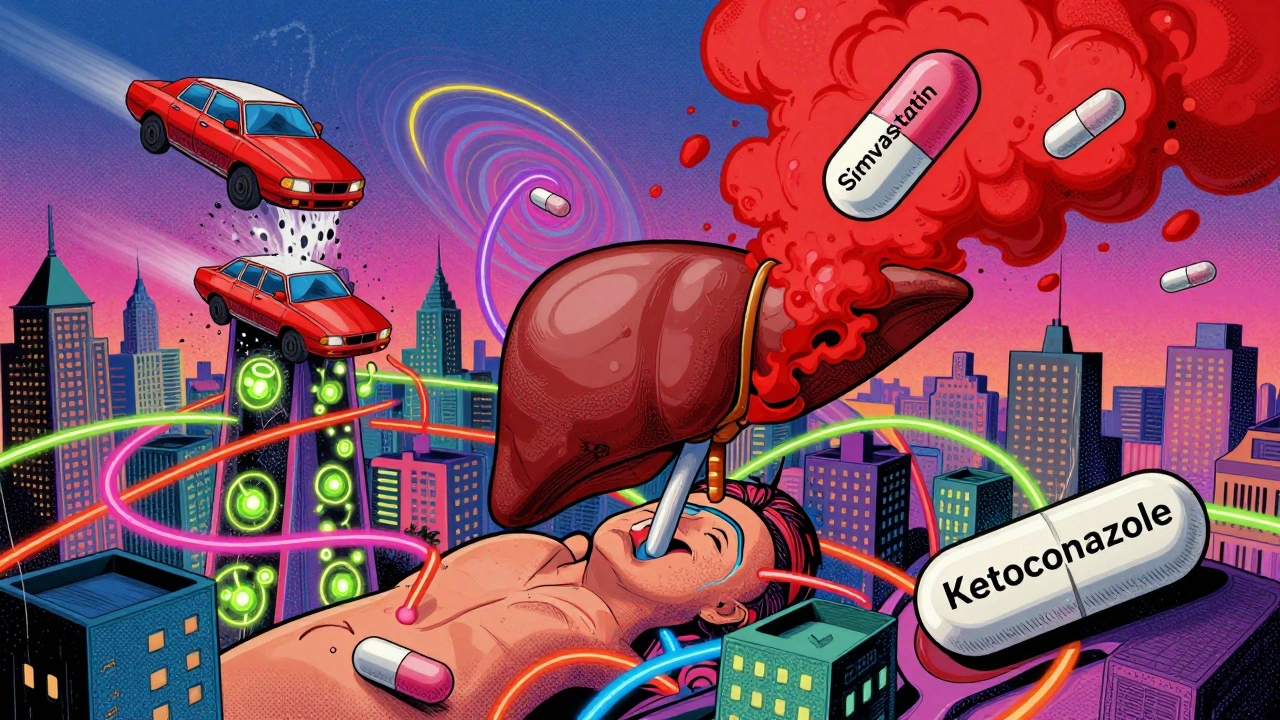
Take simvastatin, a cholesterol drug. If you take it with ketoconazole-a strong antifungal and CYP3A4 inhibitor-your simvastatin levels can spike 10 to 20 times higher. That’s not just a warning. That’s a red flag for rhabdomyolysis, a condition where muscle tissue breaks down and can shut down your kidneys.
Another example: St. John’s Wort, a popular herbal supplement for mood, is a powerful CYP3A4 inducer. It can slash the blood levels of cyclosporine (used after organ transplants) by 50-60%. That’s enough to make the body reject the new organ.
It’s not just the liver. Your gut, kidneys, and transport proteins matter too. P-glycoprotein (P-gp), for example, is a gatekeeper that pushes drugs out of cells. If verapamil (a heart medication) blocks P-gp, digoxin-a drug for irregular heartbeat-builds up dangerously. A 50-100% increase in digoxin levels can trigger fatal heart rhythms.
Pharmacodynamic Interactions: When Drugs Talk to Each Other
This one’s simpler to understand. Two drugs hit the same target in your body-and together, they either amplify or cancel each other out.Synergistic interactions make effects stronger. That’s not always bad. Sometimes doctors use this on purpose. But often, it’s dangerous.
Take fluoroquinolone antibiotics (like ciprofloxacin) and macrolides (like azithromycin). Alone, each can slightly prolong the QT interval-a measure of heart rhythm. Together? That risk jumps 5.7 times. You could develop torsades de pointes, a chaotic heart rhythm that can kill you in minutes.
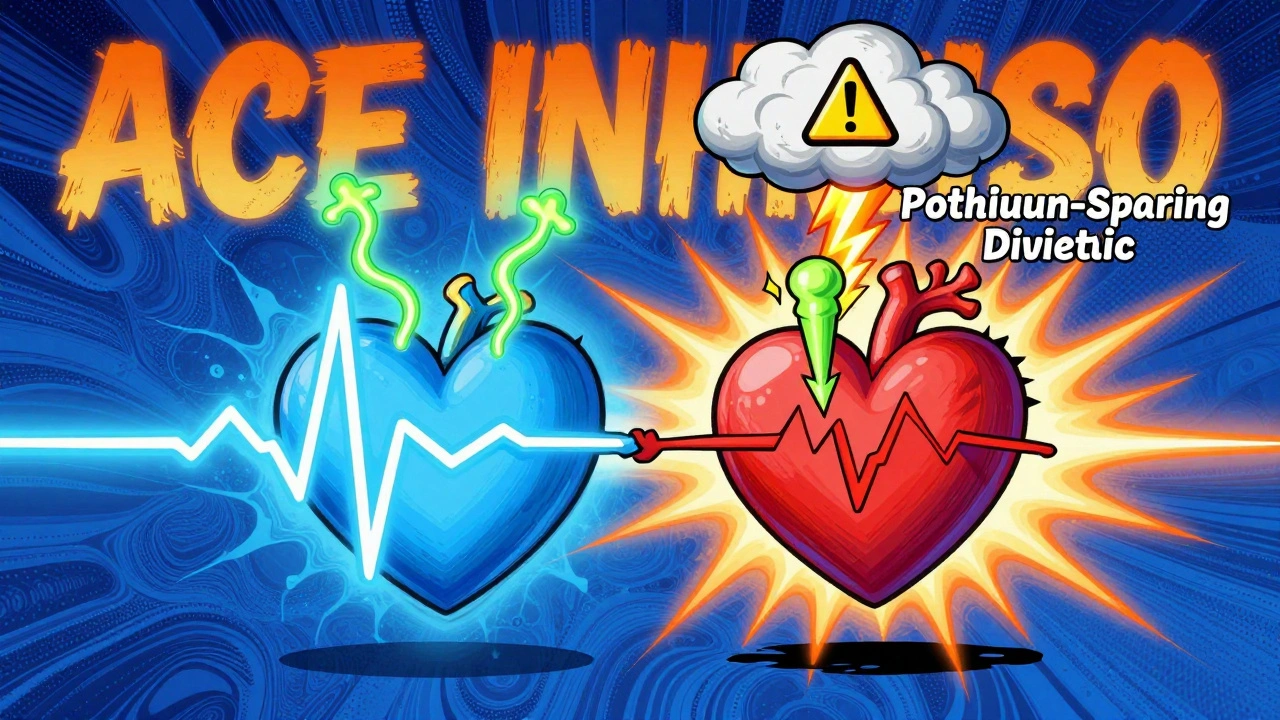
Another classic: ACE inhibitors (like lisinopril) plus potassium-sparing diuretics (like amiloride). Both raise potassium levels. Together, they can push your blood potassium up by 1.0-1.5 mmol/L. Normal is 3.5-5.0. Above 6.0? Cardiac arrest risk skyrockets.
Antagonistic interactions mean one drug blocks the other. This can be useful-like using naloxone to reverse an opioid overdose. But it can also ruin treatment. For example, if you’re on a beta-blocker for high blood pressure and take a decongestant like pseudoephedrine, the decongestant can cancel out the blood pressure control. You think your meds are working. They’re not.
Who’s at Highest Risk?
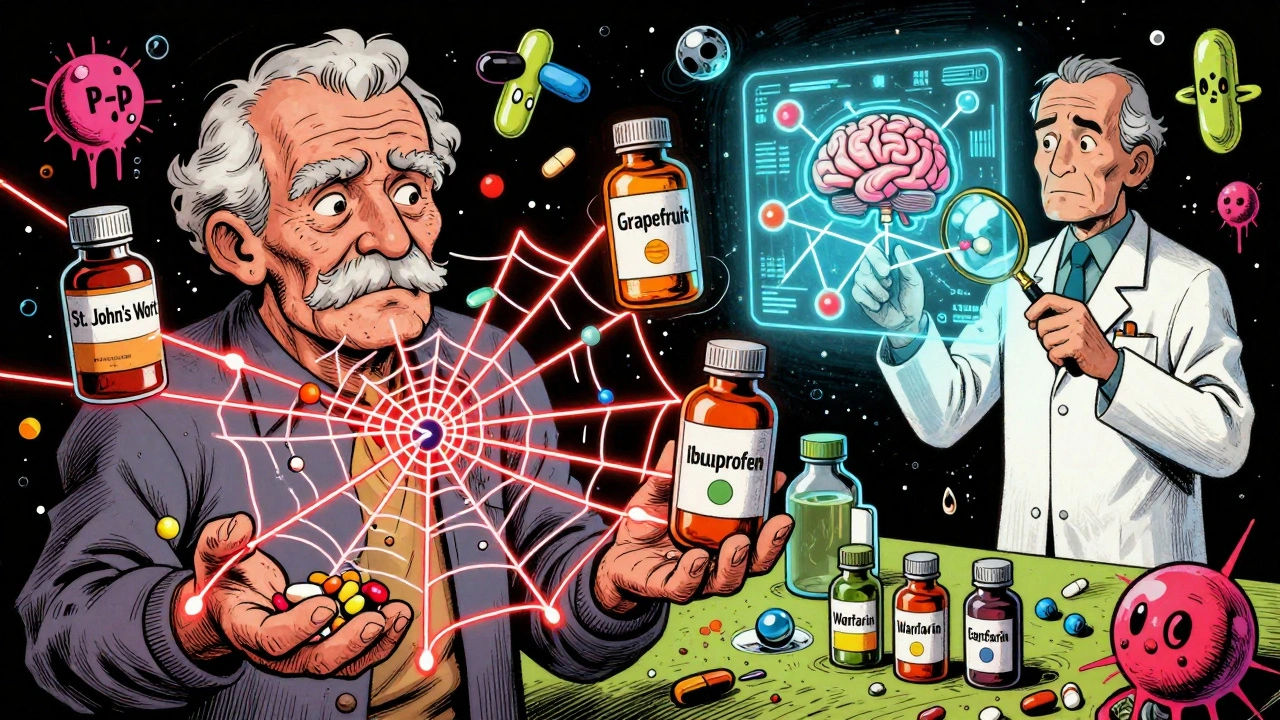
It’s not just about what drugs you take. It’s about how many.People over 65 are the most vulnerable. Why? They’re more likely to be on five or more medications. A 2018 study found DDIs caused 3-5% of all hospital admissions in this group. The Beers Criteria, updated in 2019, lists 30 high-risk combinations for older adults. One of the worst? NSAIDs (like ibuprofen) plus warfarin. That combo triples or quadruples your risk of serious bleeding.
People with kidney or liver disease are also at higher risk. Their bodies can’t clear drugs the same way. Even normal doses can become toxic.
And don’t forget genetics. About 1 in 5 people have a slow version of CYP2D6. That means they process codeine poorly. Codeine turns into morphine via CYP2D6. In slow metabolizers, it doesn’t work. In ultra-rapid metabolizers? It turns into too much morphine too fast. Combine that with a CYP3A4 inhibitor like clarithromycin, and you’ve got a morphine overdose waiting to happen.
How Do Doctors and Pharmacists Catch These?
It’s not magic. It’s systems.Electronic health records now flag potential DDIs. But here’s the problem: they flag too much. A 2022 review found that 80-90% of DDI alerts are false. Doctors get so used to clicking past them, they start ignoring even the real ones. That’s called alert fatigue-and it’s killing people.
Pharmacists are the unsung heroes here. A 2021 study showed pharmacist-led reviews cut serious DDIs by 37% in a group of over 12,000 patients. They check every pill. They ask about supplements. They call doctors.
Specialized tools help too. The Liverpool HIV-Drug Interactions Checker updates daily and covers over 350 antiretroviral combinations. It’s not just for HIV patients. The same principles apply to any complex drug regimen.
What Can You Do?
You don’t need to be a scientist to protect yourself.- Keep a list of everything you take: prescriptions, over-the-counter pills, vitamins, herbs, even CBD oil. Don’t assume “natural” means safe.
- Ask your pharmacist every time you fill a new prescription: “Could this interact with anything else I’m taking?”
- Don’t start supplements without checking. St. John’s Wort, garlic, ginkgo, and even grapefruit juice can trigger serious interactions.
- Know your high-risk meds: Warfarin, digoxin, statins, anti-seizure drugs, and certain antidepressants are common culprits. If you’re on one, be extra careful.
- Report side effects. If you feel weird after starting a new drug, tell your doctor. It might be a DDI.
The Future: Personalized Medicine and AI
The future of DDIs isn’t just about avoiding bad combos. It’s about predicting them before they happen.Pharmacogenomics-testing your genes to see how you metabolize drugs-is already in use. The Clinical Pharmacogenetics Implementation Consortium (CPIC) has 22 guidelines that tell doctors how to adjust doses based on your DNA. If you’re a CYP2D6 poor metabolizer, codeine is off the table. Period.
And AI is stepping in. A 2021 study trained a machine learning model on 89 million electronic health records. It predicted DDIs with 94.8% accuracy-far better than old rule-based systems. Soon, your doctor’s computer might warn you not just about two drugs, but about a whole combo of three, four, or five.
Even the gut microbiome is being studied. Bacteria in your intestines can break down drugs before they’re absorbed. Change your gut flora with antibiotics, and suddenly your medication doesn’t work the same way.
Bottom Line
Drug-drug interactions aren’t theoretical. They’re real. They’re common. And they’re often preventable.You don’t need to memorize every enzyme or transporter. But you do need to be aware. Medications are powerful. They don’t exist in isolation. The pill you take for your back pain might be quietly sabotaging your heart medication. The supplement you think is harmless could be making your blood thinner dangerously strong.
Stay informed. Stay curious. And never assume your doctor knows every pill you’re taking-unless you tell them.
Ollie Newland
December 4, 2025 AT 09:59Been on a cocktail of meds for years - statin, beta-blocker, and that weird antifungal for athlete’s foot. Never realized ketoconazole could turn my simvastatin into a time bomb. My PCP never mentioned it. Thanks for the wake-up call. I’m scheduling a med review this week.
Rebecca Braatz
December 6, 2025 AT 08:32THIS. THIS IS WHY YOU DON’T JUST POP SUPPLEMENTS LIKE CANDY. I used St. John’s Wort for ‘mild anxiety’ - turned my transplant med into useless water. Got hospitalized. Now I check every damn thing with my pharmacist before I touch it. You think it’s natural? It’s still a drug. Fight the myth.
Michael Feldstein
December 8, 2025 AT 05:01Love how you broke this down. The CYP enzymes are wild - like a traffic control system for your meds. And yeah, P-gp is the bouncer at the cell door. I didn’t know verapamil could mess with digoxin like that. My grandma’s on both. Gonna print this out for her doctor. Thanks for making it digestible.
michael booth
December 9, 2025 AT 15:13It is imperative that patients recognize the magnitude of pharmacokinetic interference. The cytochrome P450 system is not a suggestion. It is a biological imperative. Failure to acknowledge this may result in catastrophic outcomes. Please consult with your provider prior to altering any regimen.
Carolyn Ford
December 10, 2025 AT 12:34Oh please. You think this is news? Everyone who’s been on more than two prescriptions knows this. And yet doctors still prescribe lisinopril + amiloride like it’s nothing. And don’t get me started on NSAIDs + warfarin - that’s just malpractice waiting to happen. Why do we still have alert fatigue? Because the system is broken. Not the patients.
Heidi Thomas
December 11, 2025 AT 08:05Stop pretending this is complicated. It’s just pharmacology 101. If you’re taking more than three drugs you’re asking for trouble. My aunt took grapefruit juice with her statin and ended up in ICU. She didn’t read the label. That’s not a DDI. That’s stupidity.
Alex Piddington
December 12, 2025 AT 04:46Great breakdown. I’m a nurse and I see this every shift. People think ‘natural’ = safe. I had a patient take turmeric with warfarin and bleed out in the bathroom. No one told her. We need more education. Not just alerts. Real conversations.
Libby Rees
December 13, 2025 AT 13:29I’ve been on blood pressure meds for 12 years. Never knew grapefruit juice could mess with them. I drink it every morning. I’m switching to orange juice today. Simple change. Big difference.
Dematteo Lasonya
December 13, 2025 AT 16:26My dad’s on six meds. I started keeping a color-coded spreadsheet for him - pills, doses, times, and any supplements. We brought it to his appointment last week. The pharmacist actually smiled. Said it was the cleanest list she’d seen. Small effort. Huge impact.
Rudy Van den Boogaert
December 14, 2025 AT 21:33Had a friend on fluoroquinolone and azithromycin for a sinus infection. Got dizzy, heart racing, ended up in ER. QT prolongation. They didn’t even know it was a combo thing. Now he won’t touch antibiotics without asking about heart risks. Good lesson.
Gillian Watson
December 16, 2025 AT 16:02My mum’s 78 and on five meds. I made her a little card with all her pills and the red flags - like ‘don’t mix with grapefruit’ or ‘watch for muscle pain’. She keeps it in her wallet. She says it makes her feel less scared. Small things matter.
Emmanuel Peter
December 16, 2025 AT 21:48Why are you all acting like this is some big secret? Your doctor’s lazy. Your pharmacist’s overworked. You’re the only one who cares about your body. Stop waiting for permission. Look up your meds. Learn CYP3A4. Google it. You’re not too dumb. You’re just complacent.
Ashley Elliott
December 18, 2025 AT 04:25My brother’s a pharmacist. He says 90% of DDIs are preventable - if patients just say ‘I take this too’ when asked. But most people forget about the fish oil, the melatonin, the CBD gummies. Even ‘harmless’ stuff can flip a switch. Don’t be the person who says ‘I didn’t think it mattered’.
Martyn Stuart
December 18, 2025 AT 10:45Just had a patient come in yesterday - 69, on warfarin, ibuprofen for arthritis, and a new prescription for cipro. Three drugs. One lethal combo. We caught it because she mentioned the ibuprofen. If she hadn’t? She’d be dead by now. That’s why you list everything. Even the ‘tiny’ stuff. Even the ‘I thought it was fine’ stuff.