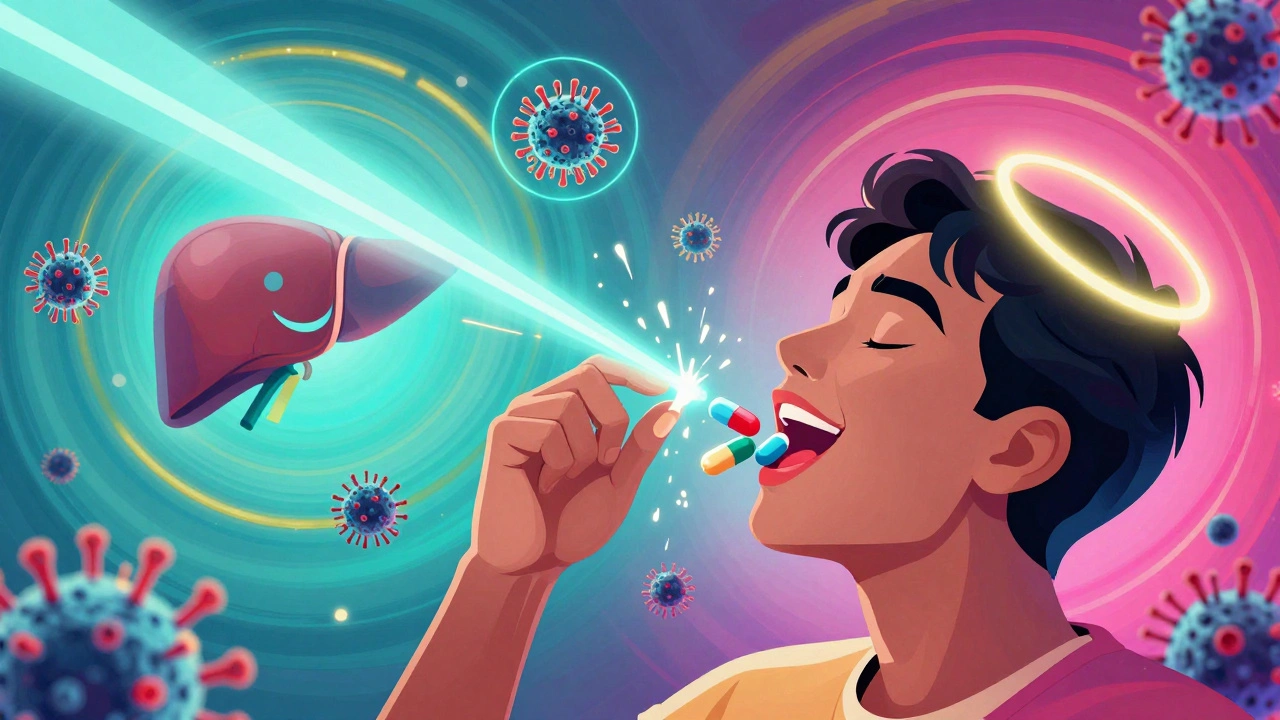
When hepatitis C was first diagnosed, most people faced a long, brutal road: weekly injections, months of fatigue and nausea, and barely a 50% chance of beating the virus. That was the reality before 2013. Today, a simple 8- to 12-week course of oral pills can cure more than 95 out of 100 people infected with hepatitis C. The shift hasn’t just been incremental-it’s been revolutionary.
What Are Direct-Acting Antivirals (DAAs)?
Direct-acting antivirals, or DAAs, are pills that target the hepatitis C virus directly. Unlike older treatments that tried to boost your immune system-often causing severe side effects like depression, anemia, and flu-like symptoms-DAAs block specific parts of the virus’s life cycle. Think of them as precision tools instead of sledgehammers.
They work by attacking proteins the virus needs to copy itself. Three main combinations are now used worldwide: sofosbuvir-velpatasvir, glecaprevir-pibrentasvir, and sofosbuvir-velpatasvir-voxilaprevir. These are called pangenotypic regimens, meaning they work against all major strains of hepatitis C, no matter where you’re from or what genotype you have.
Before DAAs, treatment lasted up to 48 weeks and required injections. Now, you take one to three pills a day, with almost no side effects. Most people report feeling fine during treatment. There’s no need for blood tests every week. No hospital visits. Just pills, a doctor check-in every few weeks, and a blood test at the end to confirm the virus is gone.
Cure Rates: More Than 95%
The numbers don’t lie. In clinical trials and real-world use, DAAs cure hepatitis C in over 95% of cases. A large U.S. study tracking more than 6,600 patients between 2014 and 2021 found that 97.3% achieved a sustained virologic response (SVR)-the medical term for being cured. That means the virus was undetectable in their blood 12 weeks after finishing treatment. And it stayed gone.
Even in people with advanced liver disease, the results are strong. In one study, patients with cirrhosis had an 87% cure rate. Those without cirrhosis had 97%. That’s still far better than anything we had before.
People living with HIV and hepatitis C at the same time? DAAs work just as well for them. A 2024 study showed cure rates matching those of people without HIV. Same for people who use drugs, people in prison, and older adults. The treatment doesn’t care about your background-it cares about the virus.
Why This Matters Beyond the Liver
Curing hepatitis C isn’t just about saving your liver. It’s about saving your whole body.
Studies show that people who achieve SVR have a much lower risk of kidney disease, heart problems, and certain cancers. One study found that treated patients had 30% fewer cases of chronic kidney disease than those left untreated. Another showed a 70% drop in liver-related deaths within five years of cure.
And it’s not just survival-it’s quality of life. People who are cured report less fatigue, better mental health, and fewer hospital visits. Many say they feel like they’ve gotten their life back.
But Not Everyone Gets Treated
Here’s the hard part: even though DAAs work so well, most people with hepatitis C still aren’t getting treated.
In the U.S., less than one in three people diagnosed with hepatitis C start treatment within a year. For Medicaid recipients, the number drops to just 23%. That’s not because the pills don’t work-it’s because of access. Many don’t know they’re infected. Others can’t afford the cost, even with insurance. Some are turned away because their liver damage isn’t “bad enough yet.”
And it gets worse. People with decompensated cirrhosis or liver cancer-those who need treatment the most-are 30% less likely to get it. Why? Because some doctors still think these patients are too risky to treat. But research proves the opposite: curing hepatitis C in these patients improves survival and can even make them eligible for a liver transplant.
Global access is even more unequal. While 91% of high-income countries have approved at least one DAA, only 52% of low- and middle-income countries offer reimbursement. In many places, you need a liver specialist to prescribe it-something most rural clinics don’t have.
Cost Has Fallen-But Barriers Remain
When DAAs first hit the market in 2013, a 12-week course cost $84,000. That sparked global outrage. But things changed fast.
Generic versions are now available in over 100 countries. In places like India and Egypt, a full course can cost as little as $260. Even in the U.S., some state programs and nonprofit groups offer free or low-cost treatment. Insurance companies, pressured by lawsuits and public outcry, now cover DAAs more often than they did five years ago.
But cost isn’t the only barrier. There’s stigma. There’s lack of awareness. There’s a broken healthcare system that doesn’t screen enough people. Many still think hepatitis C only affects people who use drugs. But a huge portion of those infected got it decades ago from blood transfusions or medical procedures before screening was standard.

What’s Next? The Road to Elimination
The World Health Organization wants to eliminate hepatitis C as a public health threat by 2030. That means reducing new infections by 90% and cutting deaths by 65%. We can do it-but only if we fix the gaps.
Simple changes could make a big difference: routine blood tests for all adults over 18, better training for primary care doctors, removing the requirement for specialist referrals, and making DAAs available in pharmacies. Countries like Australia and Egypt have already made huge progress by offering free treatment nationwide.
Here’s the bottom line: hepatitis C is now curable for almost everyone. The science is settled. The pills work. The question isn’t whether we can cure it-it’s whether we’ll make sure everyone who needs it can get it.
What to Do If You Think You Have Hepatitis C
If you’ve ever had a blood transfusion before 1992, used injectable drugs, gotten a tattoo in an unregulated setting, or were born between 1945 and 1965, get tested. It’s a simple blood test.
If you test positive, don’t wait. Talk to your doctor. Ask about DAAs. Ask if your insurance covers them. Ask if there’s a patient assistance program in your area. There are resources. You just have to ask.
And if you’ve already been cured? Tell someone. Share your story. One person getting tested could lead to another getting treated-and another being saved.
What does it mean to be cured of hepatitis C?
Being cured means the hepatitis C virus is no longer detectable in your blood 12 weeks after finishing treatment. This is called a sustained virologic response (SVR). Once you reach SVR, the virus is gone for good in over 99% of cases. You won’t get sick from hepatitis C again unless you’re reinfected-which is rare if you avoid risky behaviors.
Can hepatitis C come back after being cured?
It’s extremely rare. If you achieve a sustained virologic response (SVR), the chance of the virus returning is less than 1%. This isn’t like the flu-it doesn’t hide in your body. Once cleared, it’s gone. However, you can get infected again if you’re exposed to the virus again, such as through sharing needles or unsterile medical equipment.
Do I still need to see a liver specialist after being cured?
If you had cirrhosis before treatment, yes. Even after cure, your liver needs monitoring because the damage may still be there. Your doctor will likely check your liver every 6 to 12 months for signs of liver cancer or worsening scarring. If you didn’t have cirrhosis, routine follow-ups aren’t usually needed unless you have other health issues.
Are there any side effects from DAAs?
Most people have no side effects. The most common are mild fatigue, headache, or nausea-often less than what you’d feel with a cold. Unlike older treatments, DAAs don’t cause depression, anemia, or severe flu-like symptoms. Serious side effects are rare. If you’re taking other medications, your doctor will check for interactions, especially with heart drugs or seizure medications.
Can I drink alcohol after being cured of hepatitis C?
It’s safer than before, but not risk-free. Even after cure, your liver may still have some scarring. Alcohol can worsen that damage over time. If you had cirrhosis, it’s best to avoid alcohol completely. If you didn’t, moderate drinking may be okay-but talk to your doctor. Your liver will thank you.
Andrea DeWinter
December 7, 2025 AT 22:41Just got cured last year with sofosbuvir-velpatasvir and honestly it was the easiest thing I've ever done medically. One pill a day, no side effects, I didn't even miss work. My doctor said I was lucky to catch it early but honestly everyone should get tested if they were born between '45 and '65. It's not a death sentence anymore.
George Taylor
December 8, 2025 AT 14:22Yeah, but let's be real... these pills are still way too expensive in the U.S., and insurance companies still play games with prior authorizations. I had to fight for six months just to get approved. And don't even get me started on how they deny people who don't have 'advanced' liver damage... like, what? We're supposed to wait until we're dying to get help?
Suzanne Johnston
December 10, 2025 AT 10:21It's not just about the pills. It's about the system that lets people slip through the cracks. We've got a cure that works better than most cancer treatments, yet we treat hepatitis C like it's a moral failing. People who use drugs, people in prison, people without stable housing-they're not 'undeserving.' They're just unlucky. And if we can cure 97% of cases, why are we still letting stigma dictate who gets saved?
The real question isn't whether the science works-it's whether we have the collective will to make it accessible. We don't need more studies. We need policy. We need pharmacies to stock these pills. We need primary care docs to screen without a specialist referral. We need to stop punishing people for their past.
And yes, I know some will say 'they brought it on themselves.' But that's not medicine. That's judgment. And medicine was never meant to be a reward system for good behavior.
Chris Marel
December 11, 2025 AT 06:46I'm from Nigeria and we don't even have DAAs in most public hospitals. My cousin got diagnosed last year and had to pay out of pocket for a generic from India. Took three months to get it shipped. He's fine now but imagine if he lived in a village. No one even tests for it here unless you're already sick. We need awareness, not just medicine.
Sabrina Thurn
December 13, 2025 AT 01:59From a clinical standpoint, the SVR rates are extraordinary-pangenotypic regimens have redefined the therapeutic landscape for HCV. The elimination of interferon-based protocols has drastically reduced treatment-related morbidity. However, the persistent disparities in access, particularly among Medicaid populations and incarcerated individuals, represent a profound systemic failure in health equity. Structural barriers-including provider fragmentation, lack of screening protocols, and pharmacoeconomic constraints-continue to undermine public health gains despite therapeutic efficacy.
It's not a question of pharmacology anymore. It's a question of implementation science and political will.
iswarya bala
December 13, 2025 AT 09:06i got cured in 2022 with the generic from india and it cost me like 200 bucks total. my friend in usa paid 15k for the same thing. its not fair. why cant they just make it cheap for everyone? its just pills. not magic. why is money more important than life?
Simran Chettiar
December 15, 2025 AT 00:31One cannot help but reflect upon the metaphysical implications of this medical revolution. The eradication of a viral entity that once carried the weight of social stigma, economic ruin, and biological decay-now reduced to a twelve-week regimen of chemically synthesized molecules-invites us to reconsider the very nature of human vulnerability. Are we not, in essence, engineering our own immortality through pharmaceutical intervention? And if so, does this not render the concept of mortality itself, as it pertains to infectious disease, obsolete? The liver, once a symbol of suffering, is now merely a vessel awaiting restoration. The question remains: who shall be deemed worthy of such restoration, and by what moral calculus is this decision rendered?
Tiffany Sowby
December 15, 2025 AT 01:17So now we're supposed to feel bad for people who got it from drugs? Like, what? They made their choices. Why should I pay for their mistakes through my taxes? We've got real diseases to worry about-like obesity and diabetes. This isn't some heroic medical breakthrough, it's just rewarding bad behavior.
ian septian
December 15, 2025 AT 11:54Test. Get treated. Don't wait. It's that simple.
Stacy Tolbert
December 16, 2025 AT 01:52I was one of those people who got told my liver damage wasn't bad enough. I waited two years. By the time I got treatment, I had early cirrhosis. I'm cured now but I'll never get those two years back. Don't let them gaslight you. If you have HCV, you deserve treatment. No matter what your doctor says.