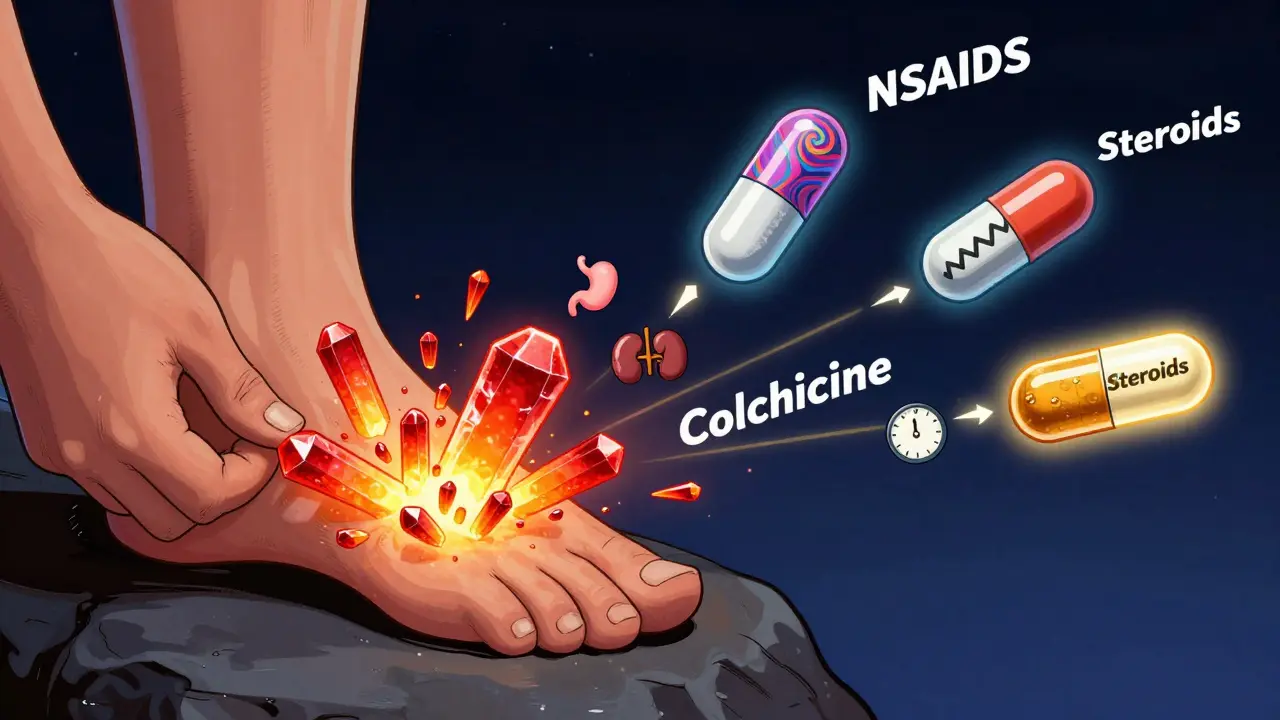
When a gout flare hits, it doesn’t just hurt - it immobilizes. The sudden, searing pain in your big toe, ankle, or knee can turn a simple walk into a nightmare. And if you’ve been there, you know timing is everything. Gout flare treatment works best when started within 24 hours - ideally sooner. But with three main options - colchicine, NSAIDs, and steroids - how do you pick the right one? There’s no single answer. It depends on your body, your other health issues, and what’s safest for you right now.
What Happens During a Gout Flare?
Gout isn’t just bad joint pain. It’s inflammation triggered by uric acid crystals forming in your joints. When these sharp crystals build up, your immune system goes into overdrive, swelling the area, turning it red, hot, and incredibly tender. A flare can come out of nowhere, often at night, and peak within 24 hours. Left untreated, it can last days or even weeks. But with the right drug, most people feel better in 24 to 48 hours.
NSAIDs: The Go-To for Many
Nonsteroidal anti-inflammatory drugs like naproxen, ibuprofen, and indomethacin are the most commonly used first-line treatment for gout flares. They work by blocking the body’s inflammatory chemicals, reducing swelling and pain fast. The NSAIDs are a class of drugs that reduce inflammation and pain by inhibiting COX enzymes. But not all NSAIDs are equal for gout.
Only three - indomethacin, naproxen, and sulindac - have specific FDA approval for gout. Still, doctors often use others like ibuprofen at high doses because they work just as well. For best results, you need strong doses: 500 mg of naproxen twice daily, 800 mg of ibuprofen three times a day, or 50 mg of indomethacin three times daily, usually for 3 to 5 days.
But here’s the catch: NSAIDs aren’t safe for everyone. If you have kidney disease, high blood pressure, heart failure, or a history of stomach ulcers, these drugs can make things worse. They can also bleed your stomach or spike your blood pressure. And if you’re on blood thinners like warfarin, mixing NSAIDs with them is risky. Older adults, who make up a big chunk of gout patients, are especially vulnerable to these side effects.
Colchicine: Less Is More
Colchicine is an ancient drug derived from the autumn crocus, used for centuries to treat gout. It doesn’t reduce inflammation like NSAIDs. Instead, it stops white blood cells from rushing to the site of the crystals, calming the immune response. It’s not a painkiller - it’s a flare blocker.
For years, the standard dose was 4.8 mg over six hours. But that caused nausea, vomiting, and diarrhea in nearly everyone. New studies show you get the same pain relief with just 1.8 mg total - taken as 1.2 mg, then 0.6 mg an hour later. That’s a game-changer. Side effects drop by more than half.
But colchicine has its own dangers. It’s processed by your liver and kidneys. If either is weak - common in older adults or people with diabetes - the drug builds up in your system. Too much can cause muscle damage (rhabdomyolysis), nerve problems, or even life-threatening poisoning. It also interacts with many common drugs, like statins and certain antibiotics. If you’re on those, your doctor needs to adjust the dose or avoid colchicine entirely.
Steroids: The Quiet Hero
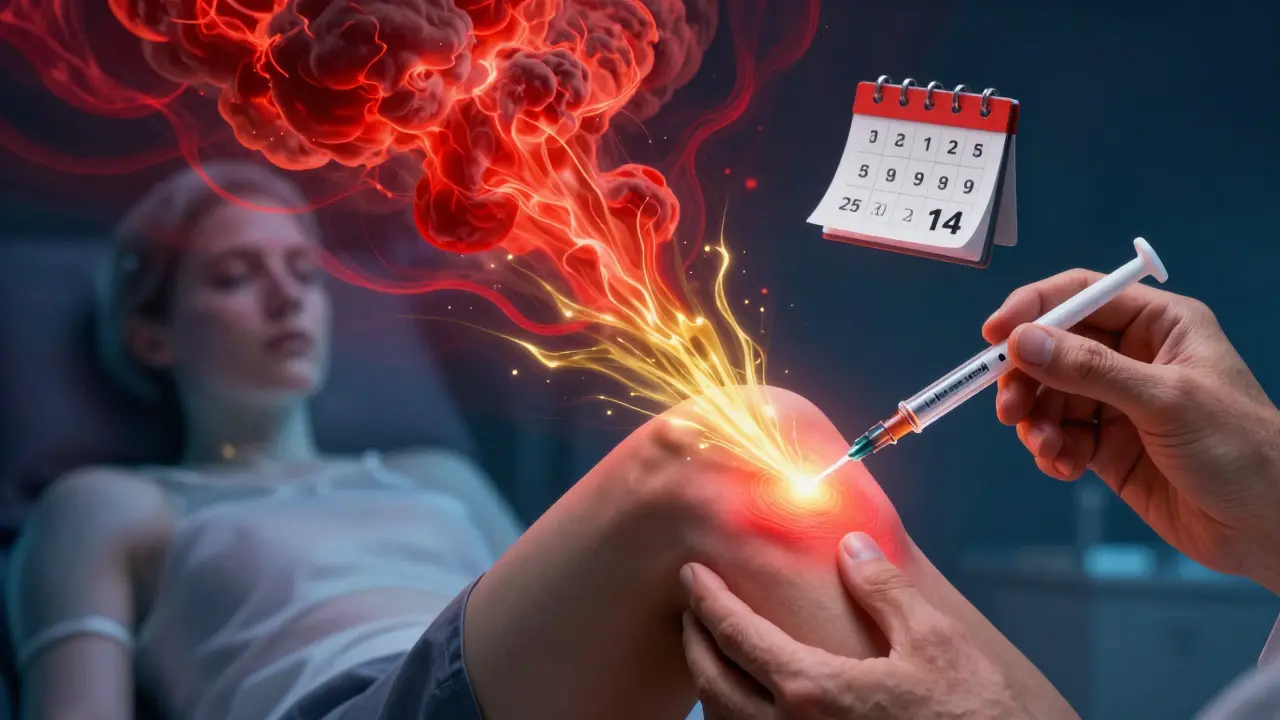
Corticosteroids are powerful anti-inflammatory drugs that mimic natural hormones produced by the adrenal glands. For gout, they come as pills (prednisone), shots (injections), or even IVs. Oral prednisone is the most common - usually 40 to 60 mg on day one, then slowly tapered over 10 to 14 days. For a single swollen joint, an injection right into the joint can work wonders with almost no side effects elsewhere.
Why are steroids gaining favor? Because they’re safer for people with kidney problems, heart disease, or stomach ulcers - the very people who can’t take NSAIDs or colchicine. A 2017 meta-analysis of six studies with over 800 patients found steroids worked just as well as NSAIDs at cutting pain. And they had fewer stomach and kidney side effects.
There’s one big risk: rebound flares. If you stop steroids too fast, the inflammation can come roaring back. That’s why tapering is non-negotiable. You can’t just quit after three days. A slow drop - like 40 mg for two days, then 30, then 20, then 10 - helps your body adjust.
Diabetics need to watch their blood sugar. Steroids can spike it, sometimes dangerously. But with monitoring, it’s manageable. Many doctors now prefer steroids as the first choice because they’re cheap, effective, and avoid the gut and kidney risks of other drugs.
Which One Should You Choose?
There’s no universal winner. It’s about matching the drug to your body.
- If you’re young, healthy, with no kidney or stomach issues - NSAIDs are fine. Naproxen is often preferred because it’s gentler on the stomach than indomethacin.
- If you have kidney disease, heart failure, or take blood thinners - skip NSAIDs. Colchicine might be risky too. Steroids become your best option.
- If you’ve had bad side effects from colchicine before - avoid it. Low-dose steroids are safer.
- If you have one swollen joint - ask about an injection. It’s targeted, fast, and avoids systemic side effects.
- If you’re on multiple medications - talk to your pharmacist. Drug interactions with colchicine and NSAIDs are common and dangerous.
Some patients need more than one drug. If one doesn’t fully control the pain, doctors sometimes combine steroids with colchicine - or NSAIDs with colchicine. This isn’t routine, but it works when flares are stubborn.
What About Prevention?
Treating the flare is only half the battle. Gout is a chronic condition. If you’re starting long-term uric acid-lowering drugs like allopurinol or febuxostat, you’re at higher risk of new flares in the first few months. That’s why most experts recommend taking a low daily dose of colchicine, NSAIDs, or a low-dose steroid for at least three to six months after starting these medications. It’s not optional - it’s essential to keep flares from returning while your body adjusts.
Real-World Advice
Don’t wait. The moment you feel that first twinge, start treatment. Waiting 48 hours means the flare will last longer and hurt more. Doctors often say: "Start within 24 hours - ideally within 24 seconds." That’s not hyperbole. Early treatment cuts recovery time in half.
Also, don’t assume your old gout treatment still works. Your health changes. Kidney function drops. New medications get added. What worked five years ago might now be dangerous. Always check in with your doctor before restarting any drug.
Cost and Accessibility
All three drugs are available as generics, so cost isn’t a barrier. Colchicine and NSAIDs like naproxen cost under $10 a month. Prednisone is even cheaper. But if your insurance blocks a specific drug, ask for alternatives. Most insurers accept any of the three as first-line. The goal isn’t brand - it’s getting you relief fast and safely.
| Drug Class | Typical Dose | Onset of Action | Best For | Key Risks |
|---|---|---|---|---|
| NSAIDs | Naproxen 500 mg twice daily Ibuprofen 800 mg three times daily Indomethacin 50 mg three times daily |
24-48 hours | Healthy patients without kidney, heart, or stomach issues | Stomach ulcers, kidney damage, high blood pressure, bleeding risk |
| Colchicine | 1.8 mg total (1.2 mg then 0.6 mg after 1 hour) | 24-72 hours | Patients with mild kidney disease, no drug interactions | Nausea, diarrhea, muscle damage, dangerous interactions with statins and antibiotics |
| Corticosteroids | Prednisone 40-60 mg daily, tapered over 10-14 days | 12-48 hours | Patients with kidney disease, heart failure, ulcers, or on multiple medications | Rebound flares if not tapered, blood sugar spikes in diabetics |
When to Call Your Doctor
Go to urgent care or call your doctor if:
- Your fever hits 101°F or higher
- The joint becomes red, swollen, and hot - but you’re not sure it’s gout
- You’ve tried one drug and it didn’t help after 48 hours
- You’re on multiple medications and unsure if the flare drug is safe
- You’ve had more than two flares in six months
These aren’t just "bad flares." They’re warning signs. You may need to adjust your long-term gout management - not just treat the pain.
Can I take colchicine and NSAIDs together for a bad gout flare?
Yes, but only under a doctor’s supervision. Combining them can give stronger pain control, especially for severe flares. However, this increases the risk of side effects - especially stomach upset and kidney stress. It’s not routine, but it’s used when one drug alone isn’t enough. Never combine them without medical advice.
Are steroids better than NSAIDs for gout?
For many people, yes - especially if they have kidney disease, heart problems, or stomach ulcers. Steroids work just as well as NSAIDs at reducing pain, but with fewer risks to the gut and kidneys. They’re often preferred for older adults or those on multiple medications. However, they require careful tapering to avoid rebound flares.
Why is low-dose colchicine now preferred over the old high dose?
Because research showed the old high dose (4.8 mg) caused severe nausea and diarrhea in most people, with no extra pain relief. The low dose (1.8 mg total) cuts side effects by over 50% while working just as well. It’s safer, easier to tolerate, and reduces the risk of dangerous overdoses - especially in older adults or those with kidney issues.
Can I use steroids if I have diabetes?
Yes, but with caution. Steroids can spike blood sugar levels, sometimes dangerously. If you have diabetes, your doctor will likely monitor your blood sugar closely during treatment and may adjust your diabetes meds. Short courses (10-14 days) are usually safe if managed properly. Don’t avoid steroids just because you have diabetes - work with your doctor to make it safe.
How long should I take steroids for a gout flare?
Typically 10 to 14 days with a gradual taper. You start with a high dose (e.g., 40-60 mg of prednisone) and reduce it slowly - for example, 40 mg for two days, then 30, then 20, then 10, then stop. Stopping too fast can cause a rebound flare. Never stop steroids suddenly unless your doctor tells you to.
Is it safe to take NSAIDs if I’ve had a heart attack?
Generally, no. NSAIDs increase the risk of heart attack, stroke, and high blood pressure - especially in people with existing heart disease. If you’ve had a heart attack, steroids or low-dose colchicine (if your kidneys are okay) are safer choices. Always talk to your cardiologist before taking any NSAID for gout.
What’s Next?
If you’ve had more than one gout flare, it’s time to think long-term. Gout isn’t just about pain - it’s about preventing joint damage, kidney stones, and chronic inflammation. Work with your doctor to lower your uric acid levels with medication like allopurinol or febuxostat. And don’t stop your flare-prevention meds too soon. Most people need to take colchicine, NSAIDs, or low-dose steroids for at least three months after their uric acid drops below 6 mg/dL - and six months if you’ve had tophi (those chalky lumps under the skin). Treat the flare. Then treat the disease.
lela izzani
February 24, 2026 AT 14:44Just had my first gout flare last month and this post saved me. I started naproxen within 12 hours and felt way better by morning. Didn’t even need to go to the ER. Seriously, if you’re reading this and you’re hesitating-just start the med. Don’t wait for it to get worse.
Stephen Archbold
February 24, 2026 AT 16:57lol i thought colchicine was just for rich people with fancy prescriptions until i found out it costs like $8 a month. my dr switched me from ibuprofen to low dose colchicine after i got kidney stats from my last checkup. no more bloating, no more stomach drama. 1.2 then 0.6? yeah that’s the move. also, steroids r underrated-i got a knee injection and it was like magic. no tapering needed for me, but i’m not dumb enough to skip it if i’m on oral.
Gabrielle Conroy
February 25, 2026 AT 05:41OMG YES!! I’ve been on low-dose colchicine for years now, and I can’t believe how much it’s changed my life!! 🙌 I used to have flares every 2-3 months, now it’s maybe once a year if I’m REALLY bad (like eating 3 steaks in a row… don’t judge me 😅). The new dosing? Game. Changer. Also, PLEASE if you’re on statins-talk to your pharmacist. I almost didn’t make it through last winter because I didn’t realize simvastatin + colchicine = bad news. My dr almost had a heart attack when I told him I’d been taking them together for 8 months. 😱
Christopher Wiedenhaupt
February 26, 2026 AT 00:09The data supporting low-dose colchicine is robust and aligns with current guidelines from the American College of Rheumatology. NSAIDs remain first-line in low-risk populations, but comorbidities such as chronic kidney disease, cardiovascular disease, and gastrointestinal pathology necessitate a shift toward corticosteroids. The 2017 meta-analysis referenced is particularly compelling due to its inclusion of randomized controlled trials with low risk of bias. One should also note that oral prednisone is not equivalent to intra-articular injection in terms of systemic exposure. Clinical judgment remains paramount.
John Smith
February 27, 2026 AT 06:59So you’re telling me the same drug that’s been used since ancient Egypt is now "the new hot thing" because they cut the dose by 60%? Wow. Groundbreaking. I’m sure the pharmaceutical companies are thrilled. Meanwhile, my uncle took 4.8 mg back in '98 and lived to be 87. Maybe we should just let people die and save the healthcare system some money.
Shalini Gautam
February 28, 2026 AT 02:55Why are Americans so obsessed with pills? In India, we treat gout with turmeric, ginger, and cold water baths. No drugs needed. If your body can't handle a little pain, maybe you're eating too much meat and too little dal. I had a flare last year and I just drank warm water with lemon and a pinch of black pepper. Gone in 12 hours. No doctor. No prescription. Just wisdom.
Natanya Green
February 28, 2026 AT 17:25WAIT. WAIT. WAIT. So you’re saying steroids are SAFE?? Like… ACTUALLY safe?? I thought they turned you into a rage monster with a moon face!! 😭 I’ve been terrified of them since I saw my cousin turn into a pufferfish after one course. But… if they’re safer than NSAIDs for my kidneys?? And I can taper?? And I don’t have to take 10 pills a day?? I’m crying. I’m actually crying. My dr never explained this. I’m gonna call them right now. Thank you. Thank you. THANK YOU.
Steven Pam
March 1, 2026 AT 14:38Just wanted to say-this is one of the clearest, most helpful breakdowns I’ve ever read on gout. Seriously. I’ve been dealing with this for 12 years and never had anyone lay it out like this. I’ve been on steroids twice now, and the tapering thing? Total game-changer. I did 40-30-20-10-0 over 10 days and didn’t have a rebound. Also, low-dose colchicine? I’m hooked. No nausea. No drama. Just peace. If you’re reading this and you’re still scared of steroids-give them a real shot. Talk to your doc. They’re not the enemy. The flare is the enemy.
Timothy Haroutunian
March 2, 2026 AT 06:58Look I get it, everyone’s got their favorite drug and their anecdote and their doctor’s recommendation but here’s the truth no one wants to admit-gout is just a consequence of being a lazy, overeating mess. You don’t need a 12-page guide on which pill to take, you need to stop drinking beer after 6pm, stop eating liverwurst sandwiches, and start walking. I’ve had three flares in three years and guess what? I didn’t take any of these drugs. I just changed my life. The medicine is just a bandaid. The real cure is not being an idiot.
Erin Pinheiro
March 2, 2026 AT 10:49Ugh. I just got back from the ER because I took naproxen and it gave me a stomach bleed. My dr said I should’ve been on steroids. But I didn’t read the fine print. I thought "NSAIDs" meant "safe for everyone." I’m so mad. I’m 52. I have diabetes. I take metformin. I didn’t think I was high risk. Now I’m on prednisone and I hate how it makes me feel. Why didn’t anyone tell me?? Why is this info so hard to find?? I feel so stupid.
Michael FItzpatrick
March 3, 2026 AT 16:34Let me paint you a picture: gout isn’t just pain-it’s betrayal. Your own body turns on you like a jealous ex. And the drugs? They’re not magic bullets-they’re peacekeepers. Colchicine? It’s the diplomat whispering to your immune system: "Calm down, we’re not at war." NSAIDs? The bouncer throwing out the inflammation thugs. Steroids? The SWAT team that shows up, does the job, then leaves quietly-if you let them taper. But here’s the kicker: none of them fix the root. The real hero? A life that doesn’t invite the crystals in the first place. But hey, if you’ve got flares, you’ve got options. Use ‘em wisely.
Brandice Valentino
March 5, 2026 AT 16:28I mean… I guess if you’re a peasant with no insurance and no access to a rheumatologist, maybe these drugs are fine. But if you’re someone who actually cares about quality of life, you should be on febuxostat + colchicine prophylaxis + monthly joint injections. Anything less is just… basic. Like, why settle for prednisone when you could be getting a biologic? I’m just saying. Also, NSAIDs? Those are for people who still use Windows XP.
Larry Zerpa
March 6, 2026 AT 16:46Let’s be real. This whole post is just pharmaceutical marketing dressed up as medical advice. Colchicine? A century-old toxin repackaged as a "low-dose miracle." Steroids? A band-aid that causes diabetes and osteoporosis. NSAIDs? A recipe for GI bleeds and renal failure. And you’re telling me this is the best we’ve got? Of course it is. Because the system doesn’t want to cure gout-it wants to monetize it. Every single drug here is a recurring revenue stream. The real solution? Stop eating purines. But that’s not profitable. So here we are. Millions of people on pills while the root cause festers.
Nandini Wagh
March 6, 2026 AT 23:33Wow. So you’re saying steroids are good now? Funny. Last week my cousin’s doctor told her they’re basically steroids and she cried for three days. Now she’s on prednisone and says she feels like a new person. I guess science is just… weird. Also, I still think turmeric works better. But hey, whatever floats your boat. 🤷♀️