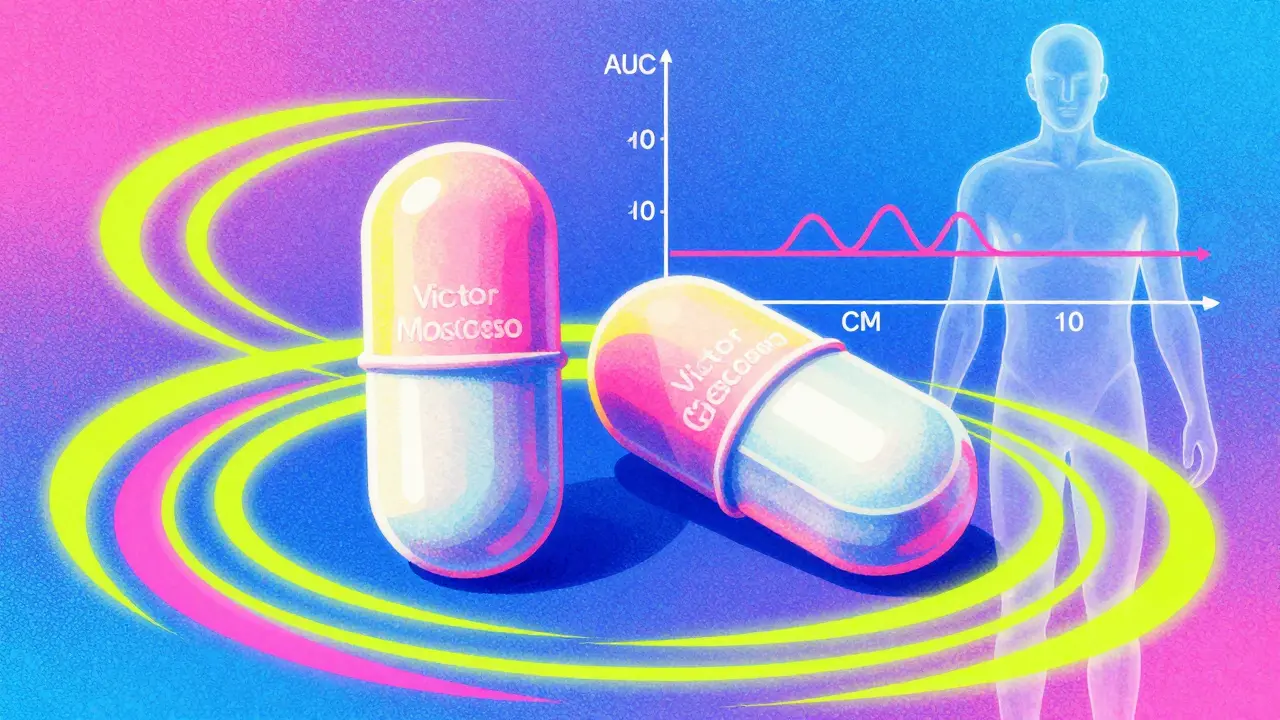
When you pick up a generic pill at the pharmacy, you might wonder: does it work the same as the brand-name version? After all, it looks different, costs less, and often comes from a company you’ve never heard of. But here’s the truth: generic absorption rates are tightly controlled-so tightly, in fact, that the difference between a generic and its brand-name counterpart is often smaller than the variation you’d see if you took the same brand drug twice on different days.
What Does ‘Absorption Rate’ Even Mean?
Absorption rate isn’t about how strong the drug is. It’s about how fast and how much of the active ingredient gets into your bloodstream. Two numbers matter most: AUC (Area Under the Curve) and Cmax (Maximum Concentration). AUC tells you the total amount of drug your body absorbs over time. Cmax tells you how quickly it peaks. If these numbers are too far off between a generic and brand drug, you could get too little relief-or too much side effect.The 80-125% Rule: Not a Range of Tolerance, But a Tight Lock
The FDA doesn’t say generics can be 20% weaker or 25% stronger. That’s a myth. The real rule is this: the 90% confidence interval for the ratio of geometric means (generic to brand) for both AUC and Cmax must fall completely within 80% to 125%. That’s not a suggestion. It’s a legal requirement for approval. Think of it like this: if you measured your blood pressure twice in one day, you’d get slightly different numbers. Your body changes. Your diet, hydration, even stress levels affect absorption. The 80-125% range was chosen because it accounts for natural human variation. If a generic drug stays within that window, it’s not just “close enough”-it’s clinically identical. And the data backs it up. A review of over 2,000 FDA bioequivalence studies found that, on average, generics differ from brand drugs by just 3.5% in absorption. In nearly 98% of cases, the difference was under 10%. That’s less than the fluctuation you’d see from one dose to the next of the same brand drug.Dissolution Isn’t the Same as Absorption
You might hear that some generics dissolve slower or faster in a lab test. And that’s true. A 2014 study found that over half of tested generics had different dissolution profiles than their brand-name versions. One generic nifedipine took much longer to break down. Another amoxicillin dissolved faster. But here’s the key: dissolution is just the first step. A pill can dissolve quickly but still not absorb well if the ingredients don’t cross into your bloodstream properly. That’s why the FDA requires in vivo studies-real tests on real people. If the drug gets into the blood at the same rate and amount as the brand, the pill’s color, shape, or how fast it breaks apart in a beaker doesn’t matter.
What About Narrow Therapeutic Index Drugs?
Some drugs are like walking a tightrope. Too little, and they don’t work. Too much, and they’re toxic. Warfarin, digoxin, phenytoin, and levothyroxine fall into this category. For these, the FDA demands tighter standards: the 90% confidence interval must fall between 90% and 111% for AUC. That’s a much smaller window. Even then, the evidence shows these generics are safe. A 2023 meta-analysis of 47 studies involving nearly 10,000 patients found no difference in outcomes between generic and brand-name cardiovascular drugs. The FDA has documented only 12 cases of possible therapeutic failure out of more than 14,000 approved generics between 2008 and 2023. That’s a 0.08% failure rate.Why Do Some Patients Say They Feel Different?
If the science says generics are the same, why do some people swear their generic bupropion doesn’t work as well-or that their thyroid meds feel off after switching? First, brand-name drugs are consistent. You’ve been on the same pill for years. Your body adapts. Then you switch to a generic that looks different, tastes different, or comes in a different capsule. Your brain notices. Sometimes, that’s enough to trigger a placebo effect-or nocebo effect-where you expect to feel worse, so you do. Second, not all generics are made the same. Different manufacturers use different fillers, binders, or coatings. That’s why you might notice a difference if you switch from one generic brand to another. But even then, each version still meets the 80-125% rule. Third, some patients are on very sensitive medications. For those, doctors may recommend staying on the same generic manufacturer-or even the brand-if switching causes instability. The American College of Physicians supports this approach for narrow therapeutic index drugs.What the FDA and Experts Really Say
The FDA’s position is clear: approved generics are therapeutically equivalent. Dr. Tsourounis, a clinical pharmacy specialist, puts it simply: “There’s generally no pharmacological reason for these impacts. I look to other causes-maybe a placebo effect based on myths.” Dr. Steven E. Sharfstein, former president of the American Psychiatric Association, has said concerns about switching psychiatric meds to generics are largely unfounded when bioequivalence standards are met. The American College of Physicians agrees-except for those narrow index drugs. The data doesn’t lie. Generic drugs account for 90% of all prescriptions filled in the U.S. But they make up only 23% of total drug spending. That’s because they’re cheaper, not because they’re weaker.
Chris Buchanan
December 23, 2025 AT 10:28So let me get this straight-you’re telling me I’ve been overpaying for blue pills my whole life because I thought the brand name meant it was stronger? My wallet’s crying tears of joy and my pharmacist just got a raise.
claire davies
December 25, 2025 AT 07:11Oh my gosh, I love this breakdown so much. I used to be terrified of generics-like, I’d stare at the label like it was a foreign language, wondering if the little white pill was secretly plotting against me. But then I switched my blood pressure med to generic, and honestly? My BP’s been more stable than my Wi-Fi during Zoom calls. Turns out, my body doesn’t care if the pill’s shaped like a star or a moon, as long as the science is solid. The 80-125% rule? That’s not a loophole-it’s a love letter to patient safety wrapped in a spreadsheet. And the fact that generics save billions? Honey, that’s not just smart economics, that’s justice in pill form.
Spencer Garcia
December 26, 2025 AT 22:35Generic = same drug. Stop overthinking it.
Abby Polhill
December 27, 2025 AT 05:00It’s fascinating how the FDA’s bioequivalence paradigm leverages geometric mean ratios with 90% CIs to constrain pharmacokinetic variance within clinically insignificant thresholds-essentially normalizing inter-individual variability through statistical rigor. The dissolution profile mismatch you referenced? Totally orthogonal to AUC/Cmax bioequivalence. The in vivo data is the gold standard, not the in vitro.
Raja P
December 27, 2025 AT 23:22I used to work in a pharmacy in Mumbai, and folks would always say, 'This Indian generic can't be as good as the American one.' But I'd show them the FDA reports and the lab sheets. Same active ingredient, same absorption curve. They’d be shocked. Money talks, but science whispers louder. Glad to see this info out there.
Rachel Cericola
December 29, 2025 AT 14:00Let’s be real-people who say generics don’t work are either clinging to brand loyalty because they’ve been sold a myth for decades, or they’re one of the 0.08% who actually had a formulation issue. And guess what? That’s why you talk to your pharmacist when you switch. Not because generics are bad, but because different fillers can affect absorption speed slightly-even if they’re still within the 80-125% window. This isn’t about fear. It’s about informed choices. The system works. Don’t let fear-mongering or placebo effects sabotage your health savings. You’re not being cheap-you’re being smart. And if your doctor says stick with the brand? Fine. But don’t assume the generic is inferior unless you’ve got hard data to back it up. The data doesn’t lie.
Delilah Rose
December 31, 2025 AT 05:16I’ve been on levothyroxine for 12 years. I switched from Synthroid to a generic and felt like I’d been hit by a truck-fatigue, brain fog, weight gain. I went back to the brand, and boom, back to normal. My endocrinologist said it happens. Not because the generic is 'bad,' but because my body is hypersensitive to tiny variations in fillers. The FDA says it’s fine, but my body doesn’t care about FDA stats-it cares about how I feel. So if you’re on a narrow therapeutic index drug, don’t just trust the numbers. Listen to your body. And if you’re stable on one generic, don’t let the pharmacist swap it out without asking. Your thyroid doesn’t care about cost savings-it just wants consistency.
Andy Grace
January 1, 2026 AT 18:15Interesting read. I’ve seen patients panic over generic switches, especially with psychiatric meds. The placebo effect is powerful, but so is the nocebo. I always tell them: if you feel different, document it. Track symptoms, mood, side effects. Then compare. Often, the change is psychological. But if the data shows a real shift? Then we investigate the manufacturer. Not the generic label. The system’s good. But humans? We’re messy.
Joseph Manuel
January 3, 2026 AT 05:50While the statistical framework presented is methodologically sound, it remains fundamentally flawed in its assumption that bioequivalence equates to therapeutic equivalence. The 80-125% confidence interval permits a 25% variance in peak concentration, which, when compounded with inter-patient pharmacokinetic variability, can lead to clinically significant deviations in drug exposure. The cited meta-analysis fails to account for subpopulations with altered hepatic metabolism, renal clearance, or comorbidities. Furthermore, the 12 reported cases of therapeutic failure may represent only a fraction of underreported adverse events. Regulatory compliance does not equate to clinical infallibility. A more rigorous, individualized approach to generic substitution is warranted.