When it comes to getting affordable medicines across Europe, the system isn’t as simple as it looks. A pill that costs €2 in Poland might still be €15 in Germany-even if it’s the exact same drug. Why? Because the European Union doesn’t have one single rulebook for generic medicines. Instead, it has four different paths for approval, each with its own delays, costs, and hidden traps. And in 2025, everything changed.
How Generic Drugs Get Approved in the EU
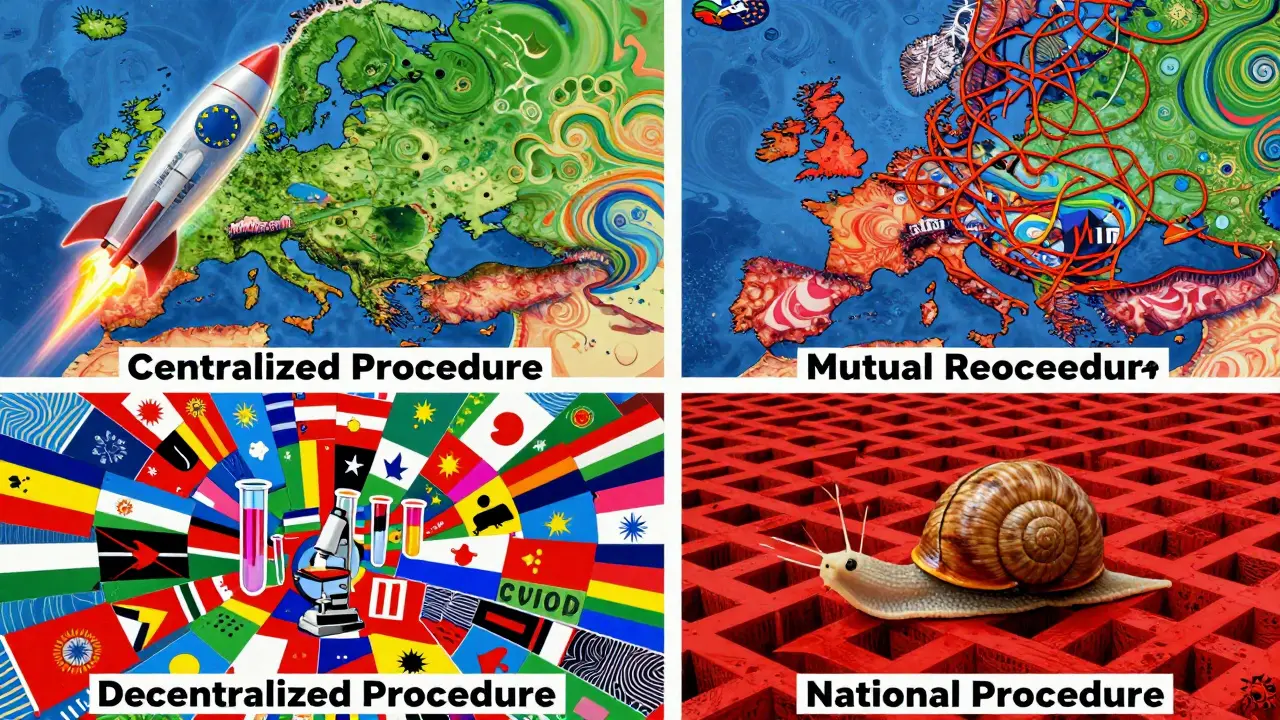
There are four main ways a generic drug can get approved in the EU. Each one is used by different companies depending on their size, budget, and target markets. The Centralized Procedure is the fastest way to sell a generic drug across all 27 EU countries plus Iceland, Liechtenstein, and Norway. But it’s also the most expensive. Companies must submit one application to the European Medicines Agency (EMA), and if approved, the drug is authorized everywhere. This route takes about 180 days under the new 2025 rules, down from 210. But the cost? Around €425,000 in fees alone, plus another €1.2 to €1.8 million in consulting and study costs. Only big players like Sandoz or Viatris use this for high-value generics-think drugs that could bring in over €250 million in sales across Europe.
The Mutual Recognition Procedure (MRP) is the most common. About 42% of generics use this path. A company gets approval in one country-called the Reference Member State-and then asks other countries to recognize it. Sounds simple, right? In theory, yes. In practice, no. Countries often drag their feet. A 2024 IQVIA report found that while the official clock says 90 days for consensus, the real average is 132.7 days. Teva learned this the hard way with a generic version of rosuvastatin. Even after getting approval in Germany, it took over eight months to get pricing agreed upon in the Netherlands and Belgium. That’s money lost in storage, delayed sales, and lost market share.
The Decentralized Procedure (DCP) is meant for companies that want to launch in multiple countries at once-without needing prior approval anywhere. But this is where things get messy. About 38% of generics use this route, and 37% of those face delays longer than six months. Why? Because countries like Poland, Romania, or Bulgaria interpret quality standards differently than Germany or France. A stability study that passes in Paris might get rejected in Bucharest over a tiny difference in how they test polymorphic forms. A 2024 GMDP Academy case study called it a “patchwork of rules,” and generic manufacturers are fed up.
Then there’s the National Procedure. Only 5% of applications use this, and it’s usually for companies targeting one specific market. Maybe it’s France, where reimbursement rates are high. Or Austria, where there’s less competition. But this path is slow-180 to 240 days-and defeats the whole point of EU harmonization. Accord Healthcare found that getting approval in France alone took 197 days, while using MRP for the same drug across five countries took just 142 days.
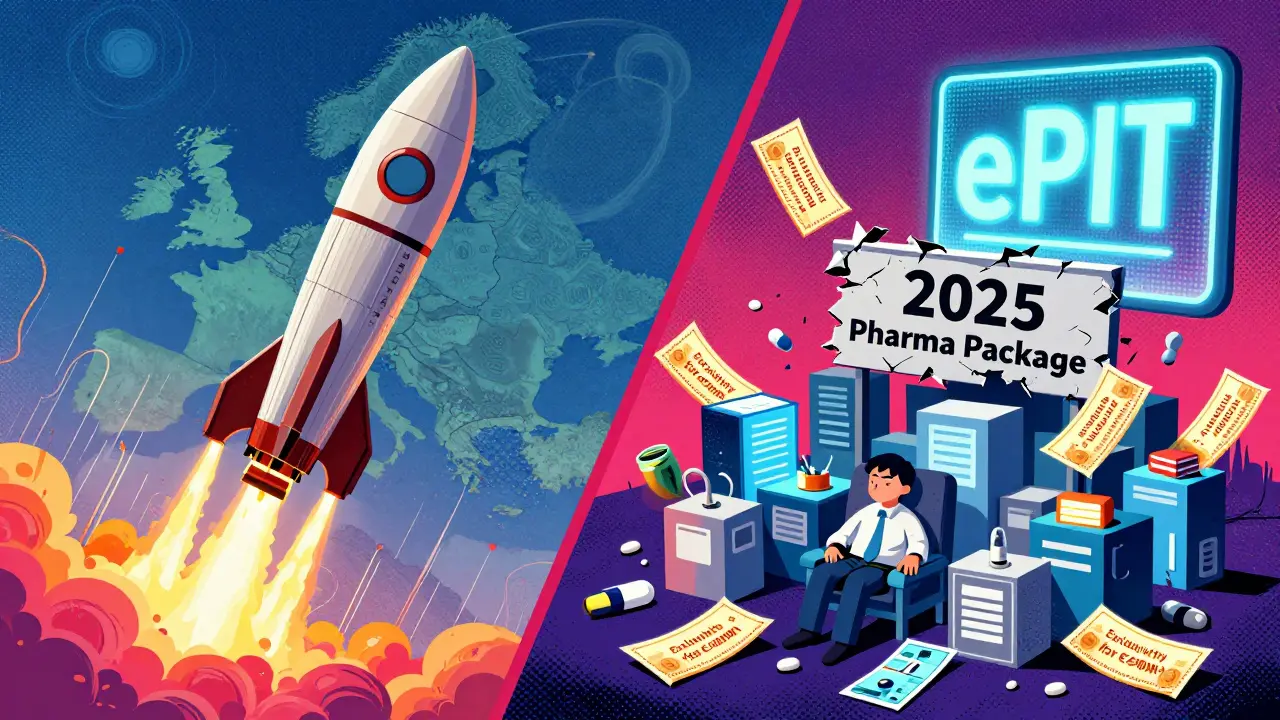
The 2025 Pharma Package: What Changed
The biggest shift happened on June 4, 2025, when the EU’s Pharma Package became law. It’s the most significant update to generic drug rules in 20 years. One major change? The Bolar exemption got longer. Before, generic companies could start negotiating prices and reimbursement with health authorities only two months before a patent expired. Now, they can start six months before. That might not sound like much, but it cuts the time to market by an average of 4.3 months per product, according to REMAP Consulting’s 2025 model. That’s huge. It means generics can get on shelves faster, and payers can start comparing prices earlier-pushing down launch prices by 12-18%.
Another big change? Regulatory Data Protection. Previously, a brand-name drug’s data was protected for 10 years. Now it’s 8 years, plus one extra year if the company meets public health goals-so up to 9 years total. For some complex drugs, like biosimilars, that extra year can be extended to two. This still gives innovators enough incentive to develop new drugs, but it opens the door for generics sooner than before. Evaluate Pharma estimates this alone will speed up generic entry for 78 high-value biologics currently in development.
But not all changes are welcome. A new rule called the Transferable Exclusivity Voucher gives a 1-year bonus to companies that develop generics for rare diseases. Sounds good? Maybe. But there’s a catch: only companies with EU-wide sales over €490 million qualify. That means small and mid-sized generic firms are locked out. Big players like Sandoz can buy these vouchers and extend exclusivity on their own products. It’s a loophole that favors giants.

Why Some Countries Are Slower Than Others
It’s not just about the approval process-it’s about what happens after approval. Germany’s BfArM requires extra pharmacodynamic studies for inhalers and injectables, even when the EMA says they’re not needed. France demands specific pediatric formulations even for adult-only generics. Italy has its own impurity profiling rules for older reference products. These aren’t just paperwork-they’re delays. A 2025 ABPI survey of 47 generic companies found that 68% listed inconsistent national requirements as their biggest headache.
And then there’s the obligation to supply rule. Starting in 2025, manufacturers must ensure “sufficient quantities” of generics are available. Sounds fair. But what does “sufficient” mean? Germany says it’s 120% of demand. Romania says it’s 80%. The lack of clarity means some countries are quietly limiting supply-not because they can’t make enough, but because they don’t want to flood the market and hurt prices. Professor Panos Kanavos from LSE Health called this a “hidden barrier,” warning it could delay access in smaller markets.
Who’s Winning and Who’s Losing
Indian manufacturers now account for 38% of all generic approvals in the EU-up from 29% in 2020. Companies like Dr. Reddy’s and Sun Pharma are thriving because they focus on high-volume, low-cost generics and use the MRP and DCP to spread risk across markets. Meanwhile, European firms like Sandoz and Viatris are doubling down on the Centralized Procedure. Sandoz’s 2025 launch of a generic version of Cosentyx was a textbook success: simultaneous approval across 30 countries, 11 months faster than MRP would have allowed.
But smaller European generics? They’re stuck. The cost of Centralized Procedure is out of reach. The MRP is too unpredictable. And the DCP? Too risky. Many are turning to national approvals just to stay alive. But that’s a short-term fix. With the new ePI (electronic product information) rule coming in 2026-requiring XML submissions and €180,000-250,000 in IT upgrades-many small firms won’t survive.
What’s Next for Generic Drugs in Europe
The EU is trying to fix a broken system. The goal is to get generics to market faster, reduce shortages, and cut prices. By 2028, analysts predict generic prescriptions will rise from 65% to nearly 69.2% of all prescriptions. That’s good for patients. But the system is still fragmented. The 2025 reforms help, but they don’t fix everything. The real test will be how well national authorities align with EMA standards. If Germany, France, and Poland keep doing their own thing, patients will keep paying more and waiting longer.
For manufacturers, the lesson is clear: don’t guess the path. Study the market. Know the costs. Understand the delays. And for small companies? Focus on one country first. Build cash flow. Then expand.
For patients? The system is getting better-but not fast enough. The same pill, same science, same manufacturer, but different prices and delays across borders. That’s not efficiency. That’s bureaucracy.
What are the four approval pathways for generic drugs in the EU?
The four pathways are: the Centralized Procedure (single application to EMA, valid across 30 countries), the Mutual Recognition Procedure (approval in one country, then recognized by others), the Decentralized Procedure (simultaneous applications to multiple countries without prior approval), and the National Procedure (approval in just one country). Each has different timelines, costs, and risks.
Why do generic drugs take longer to launch in Europe than in the U.S.?
The average gap between U.S. and EU generic launches is 22.4 months, compared to just 8.7 months between the U.S. and Canada. This is because the EU lacks a single approval system. Companies must navigate multiple national rules, inconsistent requirements, and lengthy negotiations for pricing and reimbursement-unlike the U.S., where FDA approval automatically opens access to most markets.
How has the 2025 Pharma Package changed generic drug approval?
The 2025 reforms shortened the Centralized Procedure timeline to 180 days, extended the Bolar exemption from 2 to 6 months before patent expiry, reduced regulatory data protection from 10 to 8+1 years, and introduced mandatory supply obligations. These changes aim to speed up market entry, reduce shortages, and lower prices-but they also create new challenges for smaller manufacturers.
Which countries are the most difficult for generic drug approval?
Germany and France are known for stricter requirements-Germany demands extra pharmacodynamic studies for inhalers, while France requires detailed pediatric formulation data even for adult-only drugs. Eastern European countries like Romania and Bulgaria often delay approvals due to inconsistent interpretations of quality standards, making the Decentralized Procedure especially risky there.
Are Indian generic manufacturers dominating the EU market?
Yes. Indian companies accounted for 38% of EU generic approvals in 2024, up from 29% in 2020. They succeed by focusing on high-volume, low-cost products and using the Mutual Recognition and Decentralized Procedures to enter multiple markets at once. European firms still hold 52% of the market share, but mostly through large-scale Centralized Procedure launches.
Divya Mallick
March 2, 2026 AT 14:28Let me tell you something - India has been feeding Europe’s generic drug supply for over a decade, and now they’re getting slapped with bureaucratic nonsense because Germany and France got jealous.
38% of approvals? That’s not dominance - that’s excellence.
Meanwhile, EU pharma giants cry about costs while hoarding centralized approvals like monopoly money.
The Bolar exemption extension? Great. But the transferable voucher? That’s corporate welfare dressed as reform.
Small Indian firms don’t need €490M in sales to make life-saving drugs - they just need a functional regulatory system.
Instead, we get 132-day MRP delays because Poland’s lab techs read stability data differently than Paris.
It’s not harmonization - it’s fragmentation with a fancy EU logo.
And don’t get me started on France requiring pediatric formulations for adult-only generics.
That’s not patient safety - that’s regulatory theater.
They’re not protecting kids - they’re protecting market share.
The 2025 Pharma Package is a step forward… if you’re a multinational.
For everyone else? It’s just a new set of gates to pay for.
India didn’t become the pharmacy of the world by playing nice.
We played smart. And now Europe’s trying to shut the door.
Too bad. The pills are already here.
Matt Alexander
March 4, 2026 AT 07:18Simple breakdown: EU has 4 ways to approve generics, but each one has hidden traps.
Centralized = fast and expensive.
MRP = common but slow.
DCP = messy because countries interpret rules differently.
National = only for single markets, and it’s slower than MRP.
The 2025 changes help - longer Bolar exemption means generics hit shelves 4+ months faster.
But small companies are still getting crushed by costs and inconsistent national rules.
Germany and France add extra studies nobody else needs.
It’s not about safety - it’s about control.
Gretchen Rivas
March 4, 2026 AT 23:45The real issue isn’t the approval pathways - it’s the lack of alignment after approval.
Same drug, same factory, same EMA stamp - but Germany demands extra inhaler studies, France wants pediatric data for adult meds, Italy has its own impurity rules.
That’s not regulation. That’s fragmentation disguised as sovereignty.
And the ‘obligation to supply’ rule? Vague language = local governments can quietly restrict supply to protect prices.
Patients pay the price.
tatiana verdesoto
March 6, 2026 AT 04:16I just want to say - thank you for writing this.
It’s so easy to think ‘generic = cheap = easy.’
But behind every pill is a team of scientists, regulators, and logistics teams wrestling with 27 different rulebooks.
And the real tragedy? The people who need these drugs the most - in Bulgaria, Romania, Greece - are the ones who wait the longest.
It’s not a policy problem. It’s a humanity problem.
Jessica Chaloux
March 6, 2026 AT 20:54Ugh. Another EU regulatory mess. 😒
Same pill. Different price. Same science. Different paperwork.
Why does this keep happening? 🤦♀️
Mariah Carle
March 8, 2026 AT 20:02Is this not a metaphor for modern Europe?
One continent, 27 interpretations of reality.
We demand unity in values, but fracture in execution.
The pill is identical - but the meaning?
It depends on which border you cross.
Perhaps the real medicine isn’t in the tablet… but in the courage to unify the system. 🌍
Alex Brad
March 10, 2026 AT 03:16India’s 38% market share speaks volumes.
They’re not winning because of luck.
They’re winning because they optimized for volume, cost, and speed.
EU firms still dominate high-value launches - but they’re not expanding access.
They’re protecting margins.
And the system is designed to let them.
RacRac Rachel
March 10, 2026 AT 03:20This is the kind of deep, nuanced breakdown we need more of! 🙌
The 2025 reforms? A solid step - especially the Bolar extension.
But you’re so right: the real bottleneck isn’t approval - it’s the national hang-ups after approval.
Germany’s extra studies? France’s pediatric demands?
These aren’t safety measures - they’re trade barriers in disguise.
Let’s push for harmonized post-approval standards.
Patients deserve equal access - not a lottery based on their zip code. 💪❤️
Jane Ryan Ryder
March 11, 2026 AT 00:15Of course the EU made it harder for small firms.
Because nothing says ‘progress’ like making sure only billionaires can play.
Transferable vouchers? LOL.
So now Sandoz buys exclusivity like a VIP pass?
Brilliant.
Let’s just rename the EU to ‘The Big Pharma Protection League.’
And call the patients ‘collateral.’
Callum Duffy
March 12, 2026 AT 09:14There is a certain irony in the EU’s approach.
On one hand, it seeks to harmonize markets; on the other, it permits - even incentivizes - national regulatory divergence.
The 2025 reforms represent an attempt to correct this imbalance.
Yet, without binding enforcement mechanisms, the same power asymmetries persist.
Smaller nations and manufacturers remain at the mercy of larger ones.
Harmonization without enforcement is merely rhetoric.
Policy must be matched with accountability.
Renee Jackson
March 14, 2026 AT 07:41Thank you for this incredibly detailed and well-researched overview.
It’s rare to see such clarity on a topic this complex.
The 2025 Pharma Package is indeed a milestone - but as you rightly point out, it’s not a cure-all.
For small and mid-sized manufacturers, the path forward requires strategic focus: master one market, build financial resilience, and then scale.
And for policymakers? The real challenge lies in aligning national practices with EU-wide standards - not just on paper, but in practice.
Patients everywhere deserve equitable, timely access.
This is not just policy. It’s public health.
Keep pushing for change - your work matters.