Getting medications into a feeding tube seems straightforward-you just push the medicine through the tube, right? Not exactly. If you treat a feeding tube like a simple straw, you're risking a clogged tube, a failed treatment, or even a dangerous drug reaction. In fact, research shows that improper administration can lead to treatment failure in up to 30% of cases. Whether you're a caregiver at home or a clinician in a ward, the goal is the same: keep the tube open and the medicine working.
The core problem is that many pills aren't designed to be crushed. When you break down a tablet, you might destroy its time-release mechanism or create a thick paste that acts like glue inside a narrow tube. To avoid this, we need to focus on three things: choosing the right form of the drug, preparing it correctly, and flushing the system aggressively.
The Golden Rules of Tube Flushing
Flushing isn't just about cleaning the tube; it's about ensuring the full dose of medicine actually reaches the stomach. Think of it as a "clear path" strategy. If there's leftover formula in the tube, the medication can stick to the walls or react with the nutrients, meaning the patient gets less than the prescribed dose.
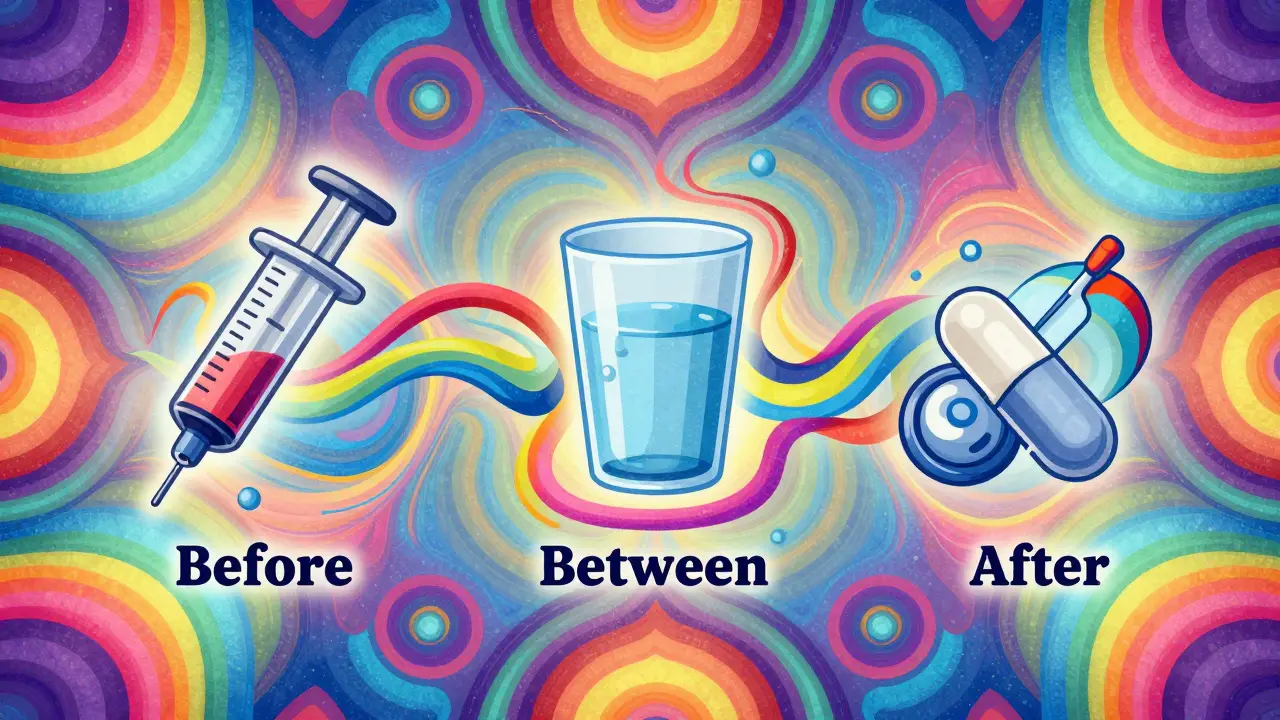
A reliable enteral feeding medication protocol follows a strict "Before, Between, and After" sequence. You should use 15-30 mL of water at three critical stages:
- Before: Clear out any remaining feeding formula so the drug doesn't mix with food in the tube.
- Between: If you're giving multiple medications, flush between each one. This prevents different drugs from mixing and forming a chemical "plug" that can block the tube.
- After: Push the final dose all the way through and clear the tube of any residue.
A good rule of thumb from the Cleveland Clinic is to use at least 15 mL of water for every 10 mL of medication you administer. If the medication is thick, you'll need more water to keep things moving. Neglecting this step is the primary cause of about 65% of all tube blockages.
Knowing Which Meds Are Safe to Crush
You can't just crush every pill you find in a blister pack. Some medications are engineered to release slowly over 12 or 24 hours. If you crush an extended-release tablet, you're delivering a whole day's worth of medicine in a few seconds, which can lead to toxicity. Other pills have an "enteric coating" designed to protect the drug from stomach acid or protect the stomach from the drug; crushing these ruins that protection.
There are absolute "no-go" zones. For example, drugs like mycophenolate (Cellcept®) or valganciclovir (Valcyte®) should never be crushed because they can create toxic exposure for the person preparing the dose. Similarly, bulk-forming laxatives like psyllium (Metamucil®) are a nightmare for tubes-they absorb water, swell up, and can cause an immediate, permanent blockage.
| Formulation Type | Tube Compatibility | Risk Factor | Action |
|---|---|---|---|
| Immediate-Release Tablets | High | Low (if dissolved) | Safe to crush if approved |
| Extended/Modified Release | Very Low | High (Toxicity/Dose Dump) | Do Not Crush |
| Enteric-Coated Pellets | Low | High (Irritation/Ineffectiveness) | Do Not Crush |
| Liquid Formulations | Highest | Lowest | Preferred Choice |

Avoiding the "Plug": Preparation Techniques
Even if a medication is safe to crush, the way you do it matters. A few grains of undissolved powder can act as a seed for a blockage, catching formula and other debris until the tube is completely sealed shut. This is especially dangerous for small-bore tubes (8 French or less), which have very little room for error.
The best approach is to turn the tablet into a liquid. Use a pill crusher to get a fine powder, then dissolve it in warm or room-temperature water. Stir it until it's completely smooth. If the medication doesn't dissolve fully, it's a red flag. Some medications, like Prevacid SoluTabs, are designed to disperse evenly in water and are much safer for tubes than standard granules.
Avoid the temptation to mix medications directly into the feeding formula bag. This is a common mistake in home care. Mixing drugs into the bag can cause the medication to bind to the formula, making the drug less effective or causing the formula to clump. Always administer medications through a separate port using the flushing method described above.
Drug-Nutrient Interactions: Do You Need to Stop the Feed?
For years, the standard advice was to stop the feeding pump for an hour before and after giving medications to avoid interactions. However, newer evidence from the ASPEN (American Society for Parenteral and Enteral Nutrition) Drug-Nutrient Interaction Task Force suggests this isn't necessary for most drugs. In most cases, the nutrient interference is clinically insignificant.
One major exception is levodopa. This medication is highly sensitive to protein in feeding formulas, which can block its absorption. For levodopa, you actually should withhold feedings to ensure the patient gets the therapeutic benefit. For almost everything else, focusing on a good flush is more important than stopping the pump.
Safety Checklist for Caregivers and Nurses
To keep the patient safe and the tube functioning, run through this checklist every single time you administer a dose:
- Verify Placement: Is the tube still in the right spot? Check pH levels or radiographic markers for NG/OG tubes.
- Check the Label: Is this an extended-release (XR, ER, SR) or enteric-coated drug? If yes, stop and call the pharmacist for a liquid alternative.
- Prepare Fresh: Did I crush the pill into a fine powder and dissolve it completely?
- Flush Sequence: Water $ ightarrow$ Med 1 $ ightarrow$ Water $ ightarrow$ Med 2 $ ightarrow$ Water.
- Document: Note the exact volume of water used and the method of preparation.
If you're managing a patient with a narrow therapeutic index-meaning the difference between a helpful dose and a toxic dose is very small-be extra cautious. For example, switching a patient from an oral capsule of phenytoin to a crushed immediate-release version can change how the drug hits the bloodstream. In these cases, you'll need to monitor serum drug levels frequently to make sure the dose is still correct.
What should I do if the feeding tube becomes clogged?
If the tube is blocked, start by attempting to flush with warm water using a gentle pulsing motion with the syringe. Do not force the plunger, as this can rupture the tube. If warm water fails, some clinicians use a mixture of sodium bicarbonate and water, though this should only be done under medical supervision. If the blockage persists, the tube may need to be replaced.
Can I just open a capsule and pour the beads into the tube?
Generally, no. Many capsules contain enteric-coated beads (like duloxetine) that are designed to bypass the stomach. These beads are often too large for the narrow internal diameter of a feeding tube and can cause an immediate clog. Always check with a pharmacist to see if the beads are compatible with the tube size.
How much water is actually needed for a proper flush?
Standard guidelines recommend 15-30 mL of water. A more precise rule is to use 15 mL of water for every 10 mL of liquid medication administered. If you are using a very small-bore tube, you may need to flush more frequently with smaller amounts of water to prevent buildup.
Is it okay to mix multiple medications together in one syringe?
It is strongly discouraged to mix medications in the same syringe. Many drugs are chemically incompatible and can precipitate, forming a solid crystal or "precipitate" that will block the tube instantly. Flush with water between every single medication to keep them separate.
Why can't I just use the feeding formula to flush the tube?
Feeding formula is thick and contains proteins and fats that can bind with medications. Using formula instead of water to flush can leave a residue that traps medication particles, eventually leading to a clog. Pure water is the only way to ensure the tube is truly clear.