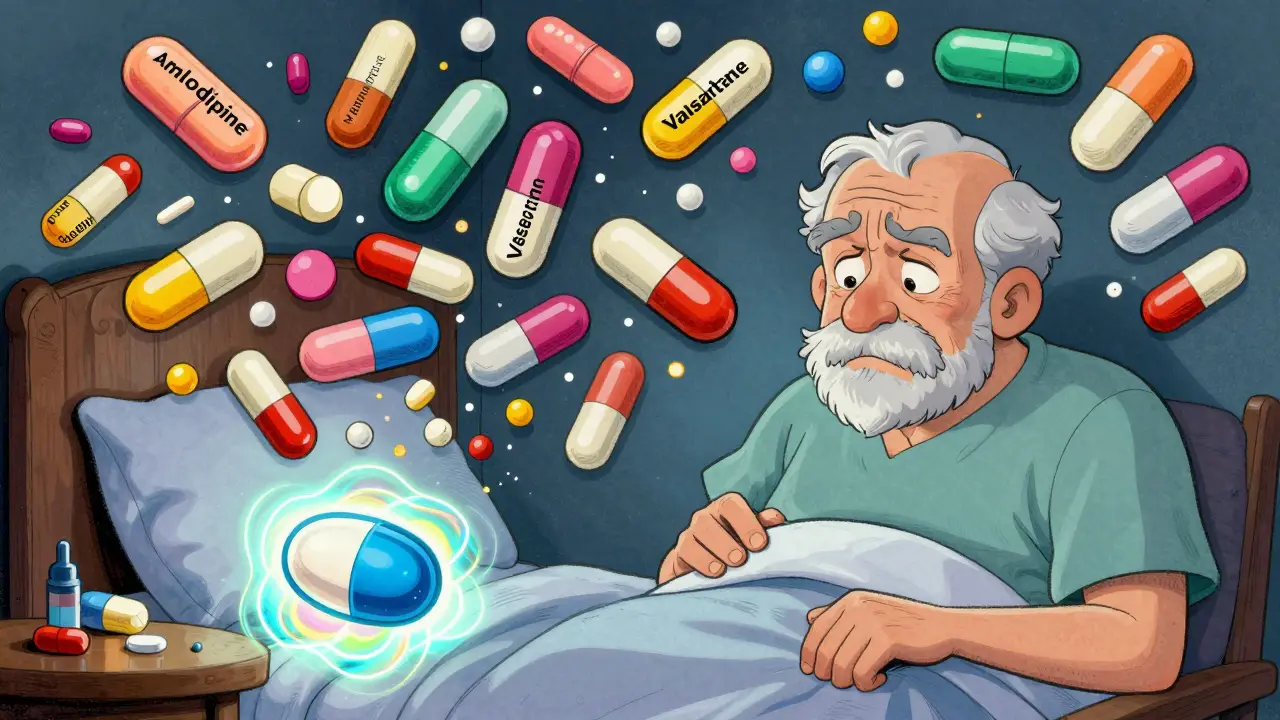
Imagine you’re on three different pills for high blood pressure. Each one is a different color, shape, and size. You have to remember which one to take in the morning, which at night, and when to refill each. Now imagine your doctor switches you to a single pill that does the same thing - one tablet, one time a day. Sounds easier, right? But for many patients, that’s not what happens. Instead, doctors keep prescribing separate generics - even when a single fixed-dose combination (FDC) exists. This isn’t a mistake. It’s a widespread practice called de facto combinations.
What Exactly Are De Facto Combinations?
A de facto combination isn’t a drug approved by regulators. It’s a real-world workaround: a patient takes two or more individual generic pills that, together, match the ingredients of an approved FDC. For example, instead of taking one pill with amlodipine and valsartan (a common FDC for hypertension), a patient might take a separate 5mg amlodipine tablet and a separate 80mg valsartan tablet. Same active ingredients. Same intended effect. But completely different packaging, dosing, and oversight.
This happens because FDCs - pills that combine two or more drugs in one tablet - are designed with fixed doses. If your body needs 10mg of one drug and 160mg of another, but the only FDC available is 5mg/80mg, your doctor can’t just give you two of those pills. The ratios don’t match. So they prescribe the generics separately. That’s not a loophole. It’s necessity.
Why Do Doctors Choose Separate Generics?
There are three big reasons: flexibility, cost, and clinical fit.
First, dosing flexibility. In chronic diseases like diabetes or hypertension, patients often need fine-tuned adjustments. A 70-year-old with kidney problems might need a lower dose of metformin but a full dose of sitagliptin. FDCs lock those doses together. Separate generics let doctors adjust each one independently. According to the American Diabetes Association, nearly two-thirds of type 2 diabetes patients need individualized dosing - and many FDCs just don’t offer that.
Second, cost savings. In some places, especially where generic competition is fierce, buying two separate generics can be cheaper than a branded FDC. In India, for example, a parliamentary report found that many FDCs offered no clinical advantage over individual drugs - and were often more expensive. Even in the U.S., if a patient’s insurance doesn’t cover the FDC but covers the generics at $5 each, the math makes sense.
Third, clinical fit. Some patients react poorly to one component in an FDC. Maybe the filler in the combo pill causes stomach upset. Maybe the tablet is too big to swallow. Or maybe the patient has a known interaction with one ingredient that’s not an issue with the other. Separate generics give doctors more control.
The Hidden Risks of Mixing Pills
But here’s the catch: those separate pills weren’t designed to work together.
When a company makes an FDC, they have to prove the combination is safe and effective. That means testing how the drugs interact inside the body - do they absorb at the same rate? Do they affect each other’s stability? Is the combination safer than taking them alone? The European Medicines Agency requires all this before approving any FDC. But when you mix two separate generics, none of that testing applies.
That’s not just theoretical. A 2020 FDA analysis found that 12.7% of generic drugs showed clinically meaningful differences in how they were absorbed compared to the original brand. So if you take two generics that weren’t tested together, you might get too much or too little of one drug. No one’s monitoring that.
And then there’s adherence. Every extra pill you have to take reduces your chance of sticking to the regimen. A study in PubMed found that each additional pill cuts adherence by about 16%. Patients on FDCs are 22% more likely to take their meds correctly than those on separate generics. One Reddit user put it bluntly: “I switched from a single Amlodipine/Benazepril pill to two separate ones to save $15 a month. I missed doses twice because I forgot which blue pill was which.”

What Do Experts Say?
Doctors and pharmacists are split.
A 2022 survey of over 1,500 U.S. pharmacists showed that 58% thought separate generics were appropriate for dose adjustments - but 72% worried about medication errors. One physician on a medical forum said he prescribes separate generics for HIV patients who need dose changes, but he gives them color-coded schedules to avoid mix-ups. “It works,” he said, “but it adds hours to my week.”
Meanwhile, Dr. Kenneth H. Fye from the University of Pennsylvania called de facto combinations a “therapeutic Wild West.” He pointed out that no one is checking whether these unapproved mixes cause hidden interactions or reduce effectiveness. The FDA has issued warnings about untested combinations, citing 147 adverse events potentially linked to them in early 2023.
On the other hand, Dr. Anant Parekh in India noted that while many FDCs there lack medical justification, the same is true for de facto combinations - too many are prescribed without clear clinical reasoning.
Who Benefits? Who Gets Left Behind?
Patients who need precise dosing - like those with kidney disease, liver problems, or complex drug regimens - often benefit from separate generics. One diabetic patient with kidney issues got her A1c down to 6.2% after switching from an FDC to separate metformin and sitagliptin. That’s a win.
But for others, especially older adults or those with cognitive challenges, the burden is real. A PatientsLikeMe analysis of 1,247 posts found that 63% of patients on separate generics struggled to remember their schedule. Only 31% of those on FDCs did.
Health systems also pay the price. The Centers for Medicare & Medicaid Services found that regimens using separate generics generated 28% more documentation errors in electronic records. Pharmacists spend more time counseling. Clinicians spend more time explaining. Nurses spend more time checking.

What’s Changing?
The tide is turning - slowly.
Pharmaceutical companies are now developing “modular” FDCs. AstraZeneca patented a system in 2022 that lets patients adjust doses within a single pill - keeping the convenience of an FDC without losing flexibility. That’s the future.
Regulators are paying attention too. The EMA launched a multi-year project in 2023 to study off-label combinations. The FDA’s 2021 guidance stressed that every drug in a combination must prove its own contribution to effectiveness - a rule that should apply to de facto mixes, even if it doesn’t yet.
And tech is helping. PillPack by Amazon started a “Combination Therapy Support Program” in 2021. They pre-sort pills into daily packs, send reminders, and offer counseling. Patients using the service saw a 41% drop in missed doses.
What Should You Do?
If you’re on separate generics for a condition that has an FDC option:
- Ask your doctor: “Is there an FDC that matches my doses?”
- If the answer is no, ask: “Why not? Is it because the ratios don’t match, or because of cost?”
- If you’re on separate pills, ask for a pill organizer or color-coded schedule.
- Use a medication app to track doses and refill dates.
- Don’t assume separate pills are safer just because they’re cheaper.
If you’re a prescriber:
- Don’t default to separate generics. Evaluate if an FDC could work.
- If you prescribe de facto combinations, document the clinical reason clearly.
- Use tools like synchronized refills and patient education to reduce errors.
De facto combinations aren’t evil. They’re a practical response to a system that doesn’t always fit real patients. But they’re not risk-free. The goal shouldn’t be to ban them - it should be to make them safer, smarter, and less necessary.
What’s Next?
The future of combination therapy isn’t about choosing between FDCs and separate pills. It’s about designing smarter options - pills that adjust doses, apps that track interactions, and systems that flag unsafe combinations before they’re prescribed. Until then, patients and providers will keep navigating the gray area. But now you know the stakes.
Palesa Makuru
January 1, 2026 AT 12:41Ugh, I can't believe people still think separate generics are 'cheaper'-it's just lazy prescribing. You're literally paying for more pharmacy visits, more errors, more wasted time. If your doctor can't bother to check if an FDC exists, they shouldn't be prescribing anything. This isn't healthcare-it's pharmaceutical chaos dressed up as convenience.
Lori Jackson
January 2, 2026 AT 00:56Let’s be real: de facto combinations are a regulatory blind spot wrapped in a pharmacoeconomic Band-Aid. The absence of bioequivalence data for off-label combos isn't just a gap-it's a liability cascade waiting to explode. And don't get me started on the pharmacokinetic unpredictability when you mix generics from three different manufacturers. This isn't medicine. It's a clinical roulette wheel.
Wren Hamley
January 3, 2026 AT 04:47Man, I’ve seen this play out with my pops-he’s on three different BP pills, all different colors, all different refill dates. He forgot one last month and ended up in the ER with a spike in creatinine. The doc said ‘it’s cheaper’-but cheaper for whom? The system? The pharmacy? Not him. I got him a PillPack box last week. Now he just opens one envelope and goes. No thinking. No stress. Just pills. Why isn’t this the default?
Sarah Little
January 4, 2026 AT 17:00Actually, the real issue isn’t the combination-it’s the lack of standardized labeling. If all generics had color-coded dosing indicators, or QR codes linking to combo guides, this wouldn’t be a problem. But nope. We still rely on patients reading tiny print on 10 different bottles. That’s not patient-centered care. That’s negligence by design.
innocent massawe
January 4, 2026 AT 17:05in nigeria, we do this all the time... because FDCs are either too expensive or not available. but i agree with the risks. i once mixed two generics for malaria and got dizzy for two days. maybe we need community pharmacists to help sort this out? 😔
veronica guillen giles
January 6, 2026 AT 06:43Oh, so now we’re romanticizing ‘flexibility’? Let me guess-the same doctors who prescribe 7 different meds for one condition also think ‘just take it at breakfast’ is a valid dosing schedule. 😒
Meanwhile, the patient who actually remembers to take their meds? They’re the one who got the FDC. The rest are just playing Russian roulette with their kidneys.
erica yabut
January 7, 2026 AT 21:13De facto combinations are the pharmaceutical equivalent of duct-taping a car engine together. Sure, it runs-until it doesn’t. And then someone dies quietly in a suburb where no one’s auditing the pill bottles. The FDA should classify these as ‘unapproved drug products’ and shut it down. No more ‘it’s cheaper’ excuses.
Tru Vista
January 9, 2026 AT 12:58lol fdc? who cares. i just take my blue pill and my red pill. i dont even know what theyre called. my apothecary says its fine. 🤷♀️
Angela Goree
January 10, 2026 AT 16:41AMERICA NEEDS TO STOP LETTING PHARMA COMPANIES CONTROL OUR MEDS! THEY WANT YOU TO TAKE ONE PILLS SO THEY CAN CHARGE MORE! SEPARATE GENERICS ARE THE PEOPLE’S CHOICE! WE’RE NOT LAB RATS FOR BIG PHARMA!!
AND WHY ISN’T THE GOVT MAKING FDCS CHEAPER?!?!?!