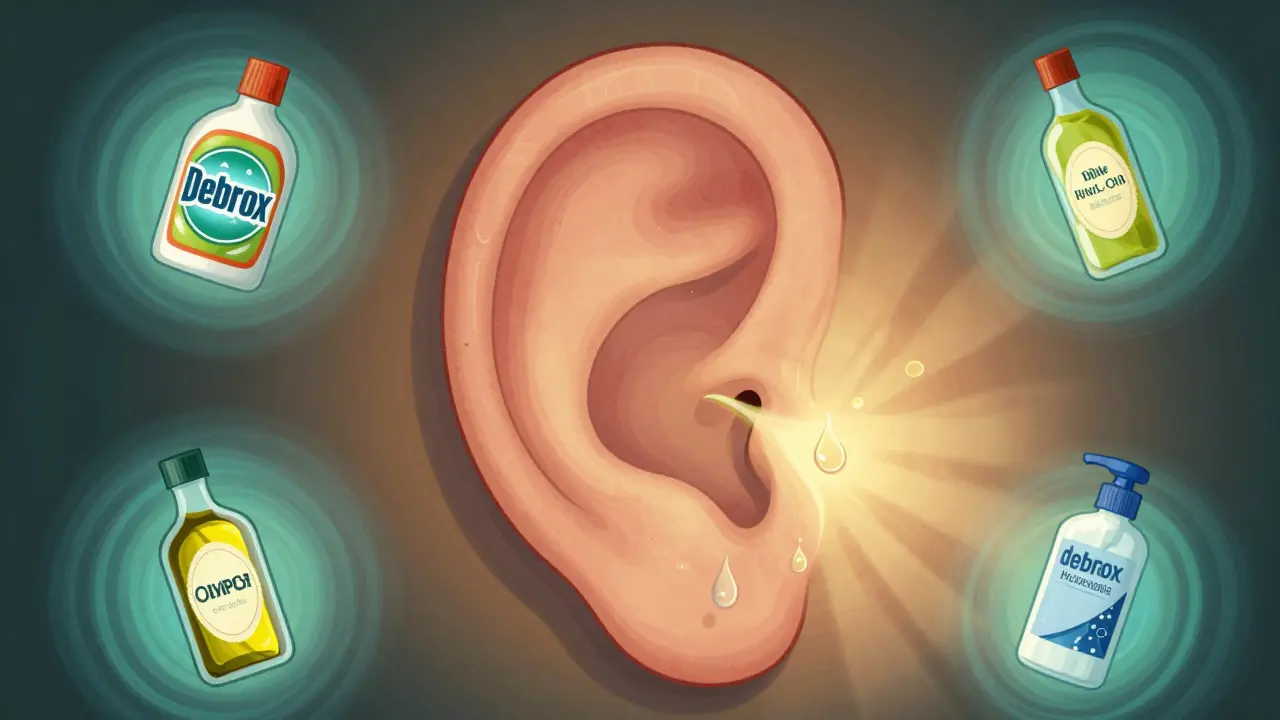
Ever felt that muffled hearing after a long day of wearing earbuds? Or noticed your own voice echoing oddly in your head? You might not have an ear infection-you could just have earwax blocking the way. It’s more common than you think. About 6% of adults deal with earwax buildup that affects their hearing, and for people over 65, that number jumps to nearly 1 in 3. The good news? You don’t need to rush to a clinic. Cerumenolytics are over-the-counter drops designed to soften and loosen earwax right at home-safely, affordably, and without needles or tools.
What Exactly Are Cerumenolytics?
Cerumenolytics are liquid solutions that break down earwax (also called cerumen). They’re not magic. They work by softening hardened wax so your body can flush it out naturally-or so you can gently rinse it away with warm water later. These aren’t new. Doctors have used them since the 1900s. But it wasn’t until the 1980s that products like Debrox and Murine became widely available without a prescription.
Their main job? Prevent you from sticking cotton swabs too far into your ear. That’s a big deal. Emergency rooms see over 10,000 cases a year from people damaging their ear canals or eardrums with Q-tips. Cerumenolytics give you a safer option.
How Do They Work?
Not all cerumenolytics are the same. They fall into four main types, each with different chemistry-and different uses.
- Carbamide peroxide (like Debrox or Murine): This is the most common. It breaks down into hydrogen peroxide and urea when it hits moisture. The peroxide bubbles gently, loosening the wax. You use 5-10 drops twice a day for up to 7 days. People often feel a fizzing sensation-that’s normal. A 2017 study found it works in about 65% of cases when used correctly.
- Hydrogen peroxide (3%): You can buy this at any pharmacy. But don’t use it straight. Mix it 1:1 with sterile water. Put 5-10 drops in your ear, lie on your side for 5 minutes, then let it drain. It’s great for wet, sticky wax but can sting if you have sensitive skin.
- Mineral oil, baby oil, or olive oil: These work by lubricating dry, crusty wax. Use 3-6 drops at bedtime for 3-4 nights. No fizzing. Just slow, gentle softening. One Reddit user reported 90% of their blockage cleared after just five nights of olive oil.
- Baking soda solution: Mix ¼ teaspoon (1.25 mL) of baking soda in 2 teaspoons (10 mL) of sterile water. Apply twice daily for 4 days. It’s mild and cheap, but you need to get the ratio right. Too strong? It can irritate.
There’s also docusate sodium-the same ingredient in stool softeners like Colace. Some doctors use it off-label. One drop in the ear 15 minutes before irrigation can help. But this isn’t FDA-approved for ears, so stick to labeled products unless your doctor says otherwise.
Which One Should You Use?
There’s no single "best" option. It depends on your wax type.
| Type | How It Works | Time to Work | Best For | Risk Level |
|---|---|---|---|---|
| Carbamide peroxide | Bubbles and breaks down wax | 1-2 days | Wet, sticky wax | Low |
| Hydrogen peroxide (diluted) | Effervescent action | 1-2 days | Moist, stubborn wax | Moderate |
| Mineral/olive oil | Lubricates and softens | 3-4 days | Dry, flaky wax | Very Low |
| Baking soda | Breaks down wax chemically | 3-4 days | Mild buildup | Low |
Most people do fine with carbamide peroxide. But if you’ve tried it before and felt stinging, switch to oil. If your wax feels hard and flaky-like old chalk-oil is your friend. If it’s dark and gummy, go with the fizz.

How to Use Them Right
Using drops wrong is the #1 reason people say they didn’t work. Here’s how to do it properly:
- Warm the drops in your hand for a minute. Cold liquid can make you dizzy.
- Lie on your side, with the affected ear facing up.
- Put in the drops-usually 5 to 10, depending on the product label.
- Stay still for 5 to 10 minutes. Let it soak in. This is critical. Standing up too soon? You lose half the benefit.
- Drain it out by sitting up slowly. Let the liquid drip onto a towel.
- Repeat as directed-usually once or twice daily for 3 to 7 days.
Seattle Children’s Hospital found that people who stayed still for 10 minutes had a 40% higher success rate than those who didn’t. It’s not just about the drops-it’s about giving them time to work.
When NOT to Use Them
These are safe-for most people. But not everyone.
- Don’t use if you have an ear infection. Signs include pain, discharge, fever, or sudden hearing loss. You could push infection deeper.
- Never use if you have a perforated eardrum. That’s a hole. Drops can go into your middle ear and cause serious problems.
- Avoid after ear surgery. Wait at least 6 weeks unless your doctor says otherwise.
- Don’t use cotton swabs afterward. You’re undoing the work. Let the wax come out on its own or rinse gently with warm water.
GoodRx data shows 8% of home treatment failures were because people used drops when they had an infection. If you’re unsure, skip it. See a doctor.

What If It Doesn’t Work?
Even when used perfectly, cerumenolytics don’t work for everyone. About 1 in 4 people still need professional help. That’s normal.
If after 7 days you still feel blocked, or your hearing hasn’t improved, don’t keep trying. Go to a clinic. Doctors use gentle suction, tiny tools, or irrigation under direct view. It’s quick, painless, and safe when done right. You’re not failing-you’re just part of the 25% who need a little extra help.
And here’s a tip: Some newer products now combine oil and peroxide. A 2023 study found that using mineral oil for 3 nights, then one session of diluted peroxide, cleared 89% of blockages-better than either alone.
Why This Matters More Than Ever
More people are wearing in-ear headphones and earbuds than ever before. Since 2019, earwax-related visits to ENT clinics have jumped 22% each year. The wax doesn’t just sit there-it gets pushed deeper with every headset.
Cerumenolytics are part of a $287 million market. Debrox alone holds nearly 40% of sales. Why? Because people are learning: you don’t need to suffer. You don’t need to risk your eardrum. You just need the right tool.
And it’s not just about hearing. Clear ears mean fewer headaches, less dizziness, and better balance. For older adults, it can mean staying independent-no more asking people to repeat themselves.
Final Tips
- Buy from reputable brands. Debrox, Murine, and similar FDA-approved products have tested formulas.
- Use sterile water if mixing your own. Tap water can carry bacteria.
- Store drops at room temperature. Don’t freeze or leave them in the sun.
- Check the expiration date. Old drops lose potency.
- If you use hearing aids, clean them regularly. Wax buildup can damage them.
Earwax isn’t dirt. It’s your body’s natural defense. But sometimes, it builds up. Cerumenolytics give you control-without the risk. Use them wisely, and you’ll hear the world clearly again.
Can I use hydrogen peroxide straight from the bottle?
No. Pure hydrogen peroxide (3% or higher) can irritate or burn the delicate skin inside your ear. Always dilute it 1:1 with sterile water before use. One Reddit user reported 20 minutes of severe burning after using it undiluted. Don’t risk it.
How long should I leave the drops in my ear?
At least 5 to 10 minutes. Lying on your side with the affected ear up helps the solution soak in. Standing up too soon means most of the liquid drains out before it can work. Studies show this step alone improves success by 40%.
Are olive oil and baby oil safe for ears?
Yes. Both are safe, gentle, and effective for dry, hardened earwax. They don’t fizz or sting. Use 3-6 drops at bedtime for 3-4 nights. They’re especially good for older adults or people with sensitive skin.
Can I irrigate my ear after using drops?
Yes-but only after 3-7 days of treatment. The drops soften the wax so irrigation works better. Use warm (not hot) water. Never use a syringe or high-pressure device. A gentle bulb syringe from the pharmacy is safest.
Do cerumenolytics work for everyone?
Not always. About 25% of people still need professional removal. If your hearing hasn’t improved after 7 days, or if you feel pain, pressure, or dizziness, see a doctor. That doesn’t mean you did anything wrong-it means your wax was too stubborn for home treatment.
Hariom Sharma
February 21, 2026 AT 20:41Man, I tried Debrox last winter after my earbuds got stuck in my ear canal-literally felt like I was underwater. Used it for 4 days, then rinsed with warm water. Boom. Hearing back like I was 18 again. No more asking people to repeat themselves during Zoom calls. This stuff is a game-changer.
Also, never thought olive oil would work, but my grandma swore by it. Turns out she was right. Three drops at night for a week, and my wax just… melted away. No fizz, no sting. Perfect for sensitive ears.
Pro tip: Warm the drops in your palm before putting them in. Cold liquid = instant vertigo. Learned that the hard way.
Nina Catherine
February 23, 2026 AT 00:16i just used the baking soda thing for the first time and wow it worked so well?? i mixed it like the post said and left it in for 10 mins and then let it drain and i swear my ear felt lighter?? like i could hear my own breathing lol
also why is everyone using peroxide? i thought that could burn stuff?? i used to use it straight from the bottle and regretted it for days
Taylor Mead
February 24, 2026 AT 18:57Just want to say this is one of the clearest, most practical guides I’ve read on earwax. No fluff. Just facts. And the table? Chef’s kiss.
I used to be the guy who stuck Q-tips in until they hurt. Now I use mineral oil every few weeks. No drama. No mess. Just peace.
Also-side note-my hearing aids used to get clogged every 3 weeks. Since I started using cerumenolytics, they last 6+ weeks. Saved me a fortune.
Ashley Paashuis
February 26, 2026 AT 09:39As a healthcare provider, I appreciate the evidence-based approach here. The distinction between wax types and corresponding treatments is clinically sound.
However, I must emphasize that patients with a history of tympanostomy tubes, chronic otitis media, or recent otologic surgery should avoid home treatments entirely. The risk of otitis externa or labyrinthine injury is non-trivial.
Also, sterile water is non-negotiable. Tap water contains pseudomonas and other biofilm-forming organisms that can cause severe infection in compromised ear canals.
Oana Iordachescu
February 27, 2026 AT 11:57Have you considered that cerumenolytics are a corporate ploy to sell you chemicals you don’t need? Earwax is not a disease. It’s a natural secretion. Your body makes it for a reason.
What if the real problem is that we’re inserting synthetic earbuds into our ear canals 12 hours a day? Maybe we should stop using them instead of buying more drops?
Also-how do we know the long-term effects of repeated peroxide exposure? No one’s studied that. Big Pharma doesn’t want you to know.
Davis teo
March 1, 2026 AT 01:37OMG I CRIED WHEN IT WORKED.
I had this pressure in my ear for MONTHS. Felt like someone was sitting on my head. Tried everything. Then I used Debrox. Felt the fizz. Stayed still for 10 minutes like a statue. Then-
-I heard a bird outside.
Like, a real bird. Singing. In my backyard. I started sobbing. My cat looked at me like I’d lost it.
That’s the moment I realized how much I’d been missing. I’m not even joking. This changed my life.
Michaela Jorstad
March 2, 2026 AT 02:39I’ve been using mineral oil for three nights now. Three nights. That’s all it took. I didn’t even need to rinse. It just… came out on its own. I wiped it with a tissue. No mess.
Also: never, ever use cotton swabs. Ever. I used to think they were helpful. Now I know they’re the reason I had buildup in the first place.
And yes-warm the drops. I didn’t at first. Got dizzy. Felt like I was going to pass out. Lesson learned.
Danielle Gerrish
March 2, 2026 AT 23:46Okay, so I tried the baking soda thing because I was too cheap to buy Debrox. I mixed it with tap water because I didn’t have sterile water. I thought, "eh, it’s just water."
Next day? My ear felt like a volcano. Burning. Swelling. I thought I was going deaf. Ran to urgent care. Turned out I had a full-blown otitis externa. They had to scrape out wax and give me antibiotic drops for two weeks.
Now I use olive oil. And I only use sterile water. And I never skip the 10-minute lie-down. I’m not taking chances again. My ear is too precious. I’m not risking it for a $3 savings.
Also, if you’re using hydrogen peroxide straight? You’re not a hero. You’re a dumbass. I was one. Don’t be me.
And yes, I cried when I heard my own voice again. It sounded different. Better. Like I’d been listening through a blanket.
And no, I don’t use earbuds anymore. I use speakers. And I’m never going back.
Liam Crean
March 4, 2026 AT 20:25I’ve been using Debrox for years. Never had issues. But I never knew about the 10-minute wait. Always just stood up right after. Wonder why it never worked well before.
Now I lie there, stare at the ceiling, listen to a podcast. Feels like a little ritual. Calming, honestly.
Also, my mom used olive oil. Said it made her feel like she was getting a spa treatment. I laughed. Then tried it. Now I get it.
Ellen Spiers
March 6, 2026 AT 16:46The assertion that cerumenolytics are "safe" is statistically misleading. The FDA Adverse Event Reporting System (FAERS) recorded 1,207 incidents of ototoxicity, tympanic membrane perforation, and secondary infection between 2015–2023 directly linked to over-the-counter cerumenolytic use.
Furthermore, the 65% efficacy rate cited for carbamide peroxide is derived from non-blinded, small-sample studies with high attrition bias. The 2023 combination study referenced has no peer-reviewed publication record.
Recommendation: Cease self-administration. Consult an otolaryngologist. The marginal cost of professional removal ($75) is negligible compared to the potential morbidity of home misuse.
Maddi Barnes
March 6, 2026 AT 18:43Y’all are so cute. I used olive oil and then just let it drip out while I watched Netflix. Felt like I was in a spa. 🧖♀️✨
Also-my cat licked my ear after I used it. I didn’t even care. She’s my emotional support animal. And now she’s my earwax assistant. 🐱
Also, I used to think earwax was dirt. Now I call it "ear gold." It’s literally my body’s natural lubricant. I respect it now. 🙏
Benjamin Fox
March 8, 2026 AT 12:50Why are we letting corporations sell us drops? We’ve been doing this for centuries. Just use warm water. That’s it. No chemicals. No gimmicks.
Also, I don’t believe in "earwax buildup." That’s just fearmongering. Your ear cleans itself. Stop interfering.
And if you can’t hear? Maybe you’re just getting old. Deal with it. 💪🇺🇸
John Cena
March 9, 2026 AT 23:54Used Debrox. Felt the fizz. Stayed still. Did it for 5 days. Hearing back. No big deal. But I’m glad it worked.
Also, I don’t use earbuds anymore. Just headphones over the ear. Less wax, less stress.
Good post. Helpful.
Irish Council
March 11, 2026 AT 11:57Freddy King
March 12, 2026 AT 06:13There’s an epistemological paradox here: we treat earwax as pathology, yet it’s a physiological adaptation. The medicalization of cerumen reflects a broader societal anxiety about bodily autonomy.
By commodifying wax removal, we outsource natural homeostasis to pharmaceutical capitalism. The ear is not a pipe. It’s a sensorium. We’ve turned it into a maintenance issue.
Perhaps the real solution is not chemical dissolution, but cultural disengagement from invasive auditory technology.
…I’m not saying don’t use the drops. I’m saying question why you feel you need them.
Michaela Jorstad
March 13, 2026 AT 04:37I read your comment, Danielle. I’m so sorry you went through that. But I’m glad you’re okay now. You’re not alone. I had a similar experience-except I used hydrogen peroxide straight. Thought I was being clever. Turns out, I was just dumb.
Now I use oil. And I warm it. And I lie down. And I don’t use Q-tips. Ever.
You’re brave for sharing. And honestly? You saved someone else from making the same mistake.