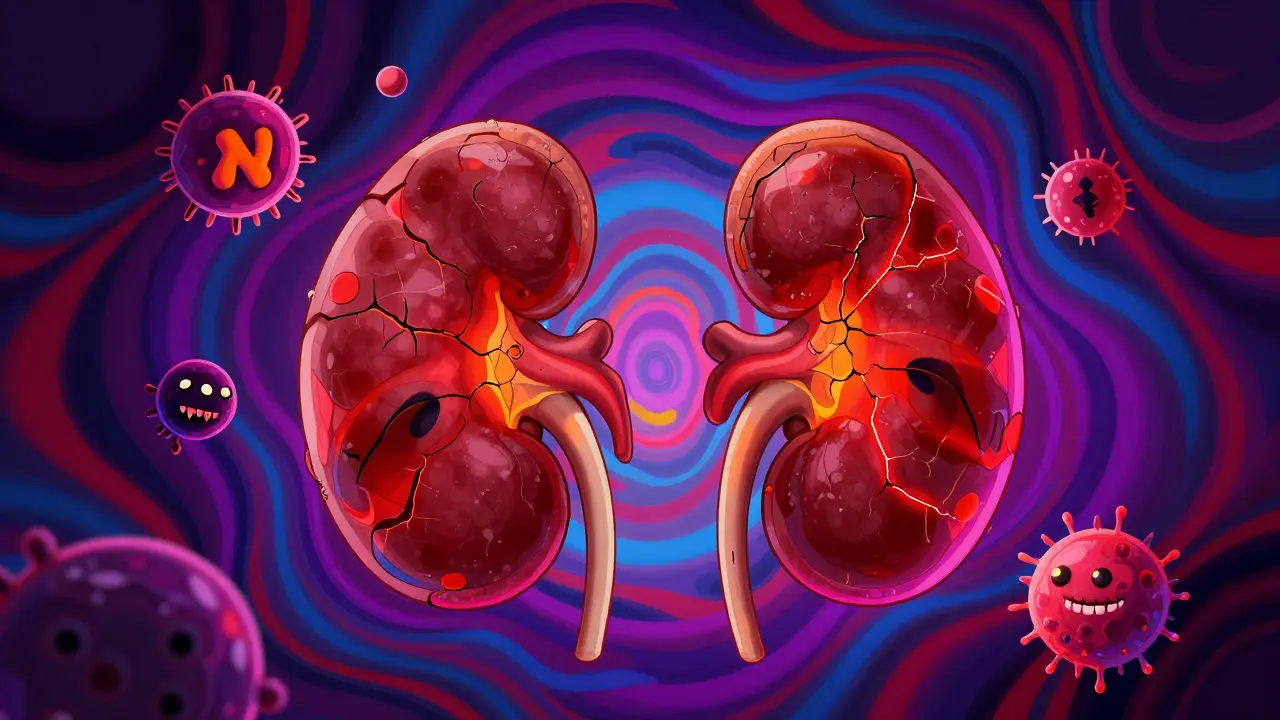
When your body can’t make enough cortisol and aldosterone, even a simple cold can turn deadly. That’s the reality for people with Addison’s disease, a rare but life-threatening condition where the adrenal glands stop producing essential hormones. Unlike diabetes or thyroid problems, Addison’s doesn’t show up on routine blood tests. It sneaks in with fatigue, weight loss, and darkened skin - symptoms doctors often mistake for stress, depression, or stomach bugs. By the time it’s diagnosed, up to 90% of adrenal tissue is already destroyed. And without treatment, an adrenal crisis can kill you within hours.
What Actually Happens in Addison’s Disease?
Addison’s disease is primary adrenal insufficiency - meaning the problem starts in the adrenal glands themselves. These small, triangle-shaped organs sit on top of your kidneys and normally make three key hormones: cortisol (your stress hormone), aldosterone (which controls salt and water balance), and small amounts of sex hormones. In Addison’s, your immune system attacks your adrenal glands like they’re invaders. This autoimmune damage slowly kills the cells that produce these hormones. By the time you feel sick, most of the gland is gone.
It’s not contagious. It’s not caused by poor diet or lack of sleep. It’s not even rare - about 1 in 10,000 people have it. In Australia, the UK, and North America, over 80% of cases are autoimmune. Back in the 1800s, tuberculosis was the main cause. Now, it’s almost always your own immune system turning against you. Blood tests show high levels of 21-hydroxylase antibodies in 90% of cases. That’s the smoking gun.
Why Symptoms Are So Easy to Miss
People with Addison’s often see five different doctors before getting diagnosed. The average delay? Over three years. Why? Because the symptoms look like everything else.
- Chronic fatigue? Must be burnout.
- Nausea and weight loss? Probably a stomach virus.
- Cravings for salt? Just a weird habit.
- Dark patches on knuckles, elbows, or gums? Maybe just sun exposure.
But here’s the clue most miss: low blood pressure that gets worse when standing up. That’s aldosterone failing. And high potassium, low sodium - classic electrolyte imbalances you won’t see in secondary adrenal problems. Hyperpigmentation is another giveaway. ACTH, the hormone your pituitary pumps out trying to wake up the adrenals, also stimulates melanin. That’s why skin darkens, even in areas not exposed to sun.
A 2023 study in the Journal of Clinical Endocrinology & Metabolism found that 63% of patients were misdiagnosed - mostly as having IBS, depression, or chronic fatigue syndrome. One patient spent two years being treated for anxiety before her cortisol level was checked. She was admitted to ICU with an adrenal crisis the week after her diagnosis.
How It’s Diagnosed - and Why Timing Matters
If your doctor suspects Addison’s, they’ll order a few key tests. First, a morning cortisol level. Normal is 5-25 mcg/dL. In Addison’s, it’s often below 5. But that alone isn’t enough. You also need ACTH - the signal your brain sends to your adrenals. In primary insufficiency, ACTH is sky-high (over 50 pg/mL) because your brain is screaming, “Make more cortisol!”
The gold standard test is the cosyntropin (ACTH stimulation) test. You get a shot of synthetic ACTH. In a healthy person, cortisol jumps to over 18 mcg/dL within an hour. In Addison’s, it barely moves. That’s the confirmation.
But here’s the critical part: if someone is vomiting, confused, or in shock, don’t wait for test results. Start treatment immediately. A 2022 study in the European Journal of Endocrinology showed that every hour you delay treatment during an adrenal crisis, death risk rises by 3-5%. That’s why emergency rooms now carry hydrocortisone in their crash carts for unexplained hypotension.
Steroid Replacement: The Lifeline
There’s no cure. But there is life - if you take your steroids. Daily. Religiously. Always.
You need two types:
- Hydrocortisone - replaces cortisol. Typical dose: 15-25 mg per day, split into two or three doses. Most take 10 mg at breakfast, 5 mg at lunch, and 5-10 mg at dinner. Some take a single dose at bedtime to mimic natural rhythm.
- Fludrocortisone - replaces aldosterone. Usually 50-200 mcg per day. This keeps your sodium up and potassium down. Without it, you get dizzy, weak, and your blood pressure crashes.
It’s not like taking a vitamin. Too little, and you risk crisis. Too much, and you’re at higher risk for heart disease, diabetes, and bone loss. Dr. Wiebke Arlt’s 2021 review in The Lancet found that over-replacement increases cardiovascular death by 44%. Under-replacement? That doubles your risk of adrenal crisis.
There’s a new option: Chronocort, a modified-release hydrocortisone approved by the FDA in 2023. It’s taken once daily and mimics the body’s natural cortisol rhythm better than regular tablets. In trials, it cut cortisol swings by 37%. It’s not available everywhere yet - and it’s expensive - but it’s a step toward more natural replacement.
The Sick Day Rules: When Illness Becomes a Medical Emergency
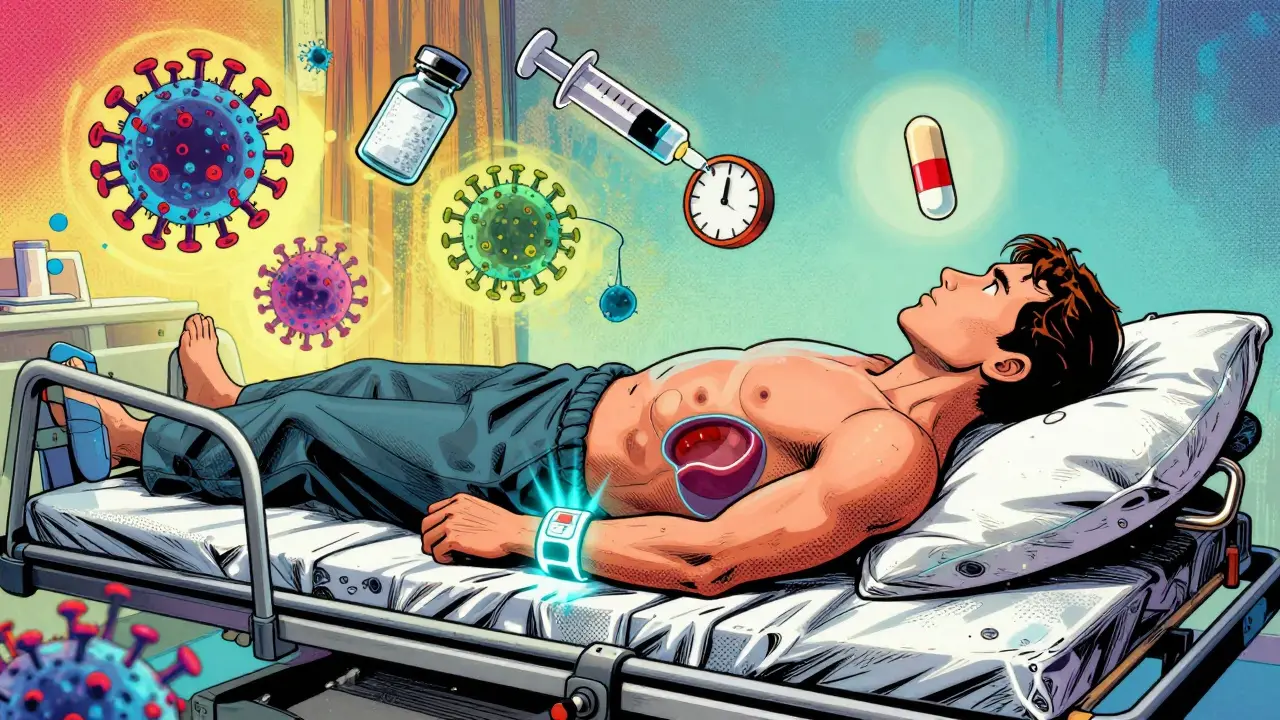
Most adrenal crises happen when people get sick - a cold, flu, food poisoning, even dental work. Your body needs 2-3 times more cortisol during stress. If you don’t increase your dose, your system shuts down.
The Addison’s Disease Self Help Group’s “Sick Day Rules” are non-negotiable:
- At first sign of illness - fever, vomiting, diarrhea, infection - double or triple your hydrocortisone dose.
- If you can’t keep pills down, use an emergency injection. Keep 100 mg of injectable hydrocortisone in your bag, fridge, or car.
- If you’re vomiting, confused, or collapsing - give yourself the injection immediately and call an ambulance.
- Never skip your fludrocortisone, even if you’re not eating.
Patients who follow these rules reduce crisis risk by 85%. Yet, a 2022 survey found 78% of people with Addison’s have had at least one crisis in the last five years. Why? Many don’t know how to adjust doses. Some are scared to increase steroids. Others can’t afford the extra medication.
What You Must Carry - And Why
Every person with Addison’s should have three things:
- A medical alert bracelet or necklace that says “Addison’s Disease - Steroid Dependent”
- An emergency hydrocortisone injection kit (100 mg IM/IV)
- A signed letter from your endocrinologist explaining your condition and emergency protocol
Paramedics aren’t always trained to recognize adrenal crisis. In the UK, data from the Addison’s Disease Registry shows that 92% of patients who wore medical ID and carried an injection had 50% lower death rates during crisis events. That’s not a suggestion. That’s survival.
Other Autoimmune Conditions You Might Have
Addison’s doesn’t come alone. Half of patients develop another autoimmune disease. The most common:
- Hashimoto’s thyroiditis or Graves’ disease (30-40%)
- Type 1 diabetes (10-15%)
- Vitiligo (8-10%)
- Pernicious anemia (vitamin B12 deficiency - 20-30%)
That’s why annual blood tests aren’t optional. You need thyroid function, fasting glucose, B12, calcium, and antibody screening every year. One patient I spoke to didn’t realize her constant tiredness was from low B12 - not her Addison’s. Once she started injections, her energy returned.

The Cost and Access Problem
Hydrocortisone isn’t expensive in Australia - about $10-$20 a month with the PBS. But in the U.S., without insurance, it can cost $350-$500 monthly. Fludrocortisone adds another $50-$100. And emergency injections? Up to $200 per kit.
A 2022 survey by the Endocrine Society found 40% of U.S. patients ration their meds. One woman said she cut her hydrocortisone in half because she couldn’t afford the refill. She ended up in the ER with a crisis. That’s not healthcare - that’s gambling with your life.
Even in Australia, some patients struggle to get fludrocortisone on time. Pharmacies don’t always stock it. Endocrinologists are scarce. That’s why patient groups like the Addison’s Disease Self Help Group are vital - they help people navigate access, find financial aid, and learn how to advocate for themselves.
What’s Next for Treatment?
The future is promising. Researchers are testing continuous cortisol monitors - tiny sensors that track your cortisol levels in real time, like a glucose meter. One device in phase 2 trials can alert you when your levels drop too low. Early results suggest it could cut adrenal crises by 60% in five years.
There’s also talk of stem cell therapies to regenerate adrenal tissue. Still experimental. But for the first time, scientists are looking beyond replacement - toward repair.
For now, the goal is simple: live well with what we have. That means knowing your numbers, trusting your body’s signals, and never ignoring a fever.
Living With Addison’s: Real Talk
Reddit threads from r/AddisonsDisease say it best:
- “I carry my injection everywhere - even to the movies.”
- “I don’t go hiking without telling someone where I am.”
- “My partner knows: if I’m quiet for more than two hours, check my pulse.”
- “I’ve missed birthdays because I was too weak to get out of bed.”
- “But I’m alive. And I’m working. And I’m raising kids.”
Addison’s doesn’t define you. But it demands respect. You can travel. You can work. You can have children. But you must be prepared. Every single day.
Can you outgrow Addison’s disease?
No. Addison’s disease is permanent. The adrenal glands are permanently damaged and cannot regenerate. Lifelong steroid replacement is required. There are no known cases of spontaneous recovery. Even if symptoms improve, stopping medication leads to adrenal crisis.
Is Addison’s disease hereditary?
It’s not directly inherited, but your genes can increase risk. If you have a close relative with autoimmune Addison’s, your chance of developing it is higher. The same genes linked to type 1 diabetes, thyroid disease, and vitiligo often run in families. Genetic testing isn’t routine, but if multiple autoimmune conditions run in your family, it’s worth discussing with your doctor.
Can you exercise with Addison’s disease?
Yes - but you need to adjust your dose. Moderate exercise is safe and encouraged. For intense workouts, increase hydrocortisone by 50-100% the day before and after. Stay hydrated. Watch for dizziness or extreme fatigue. Many athletes with Addison’s compete at elite levels - including Olympic swimmers and marathon runners - with proper planning.
What happens if you miss a dose of hydrocortisone?
Missing one dose isn’t an emergency - but it’s risky. If you forget your morning dose, take it as soon as you remember. If it’s close to your next dose, skip the missed one. Never double up. If you miss two or more doses, or if you feel weak, dizzy, or nauseous, increase your dose and contact your doctor. Always carry your emergency injection.
Can women with Addison’s have a safe pregnancy?
Yes, with careful management. Hormone needs increase during pregnancy - especially in the third trimester. Your endocrinologist will adjust your hydrocortisone dose, often increasing it by 30-50%. Fludrocortisone may also need tweaking. Most women with Addison’s have healthy pregnancies and babies. The biggest risk is adrenal crisis during labor or delivery - so delivery should be planned in a hospital with endocrine support.
Why do people with Addison’s crave salt?
Because your body can’t hold onto sodium. Aldosterone tells your kidneys to reabsorb salt. When it’s missing, sodium leaks out in urine. That causes low blood pressure and dehydration. Your body craves salt to compensate. That’s why many patients add extra salt to meals, eat pickles, or drink broth. It’s a natural survival signal.
Is Addison’s disease the same as adrenal fatigue?
No. Adrenal fatigue is not a real medical diagnosis. It’s a term used in alternative medicine to describe tiredness from stress. True adrenal insufficiency is a proven, measurable hormonal failure with clear lab markers. You can’t diagnose it with a saliva test or a questionnaire. Only blood tests and ACTH stimulation confirm it. Don’t confuse the two - mistaking one for the other can delay life-saving treatment.
What to Do Next
If you think you might have Addison’s - see an endocrinologist. Don’t wait. Get your cortisol and ACTH tested. If you’ve been diagnosed, make sure you have your emergency injection, medical ID, and sick day plan in place. Talk to your doctor about Chronocort if you’re struggling with dosing. Join a patient group. You’re not alone. And if you’re a caregiver or family member - learn the signs of crisis. Your quick action could save a life.
Duncan Careless
December 28, 2025 AT 16:27Just read this through and honestly? This is the clearest breakdown I’ve ever seen. I’ve got a cousin with Addison’s and I never realized how much goes into just staying alive. Thanks for laying it out like this.
Samar Khan
December 28, 2025 AT 17:15OMG this is so relatable 😭 I’ve been misdiagnosed 4 times and spent 3 years in limbo… my doctor thought I was just ‘overthinking’ until I collapsed at work. Now I carry my shot everywhere. Even to yoga. 🙃
Russell Thomas
December 29, 2025 AT 20:35So let me get this straight - your body’s basically a broken car that needs constant fuel, and if you forget to refill, you die? And the system still charges $500 a month for the gas? 💀 I’m not mad, I’m just disappointed in humanity.
Joe Kwon
December 31, 2025 AT 14:02Great breakdown - the pathophysiology here is textbook, but the clinical pearls are gold. The ACTH stimulation test remains the diagnostic cornerstone, and the 2022 EJE data on time-to-treatment mortality is critical for ER protocols. Also, Chronocort’s pharmacokinetic profile is promising - reduced Cmax variability could significantly lower crisis incidence. Still, access remains the elephant in the room.
Jasmine Yule
January 1, 2026 AT 20:54I’m so glad someone finally wrote this with real depth. I’ve been living with this for 12 years and people still think I’m ‘just tired.’ I carry my epinephrine pen *and* my hydrocortisone shot. I’ve had to teach EMTs how to treat me. Please, if you know someone with this - learn the signs. It’s not anxiety. It’s not laziness. It’s a silent killer.
Henriette Barrows
January 3, 2026 AT 20:19My sister was diagnosed last year and this post made me cry. Not because it’s sad - but because it’s so accurate. I used to tell her to ‘just push through’ until I learned what cortisol actually does. Now I help her refill her meds and remind her to eat salt. She says I’m her human alarm clock. 😊
Teresa Rodriguez leon
January 5, 2026 AT 07:29This is all well and good but nobody talks about how the constant fear of dying from a cold ruins your mental health. You can’t just ‘take your meds’ and be fine. You’re always one sneeze away from the ER. And no, I don’t want to hear your ‘positive vibes.’
Manan Pandya
January 5, 2026 AT 14:39Excellent summary. One point to add: the 21-hydroxylase antibody test isn't just diagnostic - it's predictive. In families with autoimmune polyglandular syndrome, screening asymptomatic relatives can catch Addison’s before crisis. Early detection saves lives. Also, fludrocortisone dosing must be individualized - renal function affects clearance.
Aliza Efraimov
January 6, 2026 AT 15:51My mom had Addison’s. She died at 52 because she didn’t have a medical ID. The paramedics didn’t know what was wrong. They gave her fluids - and she coded 20 minutes later. I carry two emergency kits. I teach my kids how to inject. This isn’t a ‘condition’ - it’s a war. And we win by being prepared.
Nisha Marwaha
January 6, 2026 AT 16:39As someone who works in endocrinology outreach, I can confirm: the biggest barrier isn’t knowledge - it’s pharmacy access. Fludrocortisone is often out of stock, even in urban centers. And insurers routinely deny Chronocort because it’s ‘not first-line.’ We need policy change, not just patient education. Let’s get this on the radar of health equity advocates.
Paige Shipe
January 6, 2026 AT 23:48Adrenal fatigue is real. You’re just scared to admit it. People have been telling you for years you’re tired from stress - but you ignored it. Now you’re blaming the system. The truth? You didn’t take care of yourself. And now you want a free pass? No. Stop making excuses.
Tamar Dunlop
January 8, 2026 AT 15:34As a Canadian living with this condition, I must commend the clarity of this piece. In our system, hydrocortisone is subsidized, yet fludrocortisone remains a patchwork of provincial coverage. I have traveled to the U.S. for a refill twice. The emotional toll of medical insecurity is profound. I carry my letter in my wallet - not for the paramedics, but for myself. To remind me I am not alone.