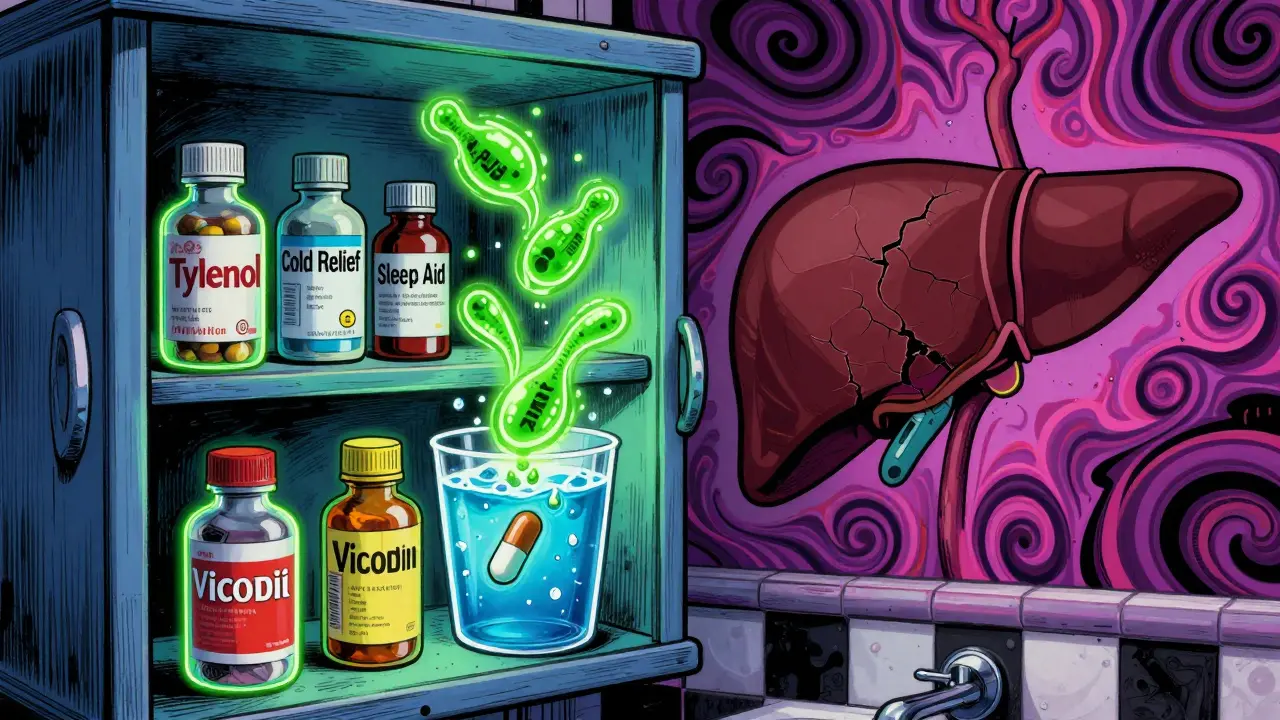
Acetaminophen - known as paracetamol outside the U.S. and sold under brands like Tylenol - is one of the most common pain relievers in the world. It’s in your medicine cabinet, your kid’s fever syrup, your cold medicine, even your prescription pain pills. And here’s the scary part: acetaminophen is the leading cause of acute liver failure in the United States. Not opioids. Not alcohol. Not herbal supplements. This everyday pill, taken by millions without a second thought, is quietly putting lives at risk - not because it’s dangerous, but because we don’t understand how easily it can become deadly.
How Acetaminophen Turns Toxic
Your liver breaks down acetaminophen every time you take it. Most of it turns into harmless byproducts and leaves your body. But a small portion becomes a toxic chemical called NAPQI. Normally, your liver uses an antioxidant called glutathione to neutralize it. But if you take too much - even just a little over the limit - your glutathione runs out. Suddenly, NAPQI starts destroying liver cells. This isn’t a slow burn. It happens fast. And you won’t feel it until it’s too late.
For adults, the safe daily limit is 4,000 milligrams. That’s eight 500 mg tablets. Sounds simple? Think again. Many people don’t realize that acetaminophen hides in dozens of other products. A cold medicine. A sleep aid. A migraine combo pill. Take two of those, plus your Tylenol for a headache, and you’ve crossed the line without even trying.
The Four Stages of Overdose - And Why You Won’t Notice Until It’s Too Late
Acetaminophen poisoning doesn’t hit like a punch. It creeps in. Here’s what actually happens after you take too much:
- Stage 1 (0-24 hours): You might feel a little nauseous. Maybe a bit sweaty. Or nothing at all. Your liver enzymes are already rising, but you feel fine. This is when most people think, “I’m okay.”
- Stage 2 (24-72 hours): Pain starts in your upper right abdomen - right under your ribs. Your nausea gets worse. You feel tired. This is your liver screaming. But many still ignore it, thinking it’s just a stomach bug.
- Stage 3 (72-96 hours): This is the crisis. Your skin turns yellow (jaundice). Your hands shake. You get confused. Your blood can’t clot. Your kidneys start failing. At this point, you’re in the ICU. Liver transplant is the only chance.
- Stage 4 (after 5 days): Either you recover - if you got treatment fast - or you don’t. Without treatment, death rates jump to 30-40%. With timely care, they drop to 2-4%.
Here’s the brutal truth: if you wait until you feel sick, it’s already too late for full recovery. The damage is done.
Why This Is Happening - And Who’s Most at Risk
Most overdoses aren’t suicide attempts. They’re accidents. And they’re getting worse.
A 2022 study found that 48% of acetaminophen overdose cases came from people taking multiple medicines without realizing they all contained the same drug. One man took Tylenol for his back pain. He also took a cold tablet for his runny nose. Both had acetaminophen. He took the recommended dose of each - but doubled his total. He ended up in the hospital with liver enzymes 12 times higher than normal.
Alcohol makes it worse. Just three drinks a day cuts your liver’s ability to handle acetaminophen. That’s why people who drink regularly are at higher risk - even if they take normal doses.
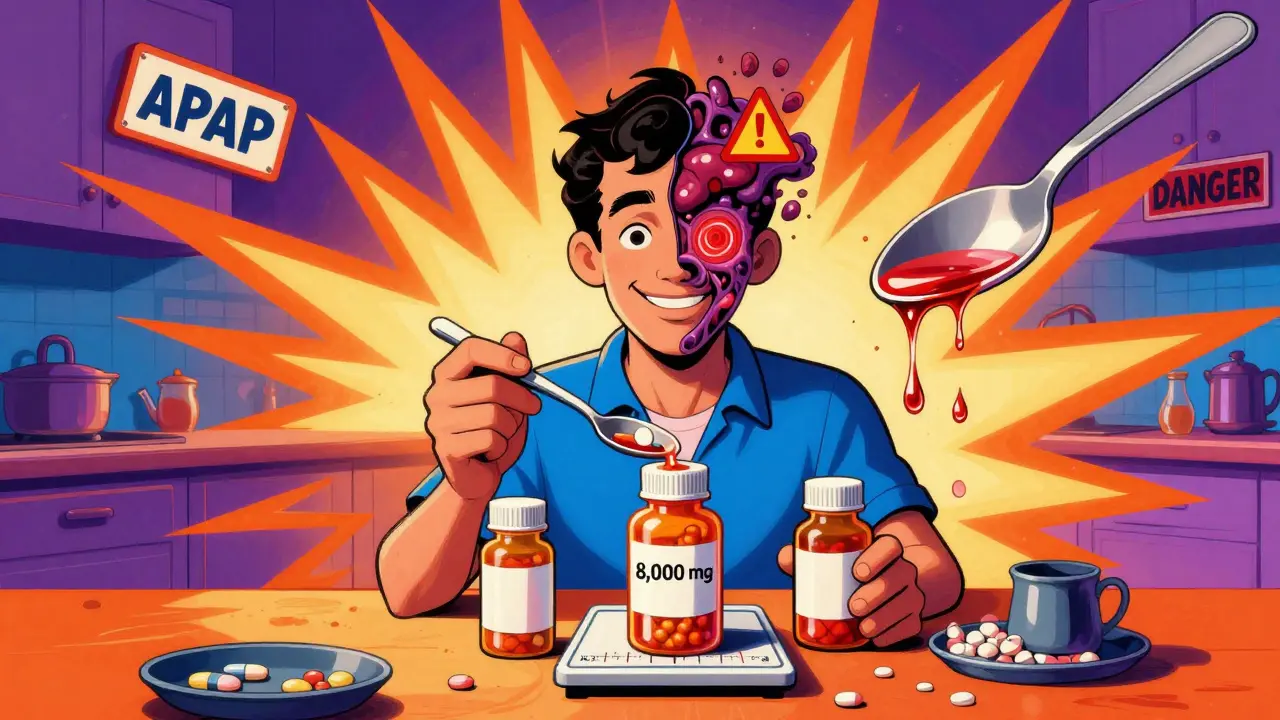
Children are another hidden risk. Parents use adult liquid Tylenol for kids because it’s cheaper. But the concentration is wrong. A teaspoon of adult formula can be three times the safe dose for a toddler. The CDC says 12% of pediatric overdoses happen because people use kitchen spoons instead of dosing cups.
How to Prevent an Overdose - Simple, Real Steps
You don’t need to avoid acetaminophen. You just need to use it wisely. Here’s how:
- Know the limit: Never take more than 4,000 mg in 24 hours. For safety, aim for 3,000 mg or less - especially if you drink alcohol, have liver issues, or are over 65.
- Check every label: Look for “acetaminophen” or “APAP.” It’s not always obvious. It’s often in small print. If you see it, write it down. Add up all sources.
- Never mix with alcohol: Even one drink on the same day as taking acetaminophen increases risk. Skip it.
- Use the right tool: Always use the dosing cup or syringe that comes with liquid medicine. Never use a kitchen spoon. A tablespoon is 15 mL. A teaspoon is 5 mL. Most overdoses happen because people confuse the two.
- Watch for combination drugs: Vicodin, Percocet, Darvocet - these all contain acetaminophen. If you’re on one of these, you can’t take Tylenol on top of it. Period.
- For kids: Dose by weight, not age. Use a pediatric formula. Never give adult medicine to a child. Ask your pharmacist if you’re unsure.
The Antidote That Saves Lives - But Only If You Act Fast
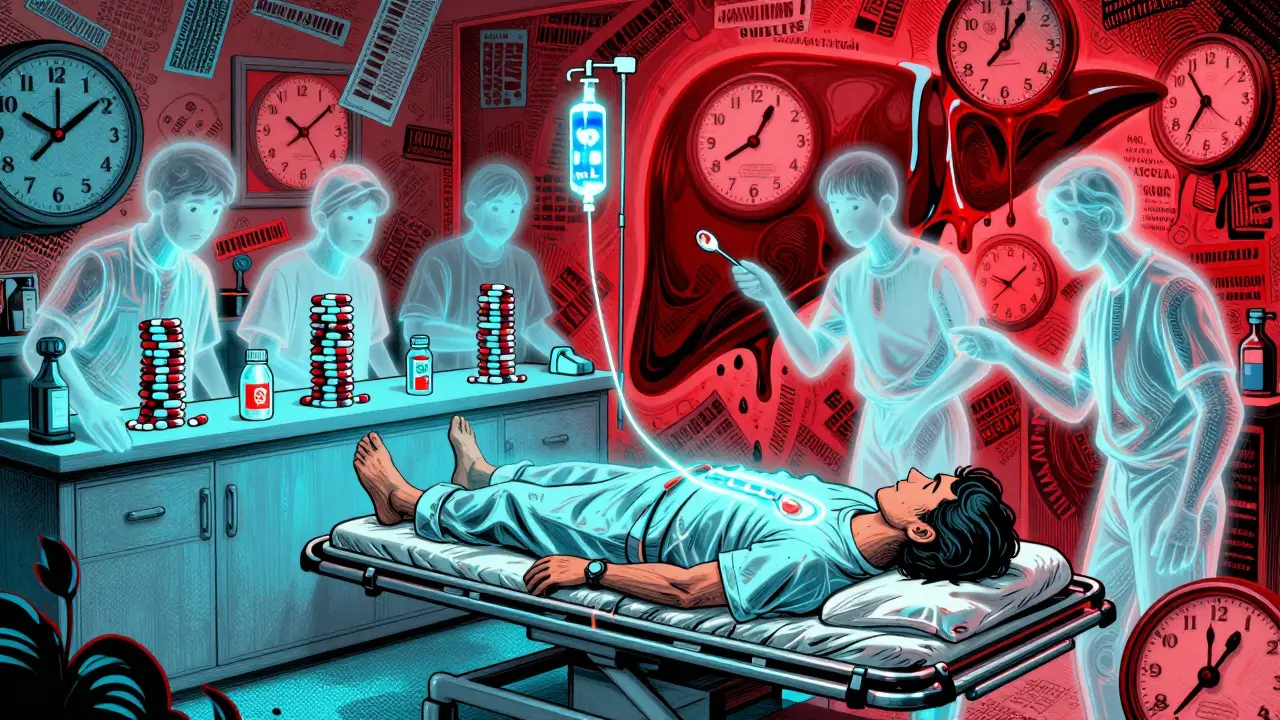
There is a miracle drug: N-acetylcysteine (NAC). It’s not fancy. It’s cheap. And it works - if given within 8 hours of overdose. Studies show 90% of people who get NAC within 8 hours recover without liver damage. After 16 hours? That drops to 60%. After 24 hours? It’s often too late.
That’s why timing matters more than anything. If you think you’ve taken too much - even if you feel fine - call Poison Control immediately. In the U.S., it’s 1-800-222-1222. In Australia, it’s 13 11 26. Don’t wait for symptoms. Don’t hope it’ll pass. Don’t Google it. Call now.
What’s Being Done - And What’s Still Missing
The FDA has tried to fix this. Since 2011, prescription combo pills can’t have more than 325 mg of acetaminophen per dose. All labels now have a liver warning. But here’s the problem: only 38% of people recognize that “acetaminophen” is the ingredient they need to watch.
Consumer Reports found that labels still hide the word in tiny print. A 2023 FDA proposal wants to force manufacturers to print “ACETAMINOPHEN” in bold, large letters on the front of every package. That could save lives.
Meanwhile, apps are being developed that scan medicine barcodes and warn you if you’re over the limit. That’s promising. But until then, the responsibility falls on you.
Final Reality Check
Acetaminophen isn’t evil. It’s one of the safest painkillers when used right. But it’s also one of the most dangerous when used wrong. There’s no warning buzzer. No burning sensation. No red flag until your liver is dying. And by then, it’s often too late.
Millions of people take it every day without issue. But thousands don’t. And every one of those cases was preventable.
Next time you reach for a pill, pause. Ask: “Is this the only acetaminophen I’m taking today?” Check the label. Add it up. If you’re unsure - don’t guess. Call your pharmacist. Or call Poison Control. It takes 30 seconds. It might save your life.
Can I take acetaminophen if I drink alcohol regularly?
No - not safely. Even moderate drinking (three drinks a day) significantly increases your risk of liver damage from acetaminophen. Your liver processes both substances, and together they overwhelm its detox system. If you drink regularly, your safe limit drops to 2,000 mg per day - and even that’s risky. Talk to your doctor before combining the two.
Is Tylenol PM safer than regular Tylenol?
No. Tylenol PM contains acetaminophen (500 mg per caplet) plus an antihistamine for sleep. You’re still getting the same liver risk. If you’re taking it for pain and sleep, you’re doubling your exposure. Don’t assume “PM” means safer - it just means it has a sleep aid. Stick to plain acetaminophen if you only need pain relief.
What if I accidentally took too much but feel fine?
Call Poison Control immediately. Feeling fine doesn’t mean you’re safe. Liver damage from acetaminophen has no early warning signs. The first symptoms - nausea, pain - don’t appear until 24 hours later. By then, your liver may already be failing. NAC works best within 8 hours. Don’t wait. Don’t hope. Call now.
Can children take adult acetaminophen?
Never. Adult liquid acetaminophen is twice as concentrated as children’s formula. A teaspoon of adult Tylenol can be three times the safe dose for a toddler. Always use the product designed for your child’s age and weight. If you’re unsure, ask a pharmacist - or use a dosing chart from the American Academy of Pediatrics.
Do I need to worry if I took 5 pills of 500 mg Tylenol in one day?
Yes. Five 500 mg pills = 2,500 mg. That’s under the 4,000 mg daily limit - so it’s technically safe. But if you’ve taken other products with acetaminophen (like a cold medicine), you might have already hit your limit. Always add up all sources. And if you’re over 65, have liver disease, or drink alcohol, even 3,000 mg is too much. When in doubt, cut back.
Are there natural alternatives to acetaminophen?
For mild pain, options like ginger, turmeric, or heat therapy can help. But they don’t replace acetaminophen for fever or moderate-to-severe pain. If you’re avoiding acetaminophen due to liver concerns, talk to your doctor about alternatives like ibuprofen (if your kidneys are healthy) or physical therapies. Never replace medication with unproven remedies without medical advice.
Tom Sanders
March 8, 2026 AT 23:47Man, I took 4 Tylenol last week for my back and didn't think twice. Now I'm sitting here sweating wondering if I just signed my own death warrant. 😅
Philip Mattawashish
March 9, 2026 AT 07:04Of course it's the leading cause of liver failure. People are dumb. They don't read labels. They don't add. They don't care. They just pop pills like M&Ms and wonder why their insides turn to mush. This isn't rocket science. It's basic math. And yet, here we are. Pathetic.
Erica Santos
March 10, 2026 AT 20:53So let me get this straight - we have a drug so widely used it's practically a national pastime, and the solution is... *reading the label*? 🤡
Yeah, because the last time I tried to read tiny print on a medicine bottle while half-asleep and in pain, I totally aced it. Let's just hand out magnifying glasses with every box. Maybe then the average American won't accidentally poison themselves while trying to feel better.
George Vou
March 12, 2026 AT 03:29they say acetaminophen is dangerous but what they dont tell you is that the FDA is in bed with big pharma and they want you to keep taking it so you keep coming back for more
they know if you get liver failure youll need more drugs to fix it so they keep the dosage limits low enough to be dangerous but high enough to keep you hooked
its all a scheme man
check out the video on youtube by dr. tucker he explains it all
Scott Easterling
March 12, 2026 AT 07:494,000 mg? That’s ridiculous. I’ve taken 6,000 mg in a day - no problem. I’m 32, healthy, no alcohol. So why are they acting like we’re all walking time bombs? It’s not the drug. It’s the fear-mongering. The media. The government. They want you scared so you’ll take their other pills. Wake up.
Also - why is it always “acetaminophen” and never “paracetamol”? You’re not in the US? Too bad. You’re not allowed to be smart here.
And don’t even get me started on the “call Poison Control” nonsense. That’s not a solution - that’s a band-aid on a gunshot wound.
Mantooth Lehto
March 12, 2026 AT 20:22My mom took Tylenol for her headache and a cold med with APAP and ended up in the ER. She’s fine now, but I swear - I don’t touch anything with acetaminophen unless I’ve got a 3-page spreadsheet tracking every milligram. 🤦♀️💔
Melba Miller
March 14, 2026 AT 04:37They say 'don't mix with alcohol' - but what about the millions of Americans who drink one glass of wine every night? They're not drunks. They're just people trying to unwind. And now they're being told they're a walking hazard because they're not perfect? This isn't safety. This is moral policing wrapped in medical jargon. We’re being infantilized. And it’s disgusting.
Meanwhile, the real killers - opioids, processed sugar, corporate greed - get a pass. But Tylenol? Nope. That’s the villain today.
Katy Shamitz
March 15, 2026 AT 14:32I just want to say thank you for writing this. I’m a nurse, and I’ve seen too many patients come in with liver failure from 'just one extra pill.' You’re right - it’s not evil. It’s misunderstood. I always tell my patients: 'If you’re not sure, don’t guess. Call your pharmacist. They love questions like this.'
And yes - use the dosing cup. I’ve seen a teaspoon of adult liquid Tylenol kill a 2-year-old. It’s heartbreaking.
You’re not being alarmist. You’re being brave. Keep speaking up.
Ray Foret Jr.
March 16, 2026 AT 02:27Thanks for this!! I had no idea APAP was just acetaminophen 😅
Now I’m going through all my meds and writing down what’s in them - I even made a little chart on my phone!
My wife thinks I’m crazy but hey - better safe than sorry 🤗
Morgan Dodgen
March 16, 2026 AT 14:01The real issue isn’t acetaminophen - it’s the systemic collapse of pharmaceutical literacy. The FDA’s 325 mg limit on combination opioids is a performative gesture - a distraction from the deeper pathology: the commodification of analgesia. We’ve outsourced pain management to a profit-driven infrastructure that incentivizes polypharmacy. The NAC antidote? A band-aid on a hemorrhage. What’s needed is a paradigm shift - from pharmacological dependency to holistic neurophysiological regulation. Until then, we’re just rearranging deck chairs on the Titanic.
Jazminn Jones
March 16, 2026 AT 15:47The assertion that acetaminophen is 'one of the safest painkillers when used right' is a gross oversimplification. The pharmacokinetic profile of acetaminophen is inherently unstable in a population with variable CYP2E1 enzyme expression, comorbid metabolic conditions, and inconsistent dosing behaviors. To suggest that label reading is a sufficient mitigation strategy is to engage in epistemological naivety. The data is clear: even 'therapeutic' dosing in subpopulations leads to subclinical hepatotoxicity. Regulatory inaction is not negligence - it is structural violence.
Samantha Fierro
March 16, 2026 AT 18:53I’m the author of this post. Thank you to everyone who’s shared their stories - the fear, the confusion, the near-misses. I didn’t write this to scare anyone. I wrote it because I lost a friend to this. She took two Tylenol for a headache. One cold tablet. Didn’t realize they were both the same thing. She didn’t feel sick. She went to bed. She never woke up.
It wasn’t her fault. It was ours. We were never taught how to read a label. We were never warned. We just assumed. And that’s the most dangerous thing of all.
If you’re reading this - I’m so sorry you had to learn this the hard way. But please - next time, check the label. Even if you think you’re fine. Even if you’re tired. Even if it’s 2 a.m.
It takes 30 seconds. It might save a life.